
A cluster of 10 bird observers stood near the large pond in Southeast Portland’s Oaks Bottom Wildlife Refuge on Saturday, watching with wonder and amusement as a pair of common merganser ducks began their mating ritual.
But one word – “pileated!” – pulled their attention from that scene to another: A birder in their group had spotted a gloriously plumed pileated woodpecker busily banging its beak into a tree trunk, feasting on whatever insect colony it had found there.
The 10 wildlife gawkers at Oaks Bottom were among more than 300 volunteers who spread across Portland and its near-in western and southern suburbs Saturday to conduct the 100th annual winter bird count to take place in the city. A cheer arose from the group, as its members realized they had just seen the fifth of the five species of woodpeckers they could possibly hope to see at the refuge on a January day: hairy and downy woodpeckers, a northern flicker, a red-breasted sapsucker and, now, a pileated.
In all, the hundreds of volunteers equipped with binoculars and spotting scopes saw 122 species of birds between dawn and nightfall, four more than in 2025.
The Portlanders who took part ranged from experts to novices. Forest Tran, an outdoors educator, said it was his first birding experience as an adult. Freddy Trujillo, a musician with a sharp ear and eye for identifying species, said he’s been fascinated by birds since childhood.
The bird counters’ focus on accurately capturing the breadth and size of Portland’s avian population was as infectious as it was scientifically important. Teams worked together to use their knowledge — of how different species move, the habitats they prefer, their notable markings, their wingspan architecture, their songs and other details — to piece together what species they were seeing or hearing.
“It’s a talent anyone can develop” by sharpening their powers of observation and showing a bit of patience, said Mitch Bixby, who rated his birding skills “in the 40s” on a scale of one to 100.
Bixby and his more experienced bird recording partners, Trujillo and Joe Liebezeit, saw a belted kingfisher flying over the Waverly Golf Course and two white-breasted nuthatches gleaning trunks of its mighty oaks.
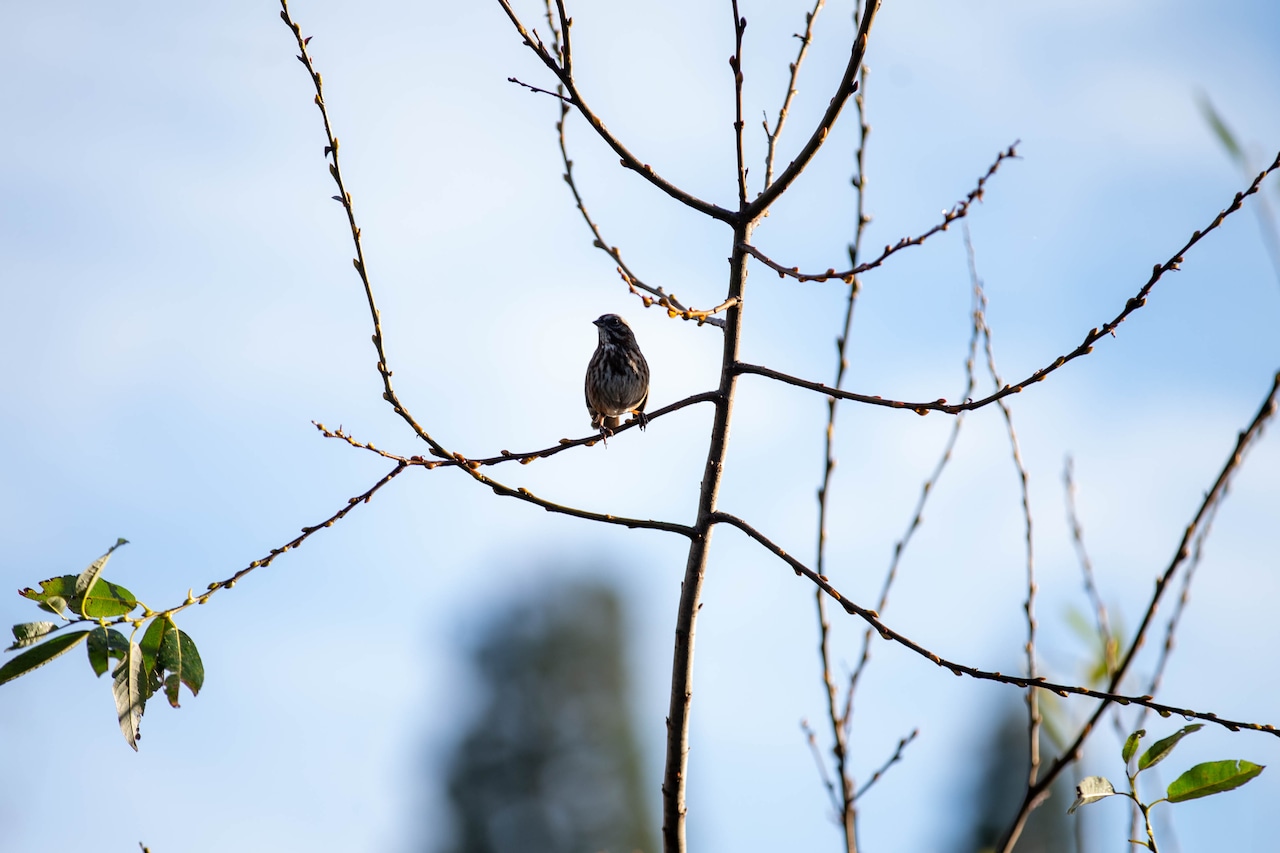
At nearby Westmoreland Park, they easily spotted golden-crowned sparrows foraging in native bushes as well as a white-crowned sparrow that lighted in the same area. They also tallied 130 cackling geese that took flight at the appearance of a large dog as well as several rock pigeons, dark-eyed juncos, song sparrows, lesser goldfinches, black-capped chickadees, Anna’s hummingbirds and Steller’s jays – all within an easy hour’s walk. They also logged a great blue heron, a northern flicker, numerous mallard ducks, a ring-necked duck and a Cooper’s hawk.
So-called Christmas Day Bird Counts like the one the Bird Alliance of Oregon organized Saturday take place all across the Western hemisphere during a two-week window in late December and early January. They were started as a peaceful, bird-affirming substitute to the old tradition of shooting and killing birds as a Christmas Day event.
Portland’s is one of the longest running in the world and provides a rich trove of information comparable across time and geography about which species are surging, which are disappearing, where and possibly why. American goldfinches, for example, peaked in Portland in 1935, when 1,112 were spotted, compared to just 299 this year. But they have been seen in each of the 100 counts conducted dating back to 1926. Similarly, the city was the winter home to nearly 10,000 American wigeon in 1948. This year, volunteers spotted just 604 of the not-so-showy ducks. But each and every year, they have made the Portland Christmas tally.

1/28
100th annual Portland Christmas Bird Count
One of the more gratifying stories the counts have told: the return of the peregrine falcon. Fifty years ago, none were found in Portland, due largely to widespread use of the chemical DDT. But beginning in the 1980s, they began to reappear, nesting largely on bridges that mimic the cliffside dwellings they choose in nature. The annual bird count found a high of 18 peregrines in Portland in 2021. This year bird watchers counted nine, one more than the five year average.
The counts “tell us a lot about what’s going on environmentally,” said Trujillo, citing as but one example the overpopulation of American crows in the Portland area, something he attributes at least in part to the amount and availability of garbage.
The 10-person crew at Oaks Bottom was treated to a particularly delightful spectacle Saturday morning. Under dry but mostly cloudy skies, they spotted a red-tailed hawk winging across the shallow lake, tormented by a much smaller, rarer-to-spot kestrel that was dive bombing the larger bird in flight.
“Wooooooooo!” the group cheered.
“That’s a very good bird for Oaks Bottom,” longtime Bird Count leader Candace Larson said knowingly of the kestrel.
“Yes! Interspecies interaction!” another group member delighted.
The kestrel, a petite falcon with showy slate blue and reddish orange feathers and cheeky black stripes and polka dots, was one of 30 spotted around Portland Saturday and seemed to delight in appearing and reappearing for the appreciative birders.
The 30 kestrels seen Saturday were 10 more than the five-year average and most seen in the past 10 years, Larson said. “People have noticed kestral numbers are up in other counts around Oregon this year,” they said.
The group was also treated to the appearance of four playful river otters that bobbed in the Willamette River across from Ross Island, then swam into an inlet jutting into the wildlife refuge. And, shortly after sighting the kestrel, one of its members shouted “peregrine,” eliciting another loud cheer from her fellow birders, who recognized the large falcon rapidly flapping its short wings as it flew high overhead.
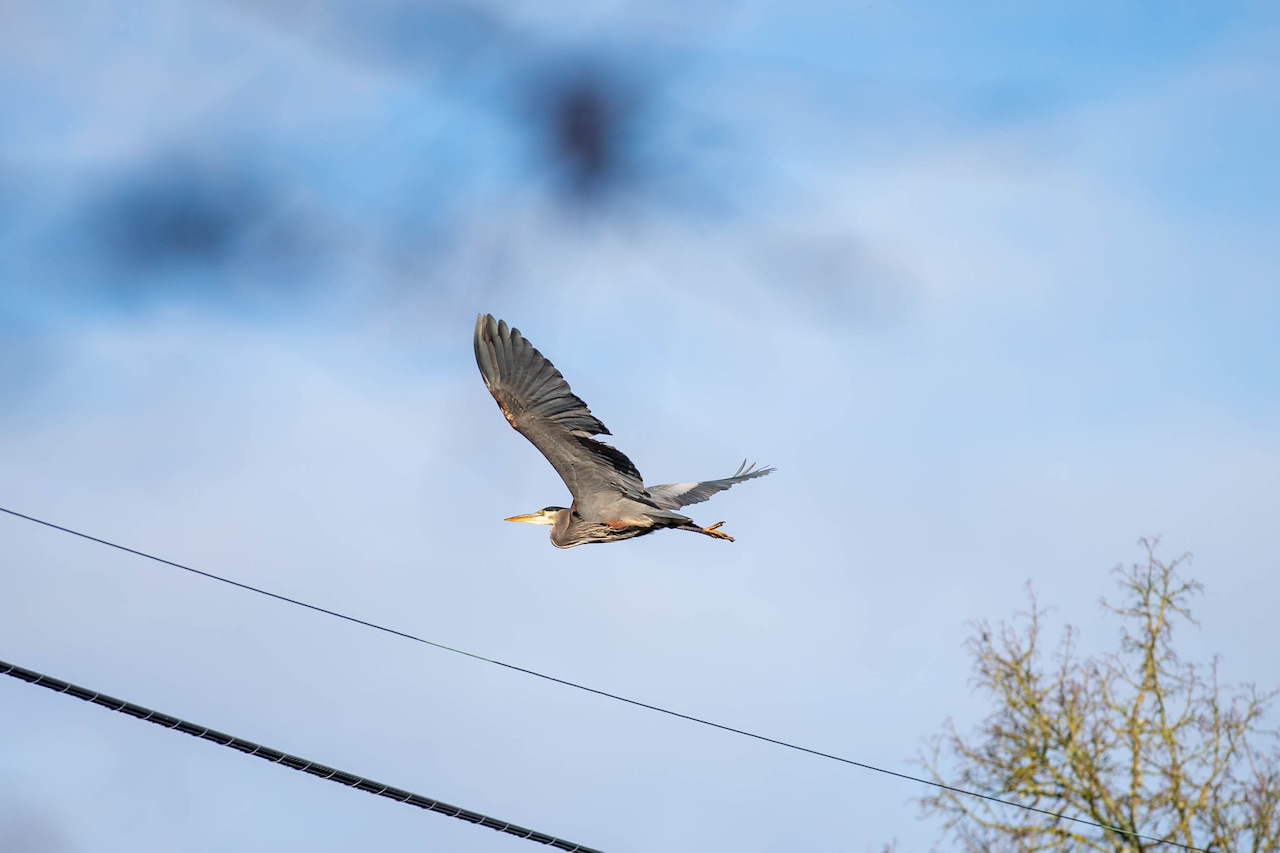
The group, captained by Larson, demonstrated the precision with which the annual counts are taken. They paused at length beside the refuge’s main lake, sharing spotting scopes and binoculars to admire the two majestic American eagles high in a tree, the scores of mergansers lazily floating and swimming on its surface, a lone great egret at water’s edge and the large number of great blue herons resting at the far end of the lake.
They used the magnifying lenses to carefully count the hulking dark blue-gray birds. Twenty-eight herons, they agreed. Still, before they moved on, Larson asked them to once again count the birds once colloquially known as Big Cranky. Twenty-eight indeed.
The precision of the count is a point of pride as well as a font of knowledge. The rise of Anna’s hummingbirds, today a common sight at many a backyard feeder in Portland, is one the more dramatic illustrations, Larson explained.
In 1968, for the first time, an Anna’s was spotted during the Portland winter count. It was the rarest bird tallied that day. By about 1996, the number was 20, Larson said. Flash forward 10 years and the number was about 100, she said. By 2018, the tally hit 754. And this year, birders counted 764, down from the high of 944 in 2023.
The popularity of hummingbird feeders is only part of the larger, more complex story of why spotting an Anna’s hummer can be as easy as looking out the window of a home in Portland to a feeder filled with sugar water, Larson said.
“People are still teasing this out,” they said. “Certainly the fact there is feeding helps those birds sustain themselves through the winter.” But the stocky green hummingbirds have been gradually expanding their range from Southern California since the 1930s, Larson said, probably aided by the planting of winter-flowering trees along the California coast. The birds began residing in Northern California, then in southern Oregon as well, before marking the Portland area as a winter home as well.
Among the surprises from this year’s count, Larson said: Bird counters didn’t spot any loons of any kind.
The “eagle eye” award for the most unexpected species observed went to Andrea Hamberg, a seasoned birder who found a black-throated gray warbler in a tree near Oaks Bottom. Hers was the lone spotting of the small, distinctly marked black and white bird that normally spends the winter in southern Mexico before breeding in Portland in the spring, Larson said. Saturday was only the fourth time one of the birds has been seen during the Portland winter count.
Larson said Bird Alliance experts will spend time analyzing results of Saturday’s count. “It’s going to be a while before we can really tease out anything notable. Our species total was pretty average … I don’t think overall this year is going to be remarkably high or remarkably low.”
One year of data doesn’t mean much, they added. “You have to look at a range of data over time to draw information about whether birds are doing well or doing poorly. That’s why the (Portland Christmas Bird Count) is so important.”