Lawmakers returned to Montpelier this week facing mounting pressure to solve the state’s affordability crisis — even as the resources they need to tackle the problem are drying up. Top priorities include addressing the rising property taxes and soaring health care costs that are squeezing many Vermonters’ household budgets.
With revenues largely flat and in some areas declining, legislators will have to reform the systems responsible for driving up costs. That process began last year with a law intended to overhaul school governance and financing.
Since the law was enacted, a task force ordered to draw consolidated school district boundaries has balked at the task, and Gov. Phil Scott branded the effort a failure. Now the ball’s in the legislature’s court.
As the reform debate rages, the question remains: How will lawmakers avoid a 12 percent property tax increase forecast for 2026?
“This session will be more like a horror movie than a Hallmark holiday film.”
Sen. Phil Baruth
The state will also need to address the loss of $65 million in federal health insurance subsidies, which threatens to make insurance unaffordable for 30,000 Vermonters.
“If last year asked a lot of us, this year will ask even more,” House Speaker Jill Krowinski (D-Burlington) said Tuesday. “This session will be tough, but so will our resolve.”
Affordability isn’t the only high-priority issue. Lawmakers are likely to consider persistent backlogs in criminal courts. And, after five lawmakers took a controversial trip to Israel, a new bill would require members of the General Assembly to disclose the funding sources for such travel.
Here’s a look at some of what’s going to be hashed out this year.
Budget Blues
State officials have warned that Vermont’s financial outlook for the year is, in a word, bleak.
“It’s going to be a very tight budget year,” Gov. Scott told reporters last month. “We’re going to do the best we can without raising taxes.”
The loss of federal funding is a particular concern. Senate President Pro Tempore Phil Baruth (D/P-Chittenden-Central) said during a budget preview in December that many of the federal actions seem intended to harm the most vulnerable: denying aid to flood victims, deporting hardworking immigrants, and reducing food and heating assistance to the poor.
“This session will be more like a horror movie than a Hallmark holiday film,” he said.
Last month, the Department of Taxes projected that education property taxes could rise 12 percent this year. Officials cited the usual suspect: inflation, particularly in terms of health care costs. Also contributing is lower tax revenue, driven in part by a sharp drop in consumer confidence, which leads to less spending. Fewer tourists visiting from Canada also contributed to the negative fiscal outlook.
Tom Kavet, the legislature’s economist, told lawmakers last month that communities closest to the border saw 36 percent fewer visitors; traffic in towns farther away was down by half that. The decline in tourism has translated into a $2 million hit to the meals and rooms taxes for 2025.
State leaders hope to offset the potential property tax hike. When property owners were facing a potential 6 percent increase last year, lawmakers found $77 million elsewhere to buy down the amount to 1 percent.
Due to continued cost increases, lawmakers and Scott would now have to pull a nearly $200 million rabbit out of a hat to repeat that feat.
The state’s general fund revenue was higher than expected in the first half of 2025, largely due to personal income taxes rising, so analysts upped their revenue projection by $77 million.
Tax revenues from goods and services were soft, however, likely because regular folks — those not benefiting from robust stock market returns — have curtailed their spending, Kavet noted, in part due to flagging consumer sentiment.
“It’s not a happy picture,” he said.
Back to School Reform
Education reform, which monopolized much of last year’s legislative session, will remain front and center in 2026.
Many of the provisions in Act 73 — the bill passed last year calling for transformations to school governance and financing — are contingent on the legislature drawing a map that consolidates the state’s 52 supervisory unions and 119 school districts into much larger units. Only then can the state implement a foundation formula, a funding mechanism that allots a set amount of money for each student.
A redistricting committee charged with proposing new school governance structures has recommended a different tack: creating five cooperative education service regions that would allow existing school districts to share resources for things such as special education and business operations. The task force, in a 160-page report, also called for voluntary mergers of school districts and, in the longer term, regional high schools — a proposal that would require restoring state funding for school construction.
Gov. Scott has panned the task force’s recommendations and urged the legislature to move forward with new maps. The governor has used the forecasted average 12 percent tax hike to bolster his case that sweeping, not incremental, reform is necessary. Senate President Baruth and House Speaker Krowinski appear willing to work with the governor, writing in separate op-eds in December that moving forward with Act 73 is critical to achieving affordability and equitable learning opportunities.
Baruth also plans to introduce legislation that imposes a cap on school budget growth for the next two fiscal years to control rising costs and tax rates until the reform efforts produce a new funding model.
On Tuesday, Baruth told his colleagues that the pattern of buying down the property tax increases was expensive, unsustainable and threatened funding for roads, housing, mental health and other services.
“We are essentially cannibalizing the General Fund to pay for the growth in the Education Fund,” Baruth said.
Educational leaders, meanwhile, have in recent weeks begun speaking out forcefully against the top-down transformation called for in the law.
Rep. Peter Conlon (D-Cornwall), the House Education chair, said his committee will dive into recommendations from the redistricting task force, as well as other education reports produced in the off-session.
“Everything remains up for debate,” Conlon said. He believes that Vermonters won’t get behind the Scott administration’s education reform plan unless the governor himself does a better job engaging with Vermonters and “making the case” for why it’s necessary.
Senate Education Committee chair Seth Bongartz (D-Bennington) said he also wants to hear different perspectives before making any moves. This fall, his committee visited school districts across the state, which gave him a greater appreciation of the “heroic efforts” schools are taking to support students, he said. The visits convinced him that bigger schools aren’t necessarily better for all students.
Still, Bongartz said, he feels a sense of urgency to find a solution this session for bringing down education spending. The answer, he believes, lies at least in part with moving to a foundation formula.
“We have to figure out a way to develop efficiencies and hold costs to levels that Vermonters are going to be able to sustain,” Bongartz said.
Lingering Ailment
Vermonters continue to face some of the highest health care costs in the nation. This year, the committees that oversee health care will grapple with two major blows from Washington, D.C.: the loss of federal insurance subsidies and new Medicaid rules.
The subsidies, which were at the heart of the government shutdown last fall, provided $65 million in annual federal support to Vermont. Without them, annual premiums will double or even triple in 2026 for many of the 30,000 Vermonters who purchase their own health insurance.
President Donald Trump’s “Big Beautiful Bill,” meanwhile, adds a strict work requirement for obtaining Medicaid that state officials fear will prevent otherwise eligible people from getting coverage. Many may end up uninsured, leading to unpaid hospital bills that could drive up costs for everyone else.
The bill is expected to decrease federal Medicaid spending in rural areas by $137 billion over 10 years, according to KFF, formerly known as the Kaiser Family Foundation. Fewer Medicaid dollars could further jeopardize the future of Vermont’s struggling rural hospital system.
“The federal government really pulled the rug out from under us,” said Sen. Ginny Lyons (D-Chittenden-Southeast), chair of the Senate Health Care Committee.
Lyons was unsure what Vermont can do to mitigate these losses but said “all options must be on the table.” That might include rearranging the state’s health insurance risk pools to better spread out costs, she said.
The state will get a cash injection in 2026 from the Rural Health Transformation Fund — a five-year, $50 billion program approved by Congress to appease Senate Republicans who were wary of the Medicaid cuts. Vermont will receive $195 million from the fund this year.
Those dollars can’t be used to backfill the lost federal subsidies, however. Vermont has proposed using the money to build out its primary care workforce, improve access to recovery housing and invest in nursing homes, among other initiatives.
Lawmakers will also keep tabs on the state-led process to transform Vermont’s hospital system.
Those efforts led to the widely publicized report last year that called on some Vermont hospitals to consider shutting down their inpatient units. The work is now in the hands of the Agency of Human Services, which must develop a statewide plan. Hospitals have been told to submit proposals by mid-January that spell out how they would restructure to become more sustainable. The submissions will almost certainly include proposals to shutter certain services.
Rep. Alyssa Black (D-Essex), chair of the House Health Care Committee, said its members will aim to hold the agency accountable in meeting its deadlines.
“If we don’t move very quickly, there will be nothing left to transform,” Black said.
Seeking a Rocket Docket
Simmering concerns over public safety will demand attention this session.
Rep. Martin LaLonde (D-South Burlington), chair of the House Judiciary Committee, said his panel will hold oversight hearings focused on the state court system’s yearslong attempt to resolve pandemic-related backlogs.
He said he’s particularly interested in whether the state can glean lessons from the special Chittenden County docket for repeat offenders with five or more pending cases. Created by Gov. Scott this fall, the docket seeks to quickly resolve cases that might otherwise remain pending for years, contributing to a perception that repeat offenders go unpunished.
The Scott administration and judiciary officials are expected to share results of the Chittenden initiative during the first month or two of the session, LaLonde said. He noted that the docket has had a dedicated prosecutor, judge and team of mental health professionals, confirming what lawmakers have known for years: Investments are needed to ensure cases get resolved in a timely manner.
“We know it’s a tough budget year, but nevertheless, we’ll be looking at properly resourcing the criminal justice system,” LaLonde said.
His committee will also take another look at Vermont’s system for handling people who are accused of crimes but deemed incompetent to stand trial because of their mental state, as well as bills addressing voter intimidation and animal cruelty.
In addition, the committee will consider several changes to Vermont’s voyeurism laws. The first would create a new crime covering cases of sexual extortion. Currently, state law prohibits the disclosure of sexual images without someone’s consent but does not criminalize the threat to do so.
The other measure would address the statute of limitations for certain crimes. This change comes in response to a case Seven Days covered last year involving a local film professor who secretly recorded two young women — one of whom was 17 — and yet was never charged criminally because more than three years had passed before the women learned their images had been posted to porn sites.
Tripping Lawmakers
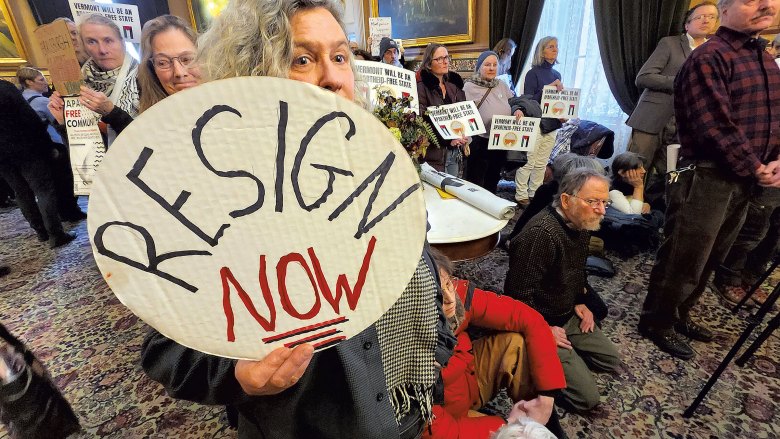
Five Vermont lawmakers sparked public outrage when they went to Israel last September on a trip paid for by the Israeli government. The public only learned of the junket through social media posts.
The controversy isn’t going away. The Vermont-New Hampshire Chapter of Jewish Voice for Peace has announced it filed ethics complaints against each of the legislators. And on Tuesday, pro-Palestine protesters in the Statehouse called on the five to resign.
Two of the lawmakers who took the trip proposed legislation that would increase transparency around legislators’ travel.
Reps. Will Greer (D-Bennington) and Gina Galfetti (R-Barre) have prepared a bill that would require public servants to file a disclosure with the state ethics commission within 30 days of embarking on a trip. The disclosure would list the purpose, destination and associated costs — including transportation, lodging and food. Officeholders would specify which expenses were paid personally, by the state or by outside sources, including associations, political committees or individuals.
“The disclosure is important because it gives our constituents an opportunity to engage with us before we undertake the travel, so that we can make their voices heard while we’re doing our work,” Galfetti said. Officeholders would be able to file the form within a month of beginning a trip and would be required to supplement the information weekly for travel longer than 30 days.
Greer and Galfetti began drafting the legislation last fall, when controversy erupted over their participation in the “50 States, One Israel” conference. Reps. Sarah “Sarita” Austin (D-Colchester), Matt Birong (D-Vergennes) and James Gregoire (R-Fairfield) also took the trip. Israel’s Ministry of Foreign Affairs paid $6,500 per person for related expenses.
Currently, state legislators are not required to disclose travel or related gifts, such as airfare or lodging.
Greer and Galfetti’s pending bill draws on existing travel disclosure rules in other states. Completed disclosure forms would be made publicly available on the Secretary of State’s website, similar to campaign finance reports. Lawmakers could face investigation by House or Senate ethics committees if they failed to comply, according to Galfetti.
Greer hopes that the expanded disclosure requirements would foster more positive dialogue between legislators and the public, which he felt took a hit after the trip to Israel.
“I don’t want any legislator to have to come back from a trip and feel that their motives have been questioned in a way that undermines trust in their constituents and the institutions that their constituents depend on,” Greer said.
The original print version of this article was headlined “Working Capitol | In a tight budget year, state lawmakers plan to tackle education reform and health care costs”