
HOULTON — “Yes.”
Sometimes it was emphatic, sometimes simple and candid.
Other times it was preceded or followed by a lengthy, and, at times, laborious explanation.
But what was clear from Thursday night’s gubernatorial candidate forum is that the eight candidates who showed up intend, for the most part, to say “yes” to the Wabanaki Nations.
Of the 17 candidates now in the race, three of the four independents, all five Democrats and none of the eight Republicans attended the forum hosted by the Wabanaki Alliance on the Houlton Band of Maliseet Indians’ territory.
It was the first such event ever to be hosted by a tribe in Maine, organizers said. Chiefs of the Houlton Band, the Mi’kmaq Nation, one of the two Passamaquoddy communities and the Penobscot Nation were all in attendance.
In a chorus of affirmations before tribal leaders and citizens, it was easy for all the candidates to say yes, they would commit to hiring Wabanaki people to serve in top leadership roles in state government. Or yes, they support sales tax exemptions for tribal people and entities on tribal land.
And on the big one — would they support full recognition of tribal sovereignty in Maine? Most gave an unequivocal yes.
With so much concurrence at the table, the approximately 100 in attendance and those online had instead to try and parse who they agree with on other issues, and who they most trust.
“They’re gonna say yes regardless, because of the demographic that’s here,” said Tyler Francis, a member of the Passamaquoddy Tribe at Sipayik (Pleasant Point).
Here’s four take aways from what the candidates shared.
1. There’s broad agreement on sovereignty
Wabanaki Nations, unlike their 571 counterparts nationwide, do not enjoy recognition of their full sovereignty in Maine. Where other tribes outside Maine benefit from federal Indian law and enjoy unabridged local jurisdiction in criminal matters and environmental regulation, authority of the four in Maine can be, and often is, superseded by the state.
Lawmakers, backed by the Wabanaki Alliance’s broad coalition, have pushed for sweeping legislation to change this, but have met stalwart resistance from Gov. Janet Mills, who has favored a more incremental approach.
So Wabanaki leaders have set their sights on 2026.
Of the eight candidates present Thursday, five gave a no-hesitation thumbs-up on tribal sovereignty.
The question specifically asked whether the candidates would support a bill mirroring those from past sessions granting broad sovereignty recognition.
In the affirmative camp were Democrats Shenna Bellows, Maine’s secretary of state; Troy Jackson, former Maine Senate president; Hannah Pingree, former speaker of the Maine House and daughter of U.S. Rep. Chellie Pingree; Nirav Shah, former director of the Maine Center for Disease Control and Prevention; and independent Rick Bennett, a former Republican state lawmaker.
Democrat Angus King III, a renewable energy entrepreneur and the son of U.S. Sen. Angus King, and independents John Glowa, a former Department of Environmental Protection official, and Derek Levasseur, a long-shot candidate who is a small-business owner from central Maine, all hedged on their answers.
The three candidates support sovereignty broadly, they said, but were unwilling to commit to backing the legislation in its most recent (failed) iteration.
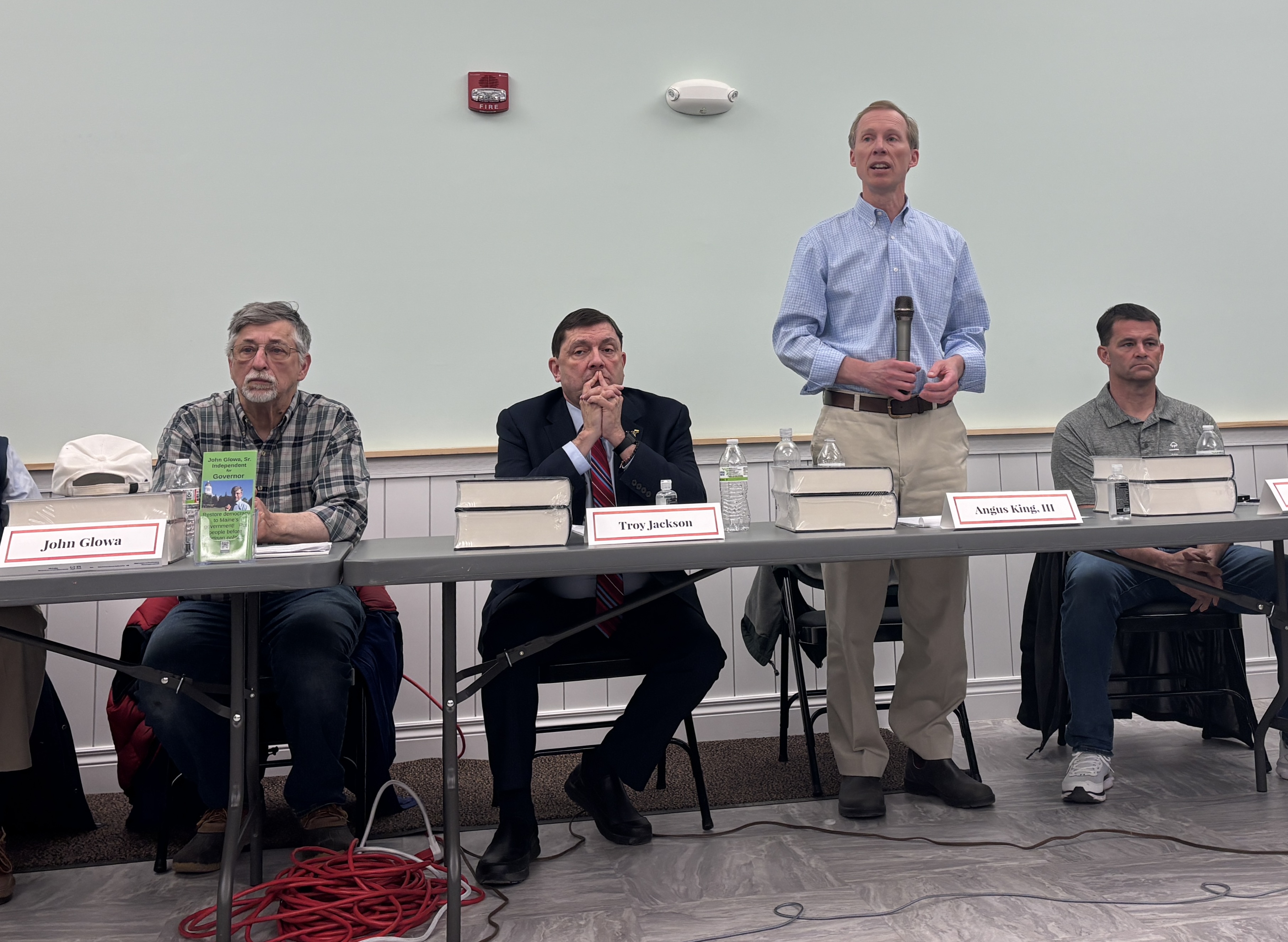
“I think there are some great pieces of that legislation, I think there are some challenges that, as John (Glowa) said, require some more work,” King said.
This was trodden ground for Bellows, Jackson, Pingree and Bennett, all of whom have built a reputation as tribal allies and came out as early supporters of sovereignty on the campaign.
For Shah, the forum was a chance to amplify his relatively unknown position on the issue.
“You have my word, as governor, that we will work toward that goal as fast as practical and that between now and January of 2027 we will take time to lay the necessary groundwork so that when that sovereignty is granted, it is real and it is actionable on day one,” he said.
2. What the audience had to say
The applause was raucous for affirmative answers on tribal sovereignty. Youths asking questions were popular, too.
So similar were the candidates’ positions that many attendees left unable to pick out any differences between them.
Marcia Gartley, of Presque Isle, showed up looking to make a decision. By the end of the night, she wasn’t much closer to one.
“We really needed a Republican here to argue,” she said.
Adam Newell, who sits on the Sipayik tribal council, said Bellows was the only standout for him, in part because she had knowledge beyond just the settlement act that extended to historic treaties.
For some, it’s now matter of who will stick to their word.
“They voiced their opinions. But I think there’s four or five, at least out of these eight, that would keep their word,” Chief William Nicholas Sr. of the Passamaquoddy Tribe at Motahkomikuk said after the event.
3. The stand-alones
The daylight between the candidates was, at times, hard to find.
In a lightning round, Houlton Band of Maliseet Indians Ambassador Osihkiyol ‘Zeke’ Crofton-Macdonald fired 13 questions up and down the table. The bolts occasionally illuminated where the candidates stood apart from the pack.
King was the sole candidate who did not commit to supporting full tribal jurisdiction over land use and natural resources on tribal land.
“Maybe,” he said. “There are a lot of details there.”
Bennett was the sole candidate to say he would not support the implementation of the Indian Gaming Regulatory Act in Maine. The 1988 federal law gave tribal nations the power to operate casinos on their territory, but is not applicable in Maine due to the terms of the implementing act.
Gambling has often been a carved out of proposals to expand the applicability of federal Indian law in Maine.
“I’ve never supported the expansion of gaming in Maine in any way, including the state lottery,” Bennet said.
He added that he would respect the implementation of a recent law giving the tribes the exclusive right to operate internet gambling in Maine even though he opposed the legislation.
When asked to support numerous pieces of hypothetical legislation, King, like Glowa and Levasseur, hedged. He seemingly indicated not opposition, but a reluctance to support something with which he was not entirely familiar.
“In general, I’m absolutely for it. I would just want to make sure I don’t commit to something that leads to an unintended consequence that I personally don’t see yet,” he said in response to a question on whether the tribes should have broader authority to place land they own in trust with the federal government.
4. The elephant in the room
The governor wasn’t present Thursday night. No one said Mills’ name during their opening statements.
But the shadow of her administration fell over the room nonetheless.
The lightning round questions seemed to needle mostly at issues where Mills had fallen short in the alliance’s eyes.
And the candidates needed little prompting.
Jackson repeatedly mentioned the “power and influence” that blocked tribal sovereignty.
“They just blocked it this week once again,” he said, a nod to two bills proceeding as watered-down compromises instead of the full sovereignty legislation originally introduced.
Pingree talked about her work on Maine’s Climate Council, where she got to know Wabanaki Alliance Executive Director Maulian Bryant. That work, she said, fueled her belief in tribal sovereignty. She did not, however, mention that work was part of her high-ranking position in the Mills administration. She has in the past specifically said this is an issue where she and the governor differ.
Bellows similarly set herself apart.
“I’m not part of the Mills administration,” the secretary of state said in her closing statement.
Bennett went out of his way at one point to say he would “show up when the tribal chieftains are invited to address the Maine Legislature,” a barely veiled shot at the governor’s absence from the 2023 State of the Tribes address. At the time, Mills said she had a scheduling conflict.
Reuben M. Schafir is a Report for America corps member who writes about Indigenous communities for the Portland Press Herald.