
Late last month, David White, interim executive director of the NFL Players Association, stopped by Halas Hall as part of his cross-country tour of NFL teams.
He talked about some of the union’s goals — such as better personal and data security — and listened to feedback from players about their wants, demands and concerns.
But one could argue he had a higher priority that wasn’t listed on the official agenda: damage control.
Confidence in NFLPA leadership was shaken over the summer when White’s predecessor, Lloyd Howell, stepped down in July as a series of controversies came to light.
Among them were reports that Howell expensed visits to strip clubs, held a side job that conflicted with players’ interests and was party to a confidentiality agreement, struck between the union and the league, that hid from players key details in an arbitrator’s report.
The most damning part of that report concluded that league executives, including Commissioner Roger Goodell, urged owners to limit guaranteed money in contracts, though it found no such evidence of collusion among owners, which would violate the collective bargaining agreement.
“There are a couple of folks who have expressed anger about what they were reading, or concern,” White told reporters in Chicago, referring to players. “But for the most part, people are ready to hear that the organization has learned from its mistakes and is moving on.”
The NFLPA’s executive committee, a board of player representatives, has the power to vote on the permanent executive director, but White said last month there was no timetable for a decision.
On Aug. 3, the committee elected White, a former national executive director of the Screen Actors Guild & American Federation of Television and Radio Artists (SAG-AFTRA), to the NFLPA post on an interim basis.
As a candidate for the permanent job, White was asked by reporters what he’s doing to regain the one thing the future union leader must have: trust.
“Players are very smart business people, right? … They can smell honesty and integrity and bull (bleep) pretty quickly,” White said Sept. 24. “So when you’re presenting honestly and transparently, they’re pretty open to hearing that.
“I have no doubt that there will be hell to pay if the players association were to repeat dumb mistakes. Fortunately, we are not going to repeat dumb mistakes.”
In the Bears locker room, several players said more transparency is welcome in the interest of rebuilding trust.
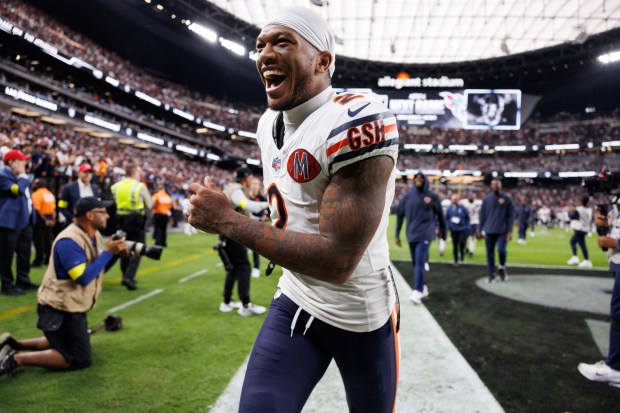
“That’ll happen over time because we wanted to know where the funds were going,” said DJ Moore, a veteran wide receiver in his eighth year. “I mean, that comes out, and then that definitely breaks the trust.
“But over time, you get somebody new — just like (first-year Bears coach) Ben (Johnson) — we’ve just got to trust it and go from there.”
Center Drew Dalman, who’s in his fifth NFL season, said communication this summer could’ve been handled better by union staff, but he downplayed any notion of a rift.
“Even if there is a bit of conflict or frustration, I don’t think it’s, like, outright us against them, or like union structure versus players, anything like that,” he said. “We’re all pulling in the same direction and we could all do a better job of (defining) our needs more, and they could do a better job explaining certain things more.
“Whatever conflict there was, was constructive. … Certainly, there are things that could be better, but I think we’ll see as it goes.”
Other Bears said they’ve otherwise had no issues with the NFLPA’s handling of matters.
“Certain things come up throughout the course of the year, but I feel like they do a good job,” running back D’Andre Swift said. “As players, we are focused on what we need to be focusing on day to day.”
While players are focused on their seasons, some keep an eye on topics that likely will affect negotiations for the next CBA. The current agreement expires in March 2031.
Owners already have stated some of their goals, including adding an 18th regular-season game. White told the Associated Press in early September that any such request “certainly is not inevitable,” and he doubled down on that at Halas Hall.
“We’ll know that they’re serious when we get a phone call saying, ‘Hey, we would like to actually talk about this with details,’ and then players are really going to have a strong opinion about that,” White said.
League representatives such as Goodell also have said owners are seeking an expansion to 16 international games (from the current eight) and a more favorable revenue split — new stadiums don’t come cheap these days.
The players have their objectives, too, though they’re likely as diverse as the 1,696 players who make up the league’s 32 active rosters.
“It’s the union’s job to take that and kind of collate all of it and make it into one uniform platform,” Dalman said.
For example, several Bears expressed a desire to see more money dedicated to retirement benefits and mental wellness.
“For players now and former players,” Moore said of mental health care. “That’d be amazing.”
Dalman said he’d like to see more a lucrative distribution of the performance-based pay pool, a system for compensating players with lower salaries who have higher playing time.
“I’m pretty pro getting money to the players that play the most, even if they’re young and on rookie deals,” Dalman said.
According to an NFL Operations report in March, guard Matt Pryor, a 2018 sixth-round draft pick who’s now with the Philadelphia Eagles, earned an additional $1,020,303 based on his performance for the Bears last season, when he made a career-high 15 starts.
Dalman said players on rookie deals in similar situations wouldn’t be compensated nearly as well as a veteran despite playing the same number of snaps and putting “mileage on their bodies.”
“So I feel like you can kind of raise the tide for those younger players that might not see a huge second contract,” Dalman said. “That also helps with the post-football life, if you make more on the front end. … That’s a big one for me.”