No U.S. state voted against Donald Trump by as wide a margin as Vermont. Yet the ramifications of his second presidency in the Green Mountains have been swift and stark.
Economic and social ties with Canadians have frayed. Small businesses have had to find the money to pay new tariffs. Low-income residents have navigated delays and cuts to food benefits. Nonprofits have scrambled as their federal grants were rescinded without notice. Undocumented immigrants — including migrant workers on farms and construction sites — have been apprehended, locked up and deported. Trans people, many of whom had found acceptance in Vermont, have endured the federal government’s attempts to strip them of their civil rights.
Vermonters Respond to Trump 2.0
These changes have challenged values held dear by many Vermonters. But the Trump administration has made it clear that defiance comes at a cost. The president has granted disaster aid to red states and denied it to blue ones, including Vermont. Trump has threatened to withhold funds from any group — local governments, universities, nonprofits — that doesn’t conform to his social vision and has deployed National Guard troops to cities whose policies he doesn’t like.
The administration’s aggressive and often vengeful actions are changing the playbook for resistance.
Some organizations have dropped or disguised their diversity, equity and inclusion programs to avoid the hammer of federal funding cuts. Vermont Gov. Phil Scott, a Republican, has picked his battles with the president carefully, drawing criticism from all sides.
For this story, Seven Days spoke with seven Vermonters, businesses and organizations who are pushing back against Trump 2.0.
Meanwhile, Sen. Bernie Sanders (I-Vt.) has been pressing his “fight oligarchy” message at cross-country rallies for much of the first year of Trump’s second term, trying to galvanize voters in conservative and swing districts.
Residents across Vermont have poured into the streets for several No Kings rallies. They’ve flown rainbow flags and donned inflatable unicorn costumes to express displeasure with the president’s expansive exercise of executive power.
Others have camped at the Burlington International Airport to monitor Immigration and Customs Enforcement officials who were escorting immigrant detainees onto commercial flights. Vermont journalist and author Garrett Graff has issued sharp warnings about the administration in his Doomsday Scenario blog under headlines such as “America Tips Into Fascism.”
For this story, Seven Days spoke with seven Vermonters, businesses and organizations who are pushing back against Trump 2.0. Some are lending a hand to people who’ve been affected by cuts to food aid or immigration crackdowns. Others are trying to preserve social ties or simply sticking up for their customers and employees.
Then there are those engaging in solo acts of protest, such as Burlington resident Meg Wallace, who explains how she uses sidewalk chalk to scrawl messages of resistance.
Their actions amount to much more than just yelling at the TV — or, worse, turning off the news altogether.
Obejction! Vermont Asylum Assistance Project
On Halloween night, immigration attorney Andy Pelcher raced home from Vermont’s only women’s prison to seek an emergency court action.
Minutes before, he had met a 24-year-old woman from Peru who was swept into detention during a routine immigration check-in. She was being held without benefit of a bond hearing — a widespread tactic of the Trump administration’s immigration crackdown.
Pelcher and fellow attorney Nathan Virag filed a habeas petition challenging the detention late that night, asking a federal judge to intervene. On November 17, Judge Geoffrey Crawford ruled the woman’s detention unlawful, and days later an immigration judge granted her bond. She was released and returned to her family.
Pelcher and his colleagues at the Vermont Asylum Assistance Project have emerged as a potent check on the Trump administration’s aggressive enforcement tactics in the state. Despite having zero previous experience litigating in the federal courts, this small, pro bono legal aid organization has been taking on the administration directly — and winning.
The Peruvian woman was the third person Pelcher had helped free through a habeas corpus petition, which asks a federal court to review the legality of a person’s incarceration. This approach — used by the ACLU of Vermont to free Mohsen Mahdawi and Rumeysa Ozturk from detention earlier this year — bypasses the immigration court system, which is housed within the Department of Justice and influenced by the president’s priorities.
“We have struggled to find relief there,” Pelcher said of the immigration courts. “But federal courts are not constrained by that reality.”
The asylum project’s attorneys have brought and won a modest number of habeas cases — fewer than 10 so far — as each one requires immense time and resources for a small team pitted against the vast resources of federal law enforcement. They haven’t proceeded alone, though. The group partners with attorneys at other organizations, including Vermont Law & Graduate School’s Center for Justice Reform Clinic, the ACLU of Vermont, and AALV, a social-services organization for immigrants — all of which have also successfully brought habeas litigation as part of a growing playbook.
But the asylum project, which had barely gotten off the ground when Trump took office, has rapidly grown into the largest immigration-law practice in a state that has never had a very deep bench. Its attorneys have picked up their expertise on the fly.
Jill Martin Diaz, who left the Vermont Law & Graduate School’s Center for Justice Reform Clinic to launch the nonprofit asylum project in early 2024, started this year with just two paid staffers focused on helping people apply for asylum. But the group has since outgrown its name and that narrow mission.
“We’ve been bringing habeas petitions when we feel there’s capacity and the law is on our side,” said Martin Diaz, the group’s executive director. “And it’s been working. It’s amazing.”
As Trump’s crackdown escalated in Vermont, the group also has helped to channel outrage over his policies into a wildly successful fundraising effort, netting more than half a million dollars for a legal defense fund for immigrants in Vermont, $200,000 of which so far has been awarded to its own office.
The project now has 10 staff members, plus a team of volunteer attorneys. The past few months have been a whirlwind, as the team has sought to expand and train its staff while putting out daily fires.
Outside of the work in detention facilities, the lawyers continue to help people apply for asylum, obtain work permits and make progress toward permanent residency. Several work specifically with unaccompanied minors and youths who were abandoned or abused by their parents.
“We’re taking this moment to set up the legal infrastructure we’ve wanted for a decade,” Martin Diaz said. “Now it’s a priority, but we were underprepared to meet this moment.”
Compared to the scale of detentions and rapid deportations across the state, their efforts are still somewhat scattershot. Every day, they turn down requests for legal help because of a lack of capacity, Martin Diaz said. In mid-November, the group paused taking on new cases for two weeks to let workers catch their breath and plan for the future.
“If my scrappy little project is going to be talking a big game, being very public about it, filing lawsuits against Donald J. Trump as a defendant … We just need to have a clean house,” Martin Diaz said. “This is new for everyone.”
On a recent Wednesday afternoon, the team gathered for an all-staff meeting at their cramped office in a coworking space that overlooks an auto lot in Burlington’s Old North End. Some staffers joined via teleconference, their faces visible on a laptop propped on the table.
Martin Diaz asked everyone to take turns sharing a recent victory.
On the laptop screen, Pelcher chimed in. The judge’s decision on the Peruvian woman’s successful habeas case happened to come down on his client’s birthday, he said. He called her to deliver the happy news.
“I said, ‘The District of Vermont has a birthday present for you,’” Pelcher recalled. His teammates celebrated by snapping their fingers in unison.
The following day, Pelcher’s client was released from prison and returned to Connecticut with her family. Whether she’ll be allowed to stay in the country is another matter, but she’ll now be able to face that uncertainty from home.
Chalk It Up: Meg Wallace
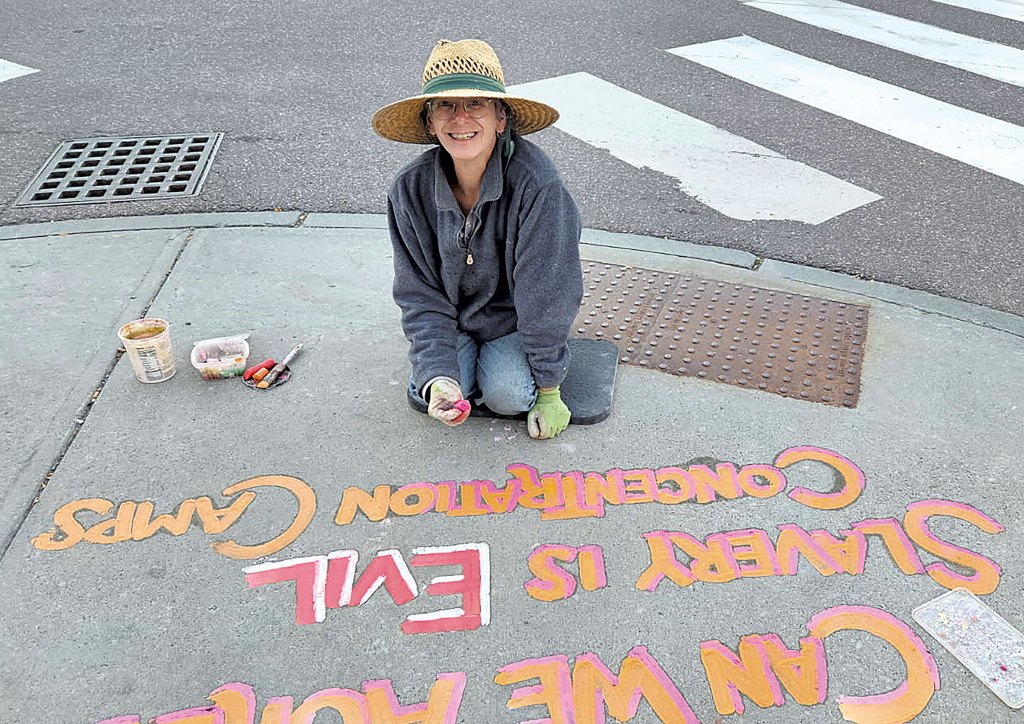
Meg Wallace firmly believes in attending protests and sending money to liberal causes. But months into Trump’s second term, those actions left her feeling unfulfilled.
“In Vermont, it just feels like you’re protesting against nothing sometimes,” said Wallace, 62, of Burlington. “Everyone there agrees with you.” Her $10-a-pop donations, meanwhile, seemed insignificant compared to the cash poured into political machinery by certain American billionaires. “You feel so powerless under this administration — this regime.”
Then Wallace heard about a nationwide day of protest that called for sidewalks everywhere to be covered in pro-democracy messages. On August 2, she grabbed a pail of chalk and hit the streets near her home in Burlington’s Old North End. When she stepped back to admire her messages that day — “No Kings,” “Be brave and kind” and an expletive in Spanish aimed at U.S. immigration authorities — something clicked. “I can do this every day,” she thought to herself, “and no one can stop me.”
“It made me feel a little less impotent,” she said.
Wallace has since spent nearly every day hunched over Queen City street corners and bus stops creating multicolored messages of dissent that have become a regular feature in her neighborhood.
The low-tech posts, which Wallace touches up and replaces frequently, range from straightforward appeals (“Save Our National Parks”) to probing, provocative questions. “What kind of leader starves their people?” one asked. “Can we agree slavery is evil?” posed another.
One stand-alone factoid read: “Undocumented workers paid $7,900,000+ in VT. taxes, 2022.”
Wallace, who is slight, bespectacled and fond of large straw hats, has a bachelor’s degree from the Tyler School of Art & Architecture in Philadelphia, where she focused on metals. And while she does not consider her chalk creations to be art, exactly, she strives to make them eye-catching, knowing that they’re more likely to be read that way. She sets out each day with a foam pad for her knees and a five-gallon bucket crammed with dusty containers holding fresh chalk and worn stubs.
Kneeling on the pad in her wide-brimmed hat, Wallace more resembles a gardener pulling weeds than a provocateur with a point to make. She begins by squirting water to create an outline of the words — she prefers thick, uppercase letters — then traces them using wet chalk.
Wallace relies on vibrant, Day-Glo colors and sometimes reserves certain shades for specific phrases, such as a particular orange hue that she often pairs with “melon felon.” She then adds a contrasting color to create a simple drop shadow that makes the words seem to pop off the pavement and finishes by using a wet paintbrush to give the chalk a smooth polish.
“I have done this for so many bloody days that I’ve gotten better at the technique,” she said. “It’s not difficult.”
It is time-consuming, however. Wallace said she has spent hundreds of hours on the project and estimates that she has used well over 1,000 pieces of chalk. She’s had to buy chalk online after exhausting the local supply.
She is still coming to terms with the impermanence of her creations. “It pisses me off when I make something really elaborate and the next day it rains,” she said. And yet it is the ephemeral nature of the messages that makes what she’s doing legal. Marking the sidewalk permanently, such as with paint, could be considered vandalism under some interpretations of city ordinances.
She encounters occasional pushback. Small cohorts of “angry white men” have yelled at her or filmed her from passing cars, while someone — she has an idea who — has purposefully defaced her work by pouring water and stomping on it. “It was the same boot print,” Wallace said.
That only deepened her resolve. “You want to smudge, ‘Jesus was a refugee’?” Wallace asked. “Fine, I can just rewrite it. I have a lot of chalk.”
Wallace said she has also been reported to police and the city’s Department of Public Works. An employee of the latter department came by one day, took a photo and told her to take care. “They don’t give a rat’s ass,” she said. “It’s sidewalk chalk.”
The overwhelming response has been positive, she said. Neighbors have applauded her efforts, while immigrant families have thanked her.
“Part of it is a public service announcement, and part of it is giving people a bit more heart,” Wallace said.
Wallace plans to take a break from the venture this winter. But she vowed to return with her chalk bucket come spring, registering her displeasure one letter at a time.
Full Plate: Capstone Community Action
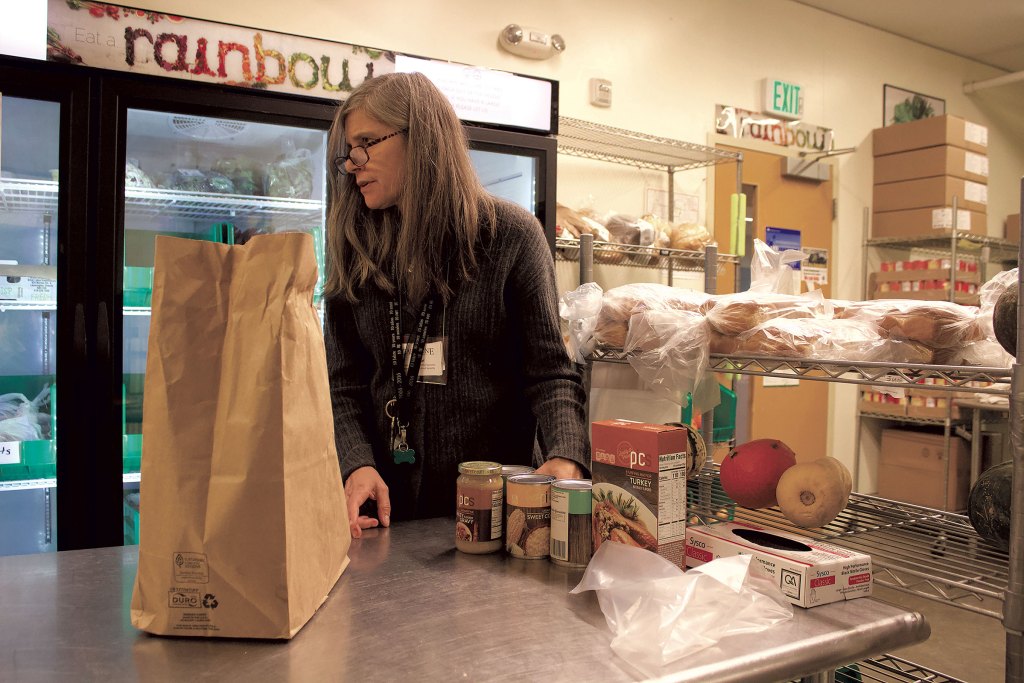
In late October, Liz Scharf noticed the food pantry at Capstone Community Action in Barre was running low on supplies. Scharf, a Capstone director, typically has no problem keeping the shelves stocked. She orders most of Capstone’s food from the Vermont Foodbank in twice-monthly deliveries, in the first and third weeks. Local farms provide additional produce.
But October spanned five weeks instead of four, creating a longer-than-usual wait for the first delivery in November. More importantly, the government shut down on October 1 and was threatening to suspend SNAP benefits. The food shelf had to bridge the delivery gap just as clients surged, anxious that their federal food assistance might disappear.
So, Scharf placed extra orders with Amazon, the food wholesaler Sysco and a farm in East Montpelier to ensure that Capstone could serve the influx of people filling the lobby. Her usual 32-hour workweek stretched closer to 40. Scharf worked with staff members to sort community donations and set up a new intake process to move people through the building efficiently.
“I said, ‘Let’s literally put the action in community action,’” Scharf said. “That’s what we were doing.”
To her relief, the extra efforts worked. In early November the food shelf received twice as many visitors as it usually does, but not a single person was turned away, Scharf said.
Capstone, like similar agencies in Vermont, has spent much of the past year adapting to rising food insecurity and demand. Higher living costs and tightened eligibility rules for federal SNAP benefits have pushed more Vermonters to seek help. Capstone staffers have placed more orders, overhauled logistics and worked longer hours at its food shelf to accommodate the need. So far, they’ve succeeded.
People in central Vermont have turned to Capstone for local assistance since the nonprofit was established in 1965. Today it is one of five organizations comprising the Vermont Community Action Partnership, which helps people improve their well-being and financial stability. In addition to its food shelf, Capstone offers job training, housing support services, financial coaching, weatherization assistance, Head Start and a variety of workshops.
Capstone’s services were a lifeline during the COVID-19 pandemic and 2023 floods, which damaged or destroyed hundreds of homes in Barre. More recently, inflation and rising health care and housing costs have brought more people through the organization’s doors. Annual visits to its food pantry jumped more than 40 percent from 2023 to 2024, surpassing 8,000.
The flow of visitors swelled further this fall, when changes to SNAP benefits, known in Vermont as 3SquaresVT, kicked in. New work requirements and tightened eligibility rules for noncitizens took effect under the budget bill that Trump signed into law.
The Department for Children and Families estimates that new work requirements could jeopardize benefits for roughly 4,000 people, 6 percent of Vermont’s 63,000 3SquaresVT participants. People experiencing homelessness, for example, must now follow SNAP’s standard proof-of-work rules. Thanks to a three-month grace period, the changes did not immediately cut off benefits for most. Scharf anticipates that 15 percent of SNAP participants who now use the food shelf will eventually lose their benefits due to the new restrictions to be phased in over the next two years.
Nearly 120 households — mostly those of refugees and asylum seekers — were immediately impacted by the citizen eligibility changes. Eighty-six of them lost benefits entirely.
Although Capstone and other food shelves have absorbed much of the increased demand this year, anti-hunger advocates caution that these networks were designed to be stopgaps during emergencies such as a job loss or flooded house — not as a replacement for grocery stores or federal programs. For every meal the Vermont Foodbank distributes to partners such as Capstone, 3SquaresVT provides nine.
Scharf has about $90,000 to spend on food this year — and she stretches every dollar. Nearly everything she buys from the Vermont Foodbank comes at a deep discount. Some items cost nothing; groceries donated to the food bank by retailers are passed along free of charge.
But the financial squeeze is tightening. Federal cuts have eliminated U.S. Department of Agriculture grants that provided Capstone up to $25,000 in recent years to buy local food, leaving a hole the organization can’t easily fill. The nonprofit has already dipped into its reserves just to keep staff paid and is waiting to learn whether it will retain the Community Services Block Grant that anchors much of its work.
Scharf described 2025 as the most challenging of Capstone’s 60 years. She said the organization shifted from its usual five-year strategic plan to a six-month contingency plan to navigate uncertainties.
“We didn’t know to what extent or how grim it might become,” Scharf said.
The food shelf has been buoyed, if only temporarily, by emergency measures. During the shutdown, the Vermont Foodbank provided a one-time infusion of $5,352, drawn from the $250,000 allocated to it by the Vermont Emergency Board. And in Barre City, municipal leaders scraped together $25,000 to fund $25 grocery gift cards meant to help residents bridge the gap during the time that 3SquaresVT was offline. Community donations, food drives and fundraisers have eased some of the strain, but none of the efforts provides lasting relief.
For now, Scharf and her colleagues are doing what they can: ordering more food, streamlining intake systems and working longer hours to meet the need. Late last month, that meant securing 160 turkeys from a local Kiwanis club and Walmart for Thanksgiving.
Scharf says the outpouring of support feels quintessentially Vermont. The same generosity carried Capstone through the pandemic and the 2023 floods.
“Unfortunately, it often takes something bad to happen to see the good come out of people,” she said. “But we’ve seen a lot of it.”
The $5 Donor: Jessie Tornabe

Jessie Tornabe spotted the news on Instagram: Seven weeks before dozens of high school students were to arrive on Vermont State University’s Castleton campus for the Governor’s Institutes of Vermont summer arts program, the federal government withdrew the $30,000 grant it had approved.
For each of the past 10 years, the arts institute, known as GIA, had received $20,000 to $30,000 in funding from the National Endowment for the Arts. This year, however, the NEA terminated awards for projects that did not align with Trump’s priorities. The money represented a small fraction of the two-week program’s total budget, “but $30,000 is significant,” said Elizabeth Frascoia, executive director of the Governor’s Institutes of Vermont, which runs it.
In response, the Governor’s Institutes launched an emergency fill-the-gap campaign.
Jessie, a 17-year-old senior at Burlington High School, decided to contribute “almost immediately,” she said. She had attended GIA in 2024 and made some of her closest friends there. The immersive experience pulled her out of her shell, put her onstage to sing and recite poetry, and gave her the courage to apply to Boston’s Berklee College of Music.
“GIA made me connect with other people who made me feel like I mattered and like my music mattered and like I could change the world,” she said. “I just felt like it was super important for kids who were younger than me to have that same experience.”
Jessie works as a cashier at Shelburne Market, where she composes song lyrics on the back of register receipts when business is slow. She typically divides her paycheck among her college savings account, clothes shopping at TJ Maxx and iced chai lattes at Starbucks.
She sent $5 to support GIA. “I want to donate more but this is all I can donate rn!” she wrote in her accompanying note.
Jessie was one of 110 donors who helped the Governor’s Institutes of Vermont raise $52,235 before GIA started in June. The program drew 172 students, the most in its 42-year history. Like previous participants, they studied a range of creative arts, including theater, writing, visual arts, film, dance, photography and fashion. Each student picks two classes to focus on.
When Jessie participated, she studied poetry with poet and clarinetist Toussaint St. Negritude and songwriting with performer and educator Andy Gagnon. A soft-spoken girl who tugs the cuffs of her sleeves over her hands as she speaks, Jessie continues to heed the advice she got from Casey Greenleaf, a singer, songwriter and producer who was a resident assistant. “Be bigger,” Greenleaf told her. “In my singing, in my writing, in my expression. Just put it out there, because somebody in the world will care and relate,” Jessie recalled.
When they are not in class, participants attend workshops run by staffers, alumni, guest artists or other students. Artists entertain each evening. Among those whom Jessie saw was Vermont-raised Myra Flynn, who performed with her band before they all sat on the edge of the stage to talk to students about their career paths.
When Jessie’s session ended and the curtain closed on the farewell ceremony, she and the other students sat in a circle and took turns standing to talk about their experiences. “My friend Kat was holding my arm,” Jessie said. “We were sitting there in tears.” Jessie knew she couldn’t speak. If she could have, she said, “I think I would have said, ‘This was the first time in my life that I felt connected to every single person in a room.’”
Watershed Diplomacy: The Memphremagog Science & Education Center
The Memphremagog Science & Education Center opened in July in Newport with a mission to deepen ties between residents of Vermont and Québec who live in the watershed of Lake Memphremagog. The timing has, to put it mildly, posed challenges.
This year, Trump has belittled Canada and imposed crippling tariffs that have disrupted trade. He has said, falsely, that much of the fentanyl flooding American cities flows across the northern border. He has ridiculed Canada’s sovereignty, too. In response, many Canadians are staying at home instead of traveling south across the border and have stopped buying goods such as Vermont-distilled spirits.
Political tensions aside, Vermont and Québec share a stunning, border-straddling glacial lake that draws tourists in both countries. Lake Memphremagog is also the drinking water source for more than 200,000 Québécois. Building understanding about the lake’s cleanliness and ecology remains a mutual interest on both sides of the border — and the chief focus of the education center.
“It’s essential for us to empower the students in our region with the knowledge and skills and tools that they need to understand that watershed and how those impacts flow,” said John Aldridge, the nonprofit group’s education director.
The international tensions, however, put the kibosh on much of the summer’s cross-border programming.
The organization had hoped that schoolchildren from Québec would come to about half of the 33 outings it planned on its floating classroom, the Northern Star. It also wanted Canadians to visit Newport for the grand opening of its downtown science center.
But Canadians, irked by the president’s rhetoric, stayed home.
Canadian politicians have urged compatriots to boycott U.S. travel. In April, the Canadian Association of University Teachers strongly recommended that its members stay away from the United States for now.
That’s when Aldridge decided that if the Québécois weren’t going to come to Vermont, he’d go to them.
In October, he packed up all his educational gear and headed over the border to Magog, Québec, to a private elementary school that was still interested in his message of shared environmental responsibility.
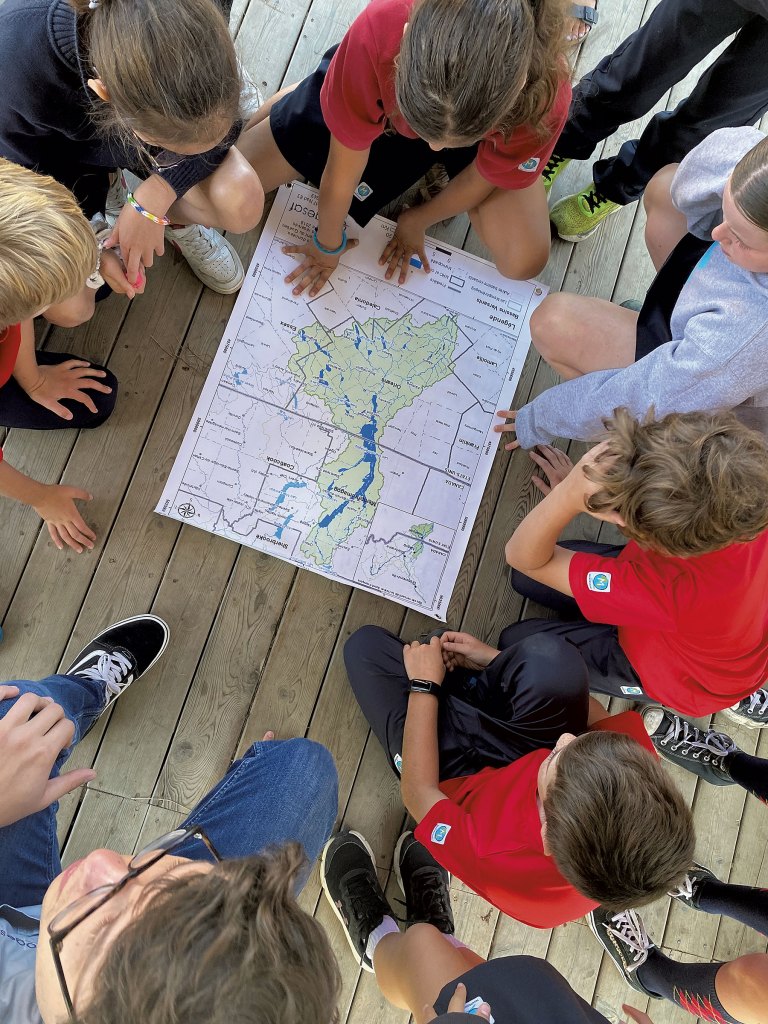
About 80 Canadian elementary school students learned about the challenges of keeping a border-spanning lake clean. They played with the center’s watershed model, sprinkling powdered cocoa into the water to simulate how waste moves downstream. They used digital microscopes to view water samples and played “cyanobacteria tag” to better understand how dangerous algae blooms can proliferate when excessive nutrients run into the lake.
“I think of myself as a member of a watershed that is binational,” Aldridge said. “So I feel it is my civic duty to not let those borders prevent us from doing the meaningful work that we intend to do.”
Tariff Triumph? Terry Precision Cycling
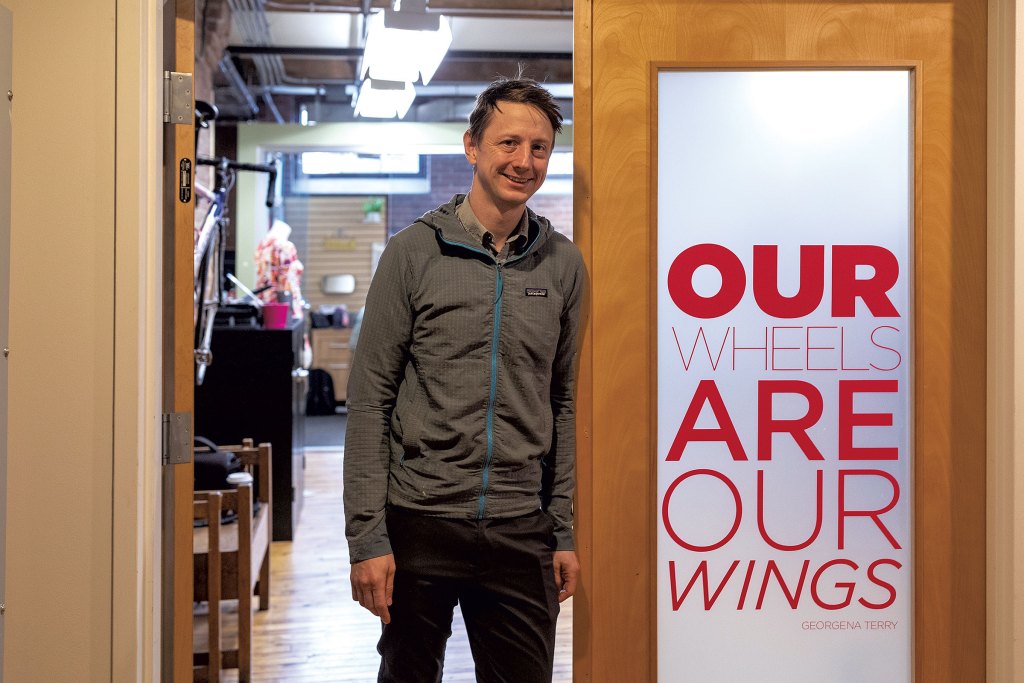
The most formidable threat to Trump’s tariffs can be found in a three-room office suite behind a Burlington coffee shop.
Terry Precision Cycling, a Vermont company that makes cycling saddles and apparel for women, is one of five small businesses across the country that joined forces in April to challenge the legal basis of the president’s “Liberation Day” trade policies.
Their lawsuit has managed to push the new tariffs to the brink. Federal judges have twice concluded that Trump lacks the legal authority to impose sweeping fees on imports from almost anywhere in the world without Congressional approval. Last month, the case was argued before the U.S. Supreme Court, where several conservative-leaning justices voiced skepticism about the president’s authority to decree the levies on his own. The high court is expected to issue a decision soon, potentially voiding Trump’s cornerstone economic policy.
Terry Precision Cycling president Nik Holm has taken on the tariffs from the company’s tiny headquarters on Maple Street. Its suite is tucked inside an industrial-chic building called the Karma Bird House, among a kava bar, a vintage clothing boutique and Kestrel Coffee Roasters. The office has space for five workstations and a conference table that’s flanked by display racks of synthetic bike shorts and jerseys.
How did a plucky Vermont bike-apparel brand wheel its way to the center of a legal battle whose outcome could shape the global economy for years to come?
By not worrying too much about the politics, Holm said.
Unlike Ben & Jerry’s, Terry Precision Cycling has not made political activism part of its brand, even though its raison d’être — making cycling more accessible to women — is infused with social purpose.
Yet Holm quickly recognized last spring that the abrupt tariff hikes posed an “existential” threat to Terry’s business.
Terry produces many of its products overseas. Its gender-specific saddles are made in Italy and Taiwan; factory workers in China, Vietnam, El Salvador and the Philippines produce its shorts, jerseys and accessories. The company has long contracted with a cut-and-sew manufacturer in Washington State, but the raw materials for its U.S.-made products are sourced from El Salvador, Guatemala, Europe and China — and therefore also subject to tariffs.
New tariffs added anywhere from $10 to $60 to the cost of Terry’s cycling shorts and tops, Holm said. The company had few options to navigate such steep price hikes. With just 18 employees, Terry doesn’t have the capacity — or cash reserves — to stockpile inventory in hopes that tariffs will be temporary. Jacking up the price on riding shorts from $165 to $199, as Terry did this year to offset import fees, risks losing customers and pricing newer riders out of the sport.
Holm anticipates tariffs will cost the company more than $200,000 this year. Terry is likely to end 2025 in the red. The hit to the company’s bottom line could nearly double in 2026, he worries. “If our case doesn’t go our way, we’ll have to operate as a leaner and more efficient team next year,” he said.
Taking on the tariffs, he said, “was about survivorship.”
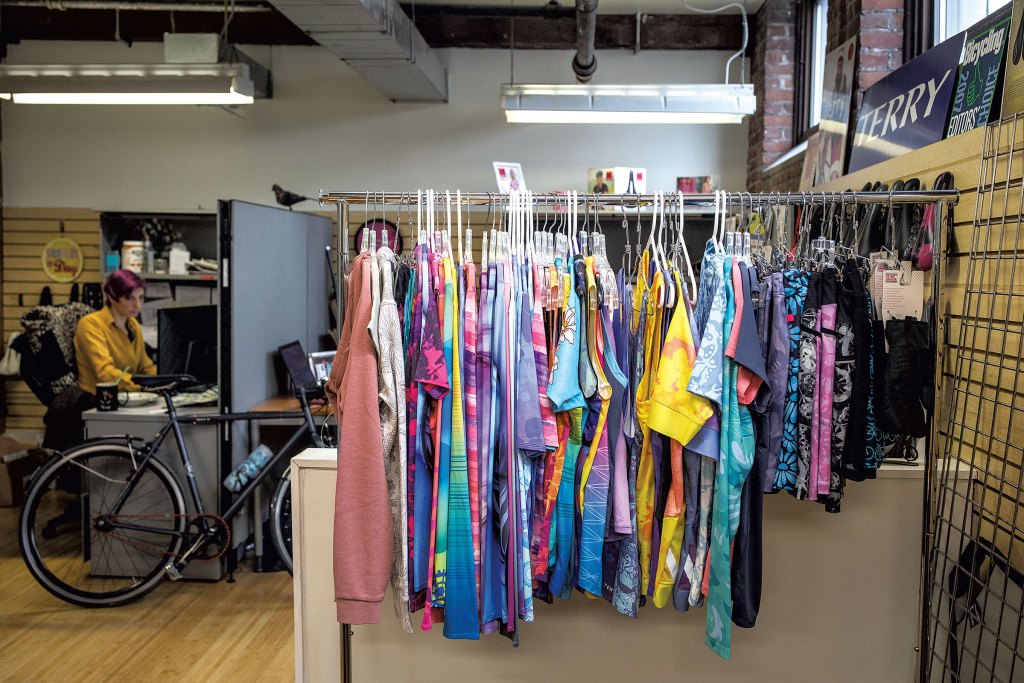
Holm, 36, had only been company president for a few months when Trump announced the new global tariffs. But he was able to immediately grasp the stakes for the business. A Massachusetts-born graduate of Northern Vermont University in Johnson, Holm joined Terry about a decade ago. His first role at the company focused on production planning, working with factories around the world to schedule and oversee the manufacturing and transportation of Terry’s goods. In that role, he learned about the global system for classifying trade products and the associated duties for each. Terry was already paying about 32 percent in tariffs on its synthetic tops shipped from most overseas manufacturers when Trump imposed additional tariffs — as high as 145 percent more for Chinese goods and 30 percent for imports from other countries.
Holm is slim and soft-spoken and often rides his bike to work. He took over a company with a rich history in pioneering women’s cycling. Georgena Terry had founded the firm in 1985, the first company to create bicycle frames designed specifically for women’s body geometry. Soon Terry developed a women’s saddle, called the Liberator; expanded into apparel; and dropped bicycle frame manufacturing.
Terry sold her namesake company in 2009 to Liz Robert, a former CEO of Vermont Teddy Bear. Robert relocated Terry from New York to Burlington. She retired last year, and Holm took over.
In April, as Holm was scrambling to respond to the new tariffs, he got an email that was going around to small businesses. A Texas law firm, the Liberty Justice Center, was looking for companies that might be willing to challenge the legality of the president’s actions.
That was on a Friday. Holm quickly put the question to Terry’s board of directors, which deliberated during a meeting the next day and during a second meeting that Sunday. Holm said the board didn’t flinch at the idea of joining such a contentious legal fight.
The resulting case, V.O.S. Selections, Inc., et al. v. Trump, was carefully crafted to avoid accusations of mere partisanship. The Liberty Justice Center has a libertarian bent and is best known as the firm behind the landmark Janus decision in 2018 that allowed government workers to opt out of paying union dues, thus undercutting union power.
Terry, of course, was far from alone in its financial distress. The new tariffs have posed challenges across most industries and to businesses of all sizes, including many in Vermont. In Holm’s estimation, though, Terry presented an “ideal” example of the harm that the fees were causing. “We’re a global company — small, niche — that is highly impacted by this,” he said. “And we also produce in the U.S.”
Holm listened to a live stream of the Supreme Court’s recent oral arguments from his brother’s house in Hyde Park after dropping his first grader off at school.
The company hasn’t turned its fight against Trump’s tariffs into a public-relations crusade. Holm has given a few interviews, but Terry hasn’t tried to enlist its customers in the fight or displayed tariff costs on its price tags. The company published a statement on its website after the U.S. Court of International Trade ruled in its favor last May.
“We are proud to have played a role in standing up for small businesses,” the statement said. “This isn’t just a win for Terry. It’s a win for the cycling industry and the communities we serve.”
Whether that victory is lasting, however, is in the hands of the U.S. Supreme Court.
Staying Power: Woodstock’s Protesters
Fresh off an Oval Office meeting during which he famously dressed down Ukrainian President Volodymyr Zelensky, Vice President JD Vance brought his family to the Mad River Valley for some skiing in March. Hundreds of Vermonters lined roads around ski resorts with not-so-subtle protest signs, including “Go ski in Russia” and “Making America Greatly Ashamed.” One banner bore the ultimate Green Mountain jab: “Vance Skis in Jeans.”
Protests have been loud and vigorous around the state since Trump’s inauguration. More recently, locals who oppose the president have donned costumes depicting frogs, T. rexes and unicorns during October’s record-setting No Kings protests.
But a group in Woodstock has trumped them all, holding a protest every single day since February 7.
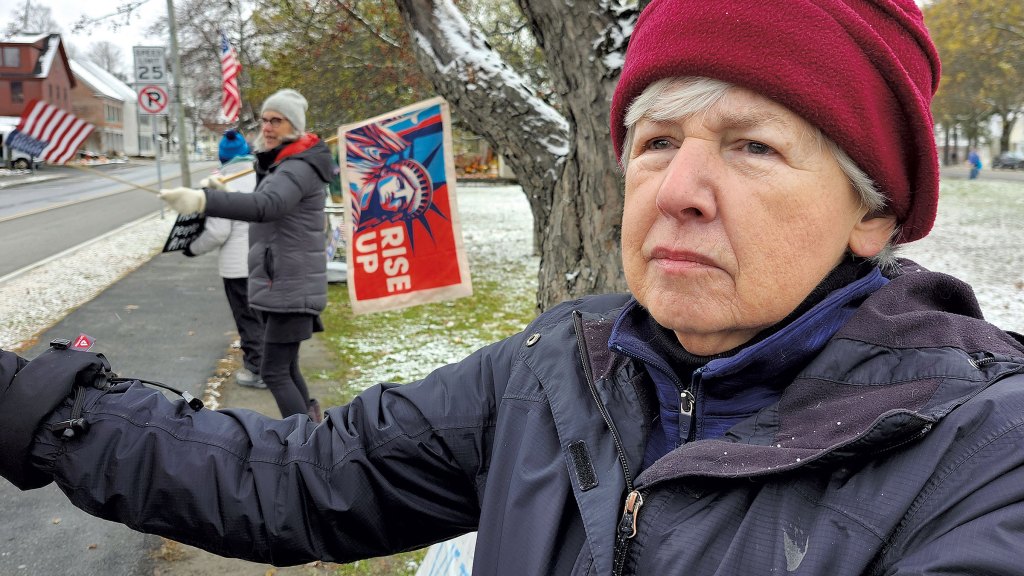
That was the date, Linda Machalaba said, that she couldn’t take it anymore. The retired teacher explained how she was so appalled by the president’s flurry of executive orders, particularly those that cut funding for the National Institutes of Health and USAID, that she decided to do something.
“I’m not a political person,” Machalaba said last month in Tribou Park, holding a “Democracy” sign in a snow flurry. “I was just very, very upset!”
Machalaba, 75, was all alone that first day.
“It just seemed strange that no one was protesting,” she said. “I just kept thinking, Am I the only one?”
She wasn’t. Someone Machalaba knew spotted her and vowed to join her the next day. Others followed suit. She was never alone again.
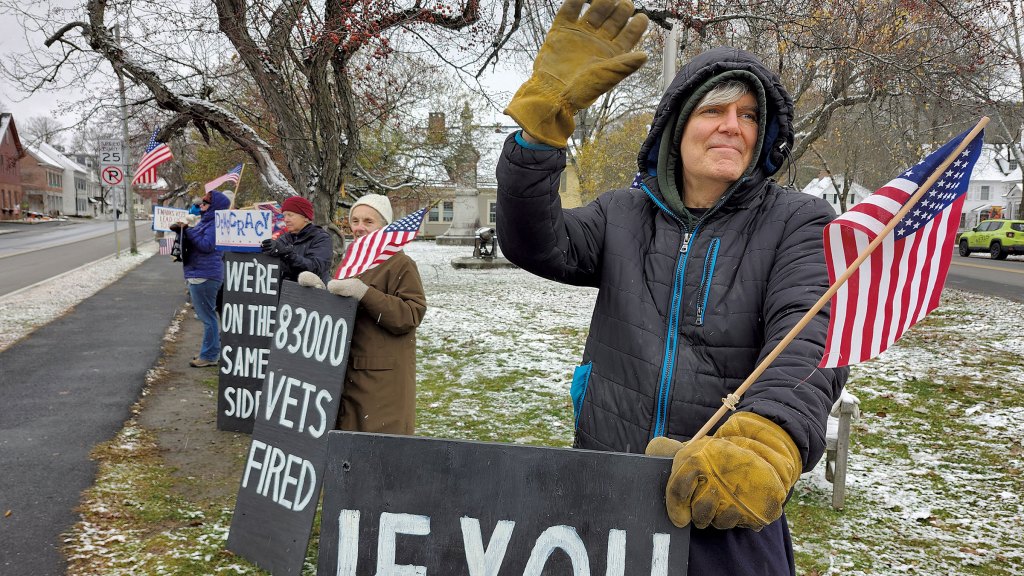
For the past 300-plus days and counting, the loosely organized group has been protesting at the same spot on Central Street from noon to 1 p.m., rain, shine or snow. The triangle-shaped park exudes small-town America. On the tourist town’s main artery, it features a flagpole, a cannon and a Civil War memorial and is ringed by tidy historic homes with white picket fences.
When Seven Days stopped by, most of the passing drivers waved back to the protesters, smiled or flashed their headlights in support. Some honked, though a sign discourages doing so out of respect for neighbors.
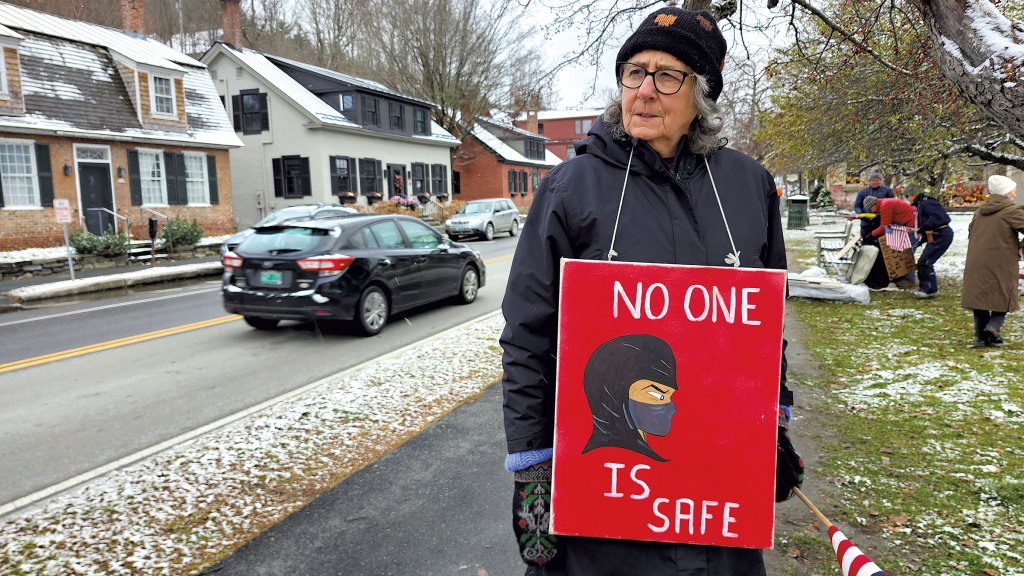
Kitty O’Hara, a semiretired artist, hung a sign around her neck so that she didn’t have to hold it aloft for an hour. “No one is safe,” it read. O’Hara helped other protesters make placards using a material that’s more durable than the flimsy poster board and cardboard some had started with.
Standing in one place for an hour can be cold and uncomfortable in November. The protesters had to perch on snowbanks last winter, she said.
“It seems like the worse the weather is, the more supportive people are of us,” O’Hara said.
As at many such events in Vermont, few young people regularly participate in the Woodstock protests. O’Hara said she’s not sure if that’s because of the demographics of the town or because young people have jobs while retirees have more time to protest.
Steve Smith isn’t retired. The local physician held up the first of a series of three signs that read, in order: “If you didn’t want” … “83,000 vets fired” … “We’re on the same side.”
That represents the number of veterans who lost their jobs during the early rounds of federal staffing cuts pushed by the Department of Government Efficiency, or DOGE.
Smith, 67, said he believed that most people, regardless of party affiliation, support that pro-veteran message. His goal, he added, is to remind people that authoritarianism requires fear and that “courage is contagious.”
“We’re not going to overpower Trump,” he said. “We’re going to outlast him.”
The original print version of this article was headlined “Stepping Up | Trump has assailed Canada, immigrants, food aid and other targets this year. Here’s how Vermonters are responding.”
This article appears in Dec 3-9 2025.