
By Cathy Erway, The New York Times
When chef Darren Chang was growing up in Arcadia, California, his mother would braise large pots of beef shanks throughout the week, to top bowls of piping-hot noodle soup for dinner, or to roll up in scallion pancakes smeared with hoisin for a quick snack. Tender and jiggly with collagen, and deeply flavored with soy sauce and aromatics, they were always in the refrigerator.
When Chang and chef Travis Masar opened their Taiwanese food stand, Pig and Tiger, in Denver nearly six years ago, they struggled to source the boneless beef shanks for their signature beef noodle soup and Los Angeles-style beef rolls. Most meat purveyors didn’t carry the cut, so the chefs often had to clear out the retail selection at local Asian supermarkets. Masar suggested using brisket or short ribs instead of beef shanks, but Chang shut down the idea.
“There’s an emotional attachment,” Chang said. “I’m usually the one who’s trying to tweak things and try different takes, but for that, no.”
Since moving the restaurant into a brick-and-mortar location last year, the partners finally secured a steady supply of beef foreshanks — their preferred section of the cut — from Gold Canyon Meat, a local wholesaler.
“It’s 100% a part of these dishes, it’s a part of that culture,” said Masar, referring to Taiwanese cooking, “and there’s no replacing it.”
There is no cut of beef quite like the shank. Technically any part of the cow’s legs, these hardworking muscles are strewed with tendon and sinew, which become meltingly soft and gelatinous after a long, slow braise. To fans, this is precisely what makes dishes that utilize it so memorable.
“We just love that texture, and it’s lean,” said Richard Ho, the chef and owner of Ho Foods, a Taiwanese beef noodle soup shop in New York City.
Yet beef shanks are largely absent from major grocery stores in the United States and can be tricky for restaurants to find outside Asian suppliers, requiring chefs to go to great lengths to obtain them.
“I was like, ‘Well, where do I source this thing and what is it even called?’” he said.
After learning as much as he could about it, he sought out a handful of small butchers who cut shank pieces for him. Today, he gets most of his beef shanks from Ends Meat, a whole-animal butcher shop in Brooklyn, which provides its entire stock of beef shanks to Ho Foods.
The partnership is “a perfect relationship,” said John Ratliff, the owner of Ends Meat, because it allows him to turn a profit on a cut that would otherwise be a hard sell.
“In our culture, people aren’t as interested in parts of the animal that have a lot of tendon,” Ratliff said. “If people don’t buy it, it ends up getting ground in a hamburger, which is a horrible use for something that is so special.”
Beef shanks have long been enjoyed in stews and braises around the beef-eating world, as in South Asian nihari, Korean stew sataejjim and northern Italian osso buco.
At Soothr, a Thai restaurant in New York City, the team fills the kitchen’s ovens with more than 16 gallons of boneless beef shanks daily to braise in a broth infused with lemongrass and soy. The shanks are cooled completely before they’re sliced and served in a handful dishes, including green curry, massaman curry and yum nuer, a beef salad with herbs, shallots and chiles.
“Thai people love stewed beef shank,” said Joel Watthanawongwat, the chef and an owner.
Other cuts get a lot of attention because they’re great for steaks, a preparation that is not typical of Thai cuisine, he said. “Beef shanks are not seen as a premium cut, more of an economical cut, but if we put technique or method to make it a little more elevated, it gives it more value,” he said.
Slow-cooking other cuts can result in a mess of falling-apart meat — which is not always a good thing. With shanks, slippery wisps of collagen connect the muscle meat in neat slices that present well, and that collagen also enriches and thickens any soup or curry.
Because tough shanks take such a long time to be rendered tender and palatable, they’ve long been regarded as an affordable (if not unwanted) cut of meat.
Nihari, a slow-cooked meat stew, traditionally comprised cheap cuts like beef or lamb shank cooked with the residual heat of a cooling tandoor, said Chetan Shetty, the chef of Passerine, an Indian restaurant in New York. The dish, once served to soldiers for breakfast, became so popular that it was embraced by the ruling class of the 18th-century Mughal Empire, and it is now the national dish of Pakistan.
“What was once a common food for the people rose to become the food for royals,” he said.
The use of shanks in Taiwanese beef noodle soup — a dish that is widely believed to have originated in the military housing villages of Taiwan in the mid-20th century — may have begun with canned-beef rations.
“Beef noodle soup would not have taken off without U.S. military aid,” said Katy Hui-Wen Hung, an author of “A Culinary History of Taipei.”
It’s hard to know exactly what cuts of beef were in those cans back in the 1950s and ’60s, but it was likely not of great quality nor of great value to the United States.
“They weren’t exporting rib-eye steaks,” Ho said.
The most faithful interpretation of Taiwanese beef noodle soup would use whatever is easiest to find, prioritizing resourcefulness. Ironically, Ho pays a premium for his grass-fed shanks, as they must be custom-cut and trimmed of their bones, an inefficient preparation for many meat suppliers. If boneless beef shanks were to become more popular, it could further drive up prices for the economical cut, much in the way of oxtail in recent years.
But they’re worth it. “It’s about bringing back the nostalgia, the comfort,” he said.
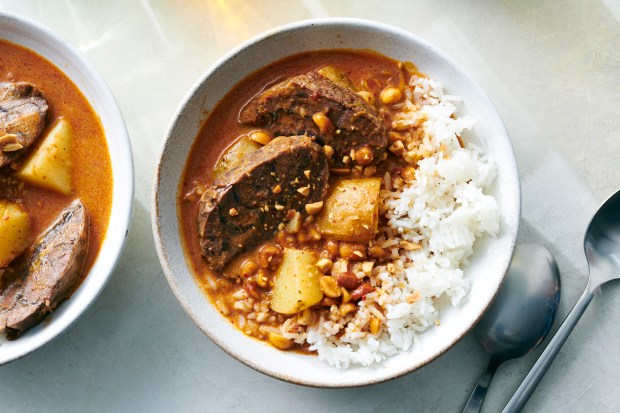
Recipe: Beef Shank Massaman Curry
Joel Watthanawongwat, the chef of Soothr, a Thai restaurant in New York City, makes large batches of braised beef shanks each day to use in several dishes, including this tamarind and coconut-rich massaman curry. The process, which can be split over two days, involves slowly braising then chilling the shanks for the most tender, flavorful results. Boneless beef shanks are rich in tendons and collagen, making this cut especially soft and tender when slowly and gently cooked. This recipe yields a large quantity, perfect for a gathering or for multiple meals.
Recipe from Joel Watthanawongwat
Adapted by Cathy Erway
Yield: 6 to 8 servings
Total time: 7 hours, 15 minutes
Ingredients
For the Braised Beef Shanks:
- 21/2 to 3 pounds boneless beef shanks, also called heel muscle (about 3 medium; see Tip)
- 1 star anise
- 1 cinnamon stick
- 1 (3-inch) piece fresh galangal, sliced (about 2 ounces)
- 1 lemongrass stalk, ends trimmed, stalk cut into 1-inch pieces
- 1/4 cup oyster sauce
- 1/4 cup soy sauce
- 1/4 cup Thai sweet soy sauce (also known as black sweet soy sauce)
- 1 tablespoon grated or chopped palm sugar or light brown sugar
For Finishing the Curry:
- 1 lemongrass stalk, ends trimmed, stalk sliced (scant 1/2 cup)
- 1 small shallot or 1/2 medium onion, sliced
- 2 tablespoons vegetable oil
- 1 1/2 cups/about 6 ounces massaman curry paste (preferably Maesri brand)
- 2 (13.5-ounce) cans coconut milk
- 1/3 cup grated or chopped palm sugar or light brown sugar
- 1 1/2 teaspoons kosher salt, such as Diamond Crystal
- 1/2 cup crushed roasted peanuts
- 1/3 cup tamarind concentrate
- 1 lime, finely zested (about 1 packed tablespoon)
- 1/2 to 1 pound Yukon Gold potatoes (1 to 2 potatoes), boiled or baked and then cut into 1-inch cubes (optional)
- Steamed rice (optional), for serving
Preparation
1. Prepare the beef shanks: Heat your oven to 350 degrees. Place the beef shanks in a Dutch oven or other large, heavy-bottomed pot with a tight-fitting lid. Add all the remaining ingredients: star anise, cinnamon, galangal, lemongrass, oyster sauce, soy sauce, sweet soy sauce and palm sugar. Cover with enough water to fully submerge the beef (about 5 or 6 cups).
2. Cover the pot and place it in the oven. Braise for 3 hours. Remove from heat and let rest for 1 hour in the pot.
3. Using tongs, take the beef shanks out of the braising liquid and place them on a tray or dish. (Strain and reserve the braising liquid; you can use it as a base for soups, sauces or noodle dishes.) Cover and refrigerate the beef shanks for at least 2 to 3 hours (or up to 3 days), until firm. This makes them much easier to slice cleanly.
4. When ready to serve, finish the curry: Slice the chilled beef into about 1/2-inch-thick rounds and set aside. In a medium saucepan, combine the lemongrass and shallot with 2 cups water. Bring to a boil, simmer for 10 minutes and strain the lemongrass broth into a bowl, discarding the solids.
5. Heat the oil in a large pan or pot over medium heat. Add the curry paste and cook for 2 to 3 minutes, stirring constantly, until fragrant.
6. Stir in the lemongrass broth, coconut milk, palm sugar and salt. Bring the mixture to a gentle boil, then reduce the heat and let it simmer for 10 minutes, stirring occasionally, until the flavors meld and the curry thickens until creamy and rich.
7. Remove the pan from the heat. Stir in the crushed peanuts, tamarind concentrate and lime zest.
8. Gently add the sliced braised beef and potatoes (if using) to the warm curry sauce. Return the pan to low heat just to warm the beef through until tender, being careful not to boil it vigorously once the beef is added.
9. Serve immediately over steamed rice.
Tips
Look for long pieces of banana-shaped boneless beef shanks at Asian butchers and markets such as 99 Ranch or H Mart, or from online vendors such as Weee!
This article originally appeared in The New York Times.