
Christina Applegate is where she spent many listless, painful nights over the last year working on her memoir: in bed.
She passes most of her days inside a bedroom of her Laurel Canyon home. And it’s already not a great day when we connect over video conference in late February — no day is free from the exhaustion and symptoms of multiple sclerosis, the autoimmune disease she was diagnosed with in 2021.
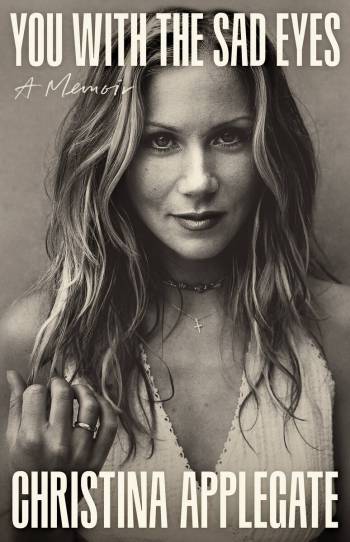
For her new memoir, “You With the Sad Eyes,” the 54-year-old actor broke open her personal journals, which she has kept since she was 13 and, in turn, the vault that is her personal history to share her story. And it was not an easy story to tell.
Yes, it’s brushed with the unbridled humor and candor that fans of the Emmy-winning actor with a résumé that includes “Married … With Children” and “Dead to Me” have come to expect. But it finds the star unpacking dark chapters — an absent father, a chaotic home life, sexual abuse she experienced as a child, body image struggles, an abusive boyfriend — before reaching her life-altering MS diagnosis.
“This book is not cathartic for me,” Applegate says. “I just needed to dump this s—- out somewhere. It’s almost like you guys are now my therapists in the world. Also, I feel like so many people have gone through this (stuff), obviously — I didn’t write this book for that. But let’s f——— come together, man, as kids of abuse, molestation — all these things — and really see each other and not feel so f——— alone.
“But I didn’t write this for that. I wrote it because someone said, ‘Do you want to write a book?’ I said, ‘Well, if I’m going to write a book, it’s going to have to start from Day 1.’ And Day 1 ain’t pretty. … There’s going to be really horrible s—- and then we’re going to have fun stuff — and crap again. That’s my life.”
Sadness in her eyes
The fun stuff? The book sprinkles some dishy and amusing moments amid the emotional heft — whether she’s reflecting on her crush on Johnny Depp, who was eight years her senior, or the time she ditched Brad Pitt, her date at the 1989 MTV Video Music Awards, for rocker Sebastian Bach. There are glimmers of light too — namely her daughter Sadie with husband Martyn LeNoble.
But trauma was a part of Applegate’s story early on. She grew up in L.A.’s storied bohemian enclave and music mecca Laurel Canyon — her father, Bob, was a music promoter turned producer, while her mother, Nancy, was a singer and actor. It was an upbringing marred by instability, pain and trauma.
Her father abandoned the family when she was a baby; her mother, whom Applegate writes about with empathy and tenderness, struggled with drug and alcohol abuse and the long-term effects of an abusive relationship.
“I love my dad. He was peripheral. He was wonderful. He passed away last year and I really don’t want to talk about him,” Applegate says. “But I didn’t have parents. I had a mom and she was it. Through all her stuff, she was right there. I love that lady. She’s 84 now and my heart’s starting to break.”
Her eyes show it.
That’s the powerful throughline in the book, the recurring reference to its Cyndi Lauper-inspired title — the sadness in Applegate’s eyes. She notes it at various moments to emphasize the accumulation of emotional weight, including the grief of being stuck in a physically and emotionally abusive relationship during the height of “Married… With Children.”
‘We need a community’
Just as the painful moments of her life took shape at an early age, so too did a refuge from it. She’s been acting since infancy, making her on-screen debut at 3 months old in 1972, playing a baby boy alongside her mother in an episode of “Days of Our Lives”; by kindergarten, Applegate became a member of the Screen Actors Guild. The fictional worlds she got lost in would become an instrumental escape from her reality at various points in her life.
Her career really began to flourish by the late 1980s and early ’90s when, despite having an aversion to comedy and initially turning down the role, she starred as Kelly Bundy in “Married… With Children.” After playing the ultra-cool and shallow character for 11 seasons, she went on to other starring roles in films (“Don’t Tell Mom the Babysitter’s Dead,” as well as the “Anchorman” and “Bad Moms” movies) and television (“Jesse,” “Samantha Who?,” “Up All Night” and “Dead to Me”), and was nominated for a Tony for the 2005 Broadway revival of “Sweet Charity.”
It all led to Applegate, in 2022, receiving a star on the Hollywood Walk of Fame, a goal she had chased since 1977, when she spotted scores of them on a drive to watch “Star Wars” with her mom. She hasn’t acted since wrapping Netflix’s “Dead to Me” in 2022 — it was during production on the show’s third and final season that she received her MS diagnosis and began treatment.
Applegate talks about living with MS — whether in interviews, in the book or on the podcast “MeSsy,” which she co-hosts with Jamie-Lynn Sigler, who also lives with the disease — with more bluntness than how she approached discussing her journey with breast cancer, which she was diagnosed with in 2008 at age 36. There’s no sugarcoating. No platitudes about blessings. Just the truth. For her, it’s just one piece of a larger effort to get people to connect honestly.
“I just feel like, when I’m talking about this, the way that I do talk about it,” she says, “our listeners from the ‘MeSsy’ podcast go, ‘Thank you, Christina, this does f——— suck!’ Let’s just vent to each other. … We need a community. We need a bunch of us talking to each other — caretakers and children of people with MS and all this stuff. I just want to have a kumbaya with everybody right now because there’s so much sadness with this disease.”