
Runners, dog walkers and horses — it is an equestrian trail, after all — are commonplace most Saturday mornings on the trail that encompasses Lone Mountain in northwest Las Vegas.
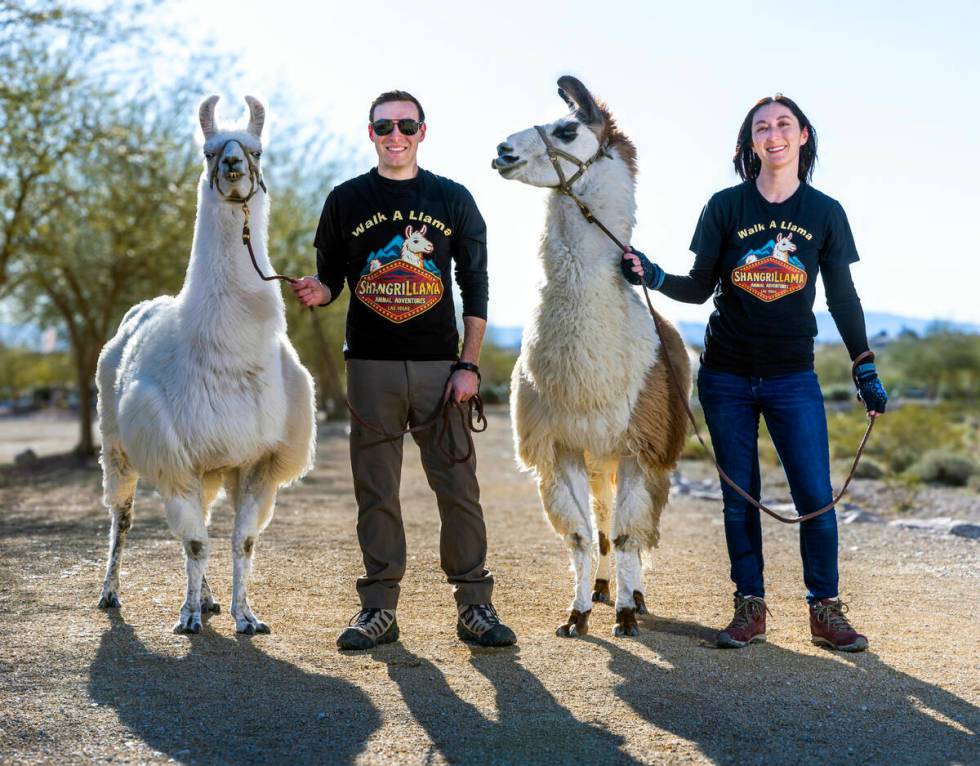
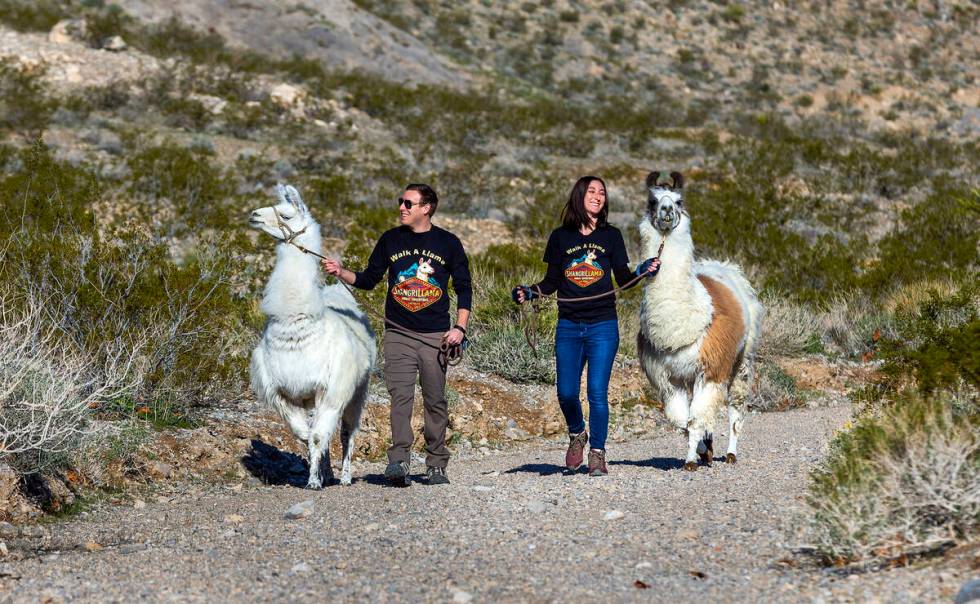
An unusual sight, however, is a llama. Nearly every weekend for the past few months, passersby have noticed a small pack of llamas, guided by a group of people. Two of them are Tommy and Jenni Brucato, owners of ShangriLlama Animal Adventures.
The family-owned business moved to Las Vegas last year and offers weekly education walks with its llamas along the 2-mile path.
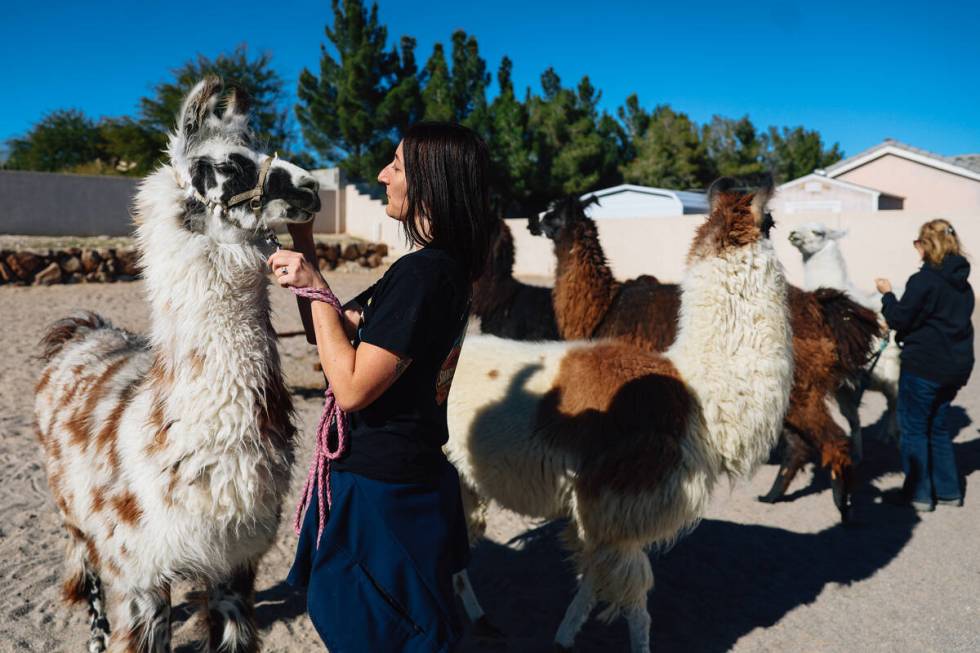
With them are their four male llamas: The Dalai Llama, all white with striking and sensitive light blue eyes, the 16-year-old leader of the pack; at the front is Bahama Llama, a 13-year-old show-winner with brown ears and a dark “mustache”; Hakuna-Ma-Llama, 4, a 6-foot-3-inch gentle giant, brown with a white tuft on his black head; and Como T. Llama, 3, with an appaloosa, or spotted, coat and cookies-and-cream face. All of them are third- or fifth-generation American-bred.
But Dalai really is in charge.
“He’s truly the one that tells them, ‘This is where we’re supposed to go. This is where we’re not supposed to go.’ He tells them who gets to eat at what times, what piles (they) get to eat, who gets to sleep at what times,” Jenni says.
Because of his blue eyes, Dalai is actually banned from the competitive show ring. Tommy explains he is leucistic, meaning he lacks pigment, but is not albino. Despite his ability to hear, his coloration means he carries the gene for deafness.
Passing on the genes of these llamas isn’t an issue, though, as all of these animals are fixed and used for education.
‘He had to pursue it’
At the Brucatos’ home in the northwest, a neighborhood peppered with horse stables, is their fifth llama, 17-year-old “self-retired” Barack O’Llama, who prefers a bit more solitude despite being a social animal.
“When we harness him, and we walk him in the neighborhood, he’s resisting. He’s like, ‘No, I want to go back. I want to go eat,’ ” Jenni says. She checks the camera on her phone to find him eating peacefully.
The names are puns, of course, but are also used again when a llama dies, as part of their remembrance. They’re holding onto Dracullama for an all-red or black-and-white llama.
The Brucatos, 30, along with their parents Sharon Brucato, 66, and Paul Brucato, 70, brought their llama walks to Las Vegas from Texas but got their start in Southern California.
The story starts when Tommy is 10. The family, including his sister, traveled to Germany on a cruise. They missed the train in Berlin and, without plans, visited a zoo. That’s where Tommy spotted the llamas.
“And for Tommy, that was it for him,” says Sharon, a former ghostwriter. “ ‘This is the animal I’ve always wanted.’ I just didn’t know. ‘Sorry, kid, I don’t know anyone who knows where you get them.’ How do you take care of them?”
She said no, but added, “He had to pursue it.”
When they returned to Southern California, where the family is from, they found a nearby llama rescue. The owner needed help, so she taught the family for a year.
“I said, ‘At the end of the year, if you’re still interested …’ ”
The family got five llamas at the end of the year.
No-drama llamas
On the walks, the participants first learn about some llama myths.
“Will he spit on me?” one asks. The answer is no, though they will spit at each other when agitated enough or to establish dominance.
Next, they’re not alpacas. Though both are in the camelid, or camel, family, they are different species. Alpacas are known for their much smaller size and coats used for fiber, and llamas, as a pack, are used as guard animals. The easiest way to tell them apart is to look at the ears: Llamas have banana-shaped ears, and alpacas have short, pointy ears.
They both trace back to their South American counterparts, so these llamas fare better here than in their previous home in humid Texas, as they prefer the dry, warm climate of Southern Nevada.
How did Jenni get involved? She and Tommy met in 2015 at Disneyland, where they both worked. For two years, she says, he didn’t tell her about the llamas.
“He said, ‘Well, now that you’ve finished your sociology degree, do you want to move to Texas and raise llamas with my parents?’ ” She went with him, and in 2020, they married.
Years later, the elder Brucatos, while living in Texas, had planned a vacation to Las Vegas, but their flights were delayed. For fun, Jenni says, they looked at real estate in the area and found the horse property where they currently live. They all flew down to check it out and realized it was perfect for the llamas.
That prompted the young couple, their llamas and two cats, to make a 22-hour drive to the Mojave Desert.
‘They are just bizarre’
Llamas aren’t well understood, Jenni says. With only a few reliable textbooks on the species published decades ago, the llama-owning community relies mainly on Facebook groups to share information.
“Education has always been at the forefront of what our family’s trying to do,” she says. “A lot of what’s online is incorrect, so we try to make sure the proper information is shared.”
Right now, the walks are the bread and butter of the business, along with the occasional wedding and photoshoot. The llamas have even been featured in a short series, “Llama Cop,” featuring the late Como T. Llama Sr., and a GameStop commercial in 2019 with Dalai Llama. While the walks are not open for children 10 and younger, they see the opportunity for children’s education and other community events.
“Llamas thrive with people who are more vulnerable, and they thrive on taking care of and protecting people,” she says.
From the start of the walk, it’s clear the Brucatos know each of these llamas very well, down to their specific personalities and quirks, as well as their physiology and behavior.
Llamas aren’t pets, they explain at the beginning. For cats and dogs, petting simulates a mother cleaning a kitten or puppy, but that’s not the case with the llamas’ short tongues. Nor are they ridden. While they’re sturdy, that’s just not how they’re used as livestock.
Too much physical attention in their early years can lead to something called berserk llama syndrome, in which they become dangerous to humans and see them as rivals. The Brucatos explain they got their llamas after this risky period. It’s understandable why an uneducated owner would overhandle a baby, or cria, as they’re only 40 pounds or so and cute as can be.
“These guys are not berserk,” she says. “They are just bizarre, and that’s good for us.”
‘Happier than can be’
At one point, Hakuna is chewing cud as he walks. For ruminant animals such as cows, it’s part of the digestion process. Partially digested food is regurgitated, and the animal chews it again to further break it down and obtain nutrients. It’s a similar process for the llamas, except their stomachs have three compartments rather than the four in cows. For Hakuna to do this on the walk means he’s pleased.
“He’s happier than can be,” Jenni says.
Llamas, on their two-toed feet, are equipped with surprisingly thick pads. As natural climbers, they can walk on extremely hot and sharp surfaces without issue. As prey animals, they’ll run to these surfaces on purpose to escape a predator if need be.
With superior peripheral vision via their highly complex eyes, they can keep watch far and wide for any dangers. Their hearing far surpasses that of humans, often detecting something before their owners notice it. At one point on the walk, Como, the youngest, is spooked. He calms down quickly, and it could have been his own shadow or a leaf that gave him fright.
“If there was anything actually dangerous, they would all still be halted and huddled together,” Jenni explains. “They get together. They act like a giant, four-headed llama to scare off any possible dangers or threats.”
Social creatures
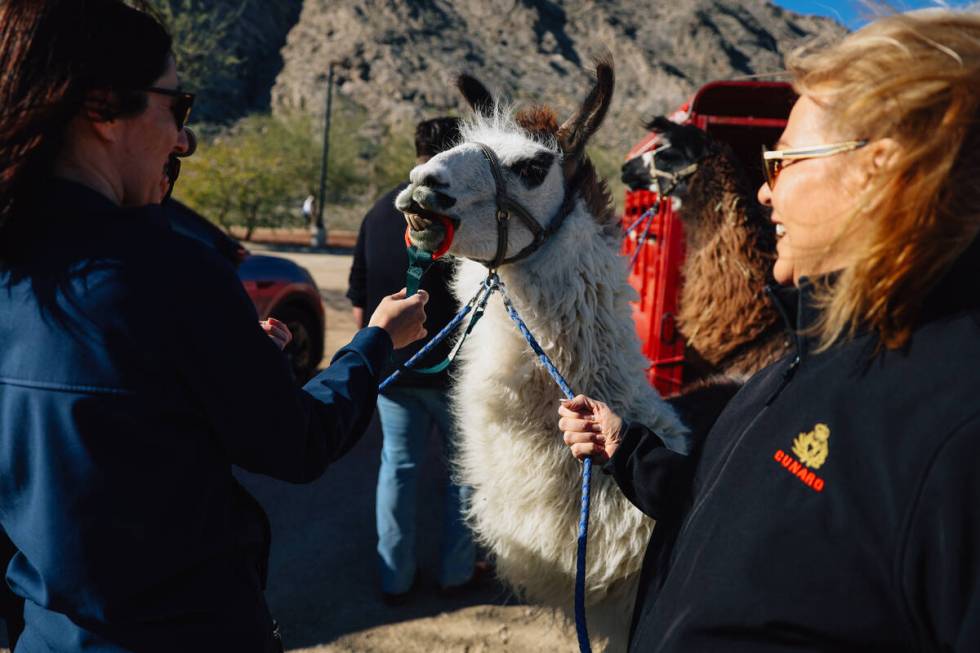
They’re otherwise used to the hustle and bustle on this trail. Not only from their experience on the walks, where they pause for treats and for the humans to trade llamas, but they’re not bothered by horses, people or dogs — just curious, keeping their long necks on a swivel.
Just as curious are the passersby.
“Holy s–t, is that a llama?” one group says. “Are those llamas or alpacas?” many ask. Nearly everyone stops to take photos or a video, and everyone is smiling.
“Bahama used to walk brides down the aisle at our previous wedding venue, so he’s used to the attention,” Jenni says.
While they’re the only llama owners of their kind in Las Vegas at the moment, Jenni acknowledged the rescued llama and alpaca at The Las Vegas Farm and Barn Buddies Sanctuary.
“We’ve been there a few times and really like their farmers market. All of their proceeds go back to the animals,” she says.
The late downtown visionary Tony Hsieh also loved llamas and alpacas. Two of them lived with him at his Airstream trailer community, “Llamapolis.” He used llamas frequently in the details of the Downtown Project, including the nicknaming of the “Llama Lot” at Fremont and 10th streets.
‘We adore it here’
Llamas are sensitive, empathetic animals. Hierarchy of the pack is key. And when it comes to who is in charge on a hike, size matters. Along the trail, which has various grades around the mountain, slopes change the perceived height of the llamas, and they’ll notice immediately by stopping and looking around.
“The tallest llama is the best llama, in their minds,” Jenni says. “So, Como was valuing the fact that at that peak right there, he was taller than both of the front two llamas. That’s why he stopped. And Dalai stopped, and looked at him … they’re talking with their ears silently. That’s how they communicate. And so they’re telling him with their ears, ‘Knock it off, little one, you’re not that hot.’ ”
For each pair guiding a llama via a handheld lead, the animal will lower or raise its head to match the walkers’ heights.
“It’s a sign of respect,” Tommy says.
They don’t vocalize much. “If they’re terrified of something and they need to alert their pack that there’s danger nearby, they do the llama alarm cry, and they scream at the top of their lungs,” Jenni says.
Llamas are fast, running up to 40 miles per hour in short bursts, but they prefer this strolling pace. The walks, while providing human education, also provide regular exercise for the animals in a more natural habitat.
The family has adjusted to Las Vegas just as well as the llamas.
“We adore it here,” Jenni says. “Las Vegas has a lot more entertainment, and it’s a lot more entertaining for them, too, because we’re going out more frequently, and it’s just been really fun.”
The joys of a dust bath
Locals have been their main customers, mostly people who already have an interest in the animals or are curious about them.
Sunni Cinelli, who participated in this Saturday stroll, is a family friend of the Brucatos. After the walk, she said it was “very calming.”
“I love learning about the different nuances of the llamas and all the little special features they have to protect themselves … (this is) a really great group event together and just get out of the city and do something different.”
At home after the outing, the herd enjoys bath time. The llamas, all about 400 pounds each, roll on the concrete in edible diatomaceous earth, a desiccant. Some folks use it to kill bugs in their homes, but for the llamas, it pulls moisture from their coat and keeps them clean. Think of a chinchilla’s dust bath, but with much larger mammals.
“They’re hearty animals,” Tommy says. Though they have a trusted local vet via Desert Pines Equine Center, the llamas don’t require much maintenance beyond a yearly exam. At home, they mostly lounge together and eat, and sleep only about two hours per day.
‘They make people really happy’
Tommy’s favorite part about owning llamas is the reaction other people have when they see them.
“They make people really happy,” Sharon adds. In 2012, she published “Llamas of ShangriLlama,” a children’s book about their llamas at the time, along with facts about the animals.
Jenni notes how calming they are.
“They’re so big, and usually if you see a big animal, and it’s like fear and kind of hesitance, but you see these guys, and they’re big, but they immediately just settle you. They’re calm. Never imagined seeing a California girl around 400-pound animals every day without getting stepped on, kicked or anything.”
She turns to the llamas, “You guys are just … you are perfect.”
After all these years, are they still Tommy’s favorite animal?
“Absolutely. They are just unlike every other creature,” he says.
The two-hour walks (Saturdays at 10 a.m., fall through early summer) cost $56.60, or $42.45 for Nevada residents. The llamas are also available for educational purposes, meet-and-greets, and other events such as weddings. ◆