
“I pictured myself like a cat walking around the city to explore. I lived at the top of a very tall hill, so every walk started with me descending. I would descend down into the city, and up and down through these hills at night. It gave me a whole new insight on the place I was living for the year, and I really wanted to get to know it.”
We’re talking about night walks in Istanbul with New York-via-Orlando artist Mär Martinez not because it is inherently fascinating — though it is — but because these wanderings, often in the company of a Turkish friend “talking and gossiping and daydreaming and bitching,” were time very well spent. These nightly perambulations provided inspiration and psychogeography for her exhibition of paintings, a loom, a fence, a wire, a thread, debuting in Maitland this week, with an opening reception on Friday night.
A loom, a fence, a wire, a thread, is, mind-bogglingly (we had to double-check with Martinez, so dubious were we) the emerging artist’s first solo exhibition in the city that she called home for many years. It is a sort of double homecoming for Martinez, both to her former hometown and a former creative home base at the Art & History Museums of Maitland. This institution once awarded her studio space — a priceless commodity for a practicing artist no matter where you live — as part of a multi-year residency that began in 2021.
“That was a gigantic milestone for me. At that time, because I had just graduated from the University of Central Florida, I suddenly lost my studio space because I was no longer in school,” Martinez says. “They essentially provided me an office where I was able to operate independently, and then also feel like I was a professional artist.”
The paintings that make up a loom, a fence, a wire, a thread were mostly created a long way from the Orlando area, though. This body of work was born from a Fulbright Scholar grant for the creative arts that took Martinez to Istanbul, Türkiye.
“I went abroad to create a body of new paintings. The project I had proposed was an investigation of the hand-weaving techniques that are seen in Turkish textiles,” she says. “I was living in Istanbul, and it was a challenging time. But a wonderful time.”
The earliest threads of this exhibition, however, go back far earlier than Martinez’s trip abroad for her Fulbright research. It stretches back to a lifelong fascination with the rugs her family took with them as they fled Syria for the United States — as both heirloom and for the intricate stitching and patterns.
During the pandemic lockdown, Martinez began to think more deeply about the history and migratory path of these rugs, both the journey to the United States and the “micro migrations” that are the footsteps of several successive generations of family. That interest led her to researching Turkish and Middle Eastern textiles, the commonalities between weaving techniques around the world and even new inspiration for her own paintings.
“Different regions are known for different types of patterning and weaving, but the mechanics of weaving are relatively unchanged,” she says. “It’s almost in this part of, like, the collective consciousness. Outside of the invention of the mechanized loom and chemical dyes, it’s been pretty constant. It’s an architecture of warp and weft, so it’s over, under, over, under.”
These paintings are bold and colorful, with soft human figures all asymmetrical and unpredictable curves and soft fleshy lines juxtaposed against the fateful and precise symmetry of barbed wire, fences, walls — indicating boundaries and separation, or perhaps hostility on the part of authorities — or the less foreboding gridwork inspired by weaving.
“I like a painting that is somewhat at odds with itself. We live in a complex world, and there are complex relationships,” she says. “With the razor wire, I was thinking about how it can sometimes mimic that inherent sensuality of the thread. There was all this spiraling wire that I saw when I was on my walks, and it made me think about these borders and barriers and barricades. They’re things used to protect, but also to restrict, and there’s a complicated relationship with that. With who’s on what side of the border.”
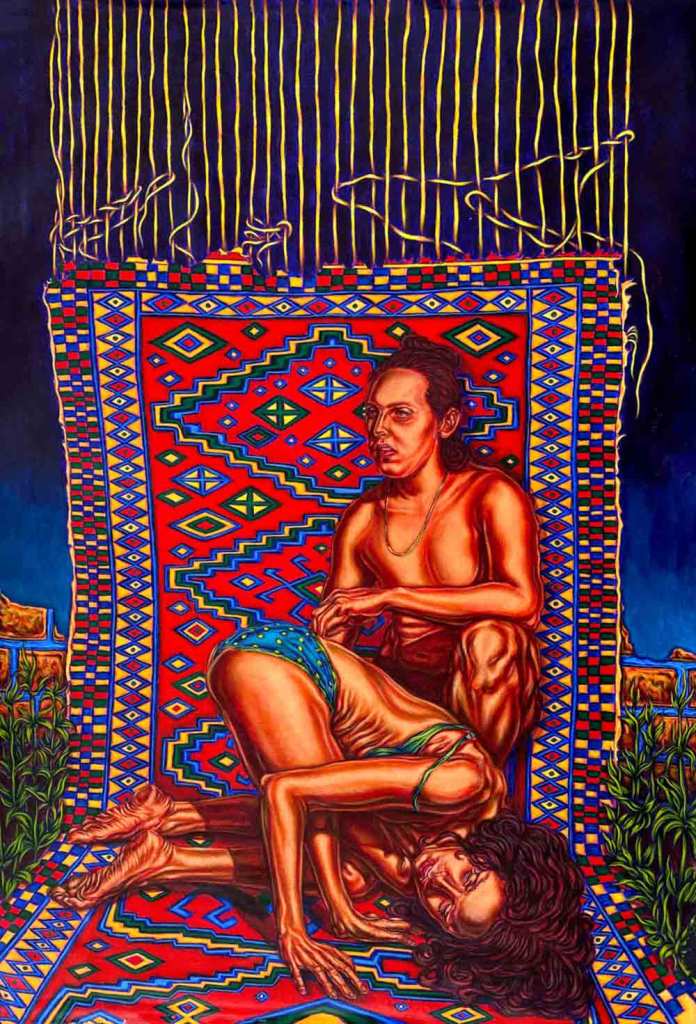
A highlight of the exhibition is “turning endlessly upon myself,” a painting of two golden figures crackling with solar energy — one folded uncomfortably in on themselves, one in an alert crouch — the two bodies blending into one another (interwoven, perhaps?), against the backdrop of a rug being woven (or unraveled) from top to bottom. Is it an ending, a beginning?
“I like the tension between the figures. There’s gender dynamics at play with weaving, especially in a contemporary sense,” she says. “The carpet is not fully woven. It is a story that is continuing. So you see it unfurled at the top. Or one could look at that as a disintegration, but I think it’s a great path of possibility. And with the figures, there’s often a strange body posturing in my work where it’s hard to discern what’s going on. Is it sexual? Is it playful? Is it aggressive? I like this uncertainty that’s between them, especially as one figure turns upon themselves.”
There are repeating color motifs in these paintings. Cool blues and purples, contrasted against loud, kinetic bright yellows and oranges and reds for the humans inhabiting these works. It’s a palette that dazzles and draws in the eye.
“I’m not a subtle person. I want things that are electric. I want to live in a world where there is beauty, even while there is tension. So my personal tastes tend toward the extreme, but I do feel like color is able to express a lot of emotions,” she says.
“It’s a kaleidoscopic experience. And I also want to say that the color choice specifically makes it feel mythic and communicates something that’s a little bit more archetypal. I’m not aiming for photorealism or representationalism. I want it to feel like it can transcend what it actually is, which is paint on a canvas.”
Orlando’s daily dose of what matters. Subscribe to The Daily Weekly.
Related Stories
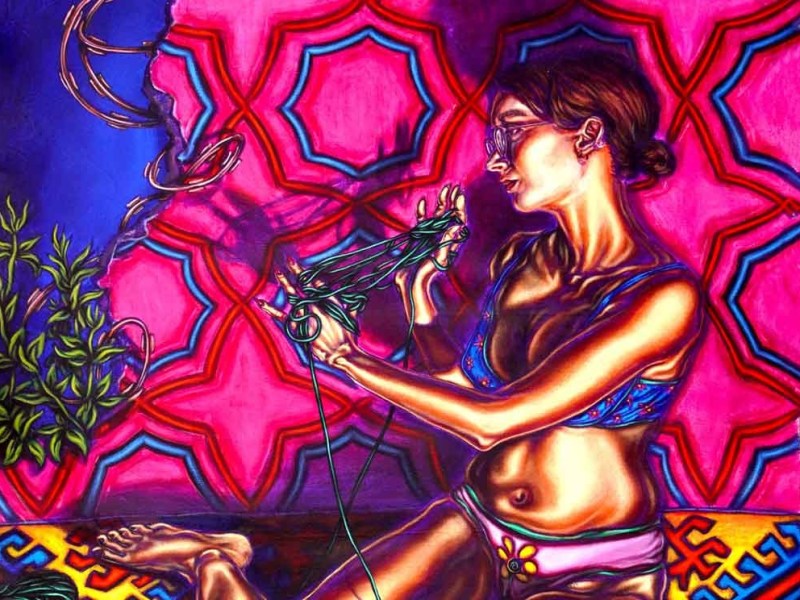
‘a loom, a fence, a wire, a thread’ is her first solo exhibition

The new troupe is founded by Charis Watler, whose personal, spiritual and socioeconomic odyssey is every bit as compelling as the play
The news comes as the project has faced questions about timing
Subscribe to Orlando Weekly newsletters.
Follow us: Apple News | Google News | NewsBreak | Reddit | Instagram | Facebook | Bluesky | Or sign up for our RSS Feed
This article appears in April 22-28, 2026.
Related
Source link