
Minnie Evans: Draw or Die | Monday, June 29, 1 and 7 p.m. | Chelsea Theater, Chapel Hill
Elizabeth Penton has vivid memories of visiting Airlie Gardens when she was growing up in Wilmington in the ’60s and ’70s—especially the moment of arrival.
From the wayback of her family’s station wagon, she could barely glimpse the ticket seller. But the vibrant drawings tacked all over the gatehouse seared themselves into her mind: intertwined human, animal, and botanical motifs, as lush and abundant as the azalea-laden grounds.
Inside was Minnie Evans, whose gatehouse atelier now stands in replica at Wilmington’s Cameron Art Museum. After more than 30 years as a domestic worker for the family that built Airlie, Evans started selling tickets there in 1948, when she was 56, until she retired in 1974. It’s where she made many of her complexly patterned drawings, often in crayon, which she would sell for less than a dollar or trade for services around town.
This was how many saw Evans—just a colorful local eccentric. Little did they know that her work was being shown in New York galleries and written about in folk art journals, or that in 1975 she would be one of the first Black women to have a major exhibit at the Whitney Museum of American Art.
“Some people in Wilmington looked askance at Minnie’s work and her obsession,” Penton said recently by phone. “They thought it was strange. These eyes are looking at you, and everything’s out of proportion. And maybe it frightened them on a religious level. But I had that connection formed as a child, so I always had a respect for Minnie’s work.”
Penton is tracking down and cataloging Evans’ pictures for a website and a book.
“They’re all over the place,” she said. “They’re in Europe, everywhere, and people are finding them in their attics. My goal is that future generations can see it, can study it, can appreciate this incredible legacy of an artist who channeled this great spiritual life.”
Penton is also one of the art professionals in Minnie Evans: Draw or Die, a new documentary by her friend Linda Royal, who has made several features since graduating from Duke’s Center for Documentary Studies. The documentary is screening at the Chelsea Theater on June 29, followed by a Q and A with one of the several great-grandchildren who appear in the film.
“It’s meant everything to me to have their support,” Royal said. “It was amazing at our premiere in Wilmington to have the entire front row filled with Evans family members and hear how some of the younger generation are doing their own art now.”
Like Penton, Royal had an unforgettable first encounter with Evans’ art.
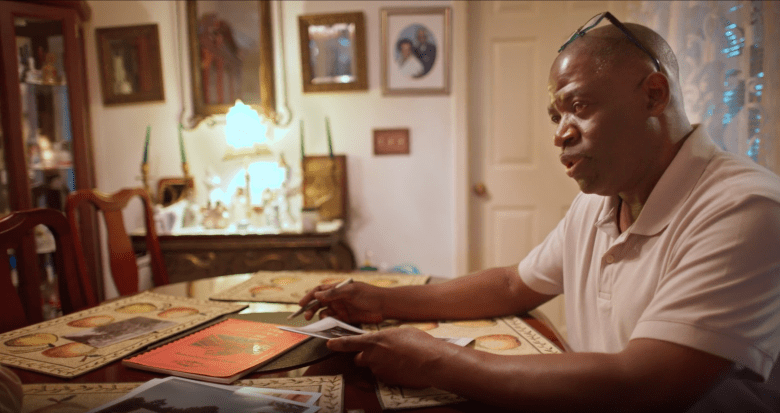
“I was getting married in Liz Penton’s home in Wilmington,” Royal said. “I was in her bedroom, putting on my wedding dress, when I noticed these incredible drawings on the walls.”
Evans’ style was inextricable from the intense dreams she had all her life. They were often Biblical or mythological in nature, and she felt that she was tapped into forgotten nations from before the Great Flood. Her drawings seem to combine many visionary traditions: the religious dreamscapes of William Blake, the divine geometry of mandalas and mosaics, the automatism of the surrealists, the floral heraldry of art nouveau.
But there’s no reason to suspect she was motivated by an interest in art history, except for that of her Trinidadian maternal heritage. Instead, her art seems to plumb a level deeper than influence, a universal intuition. When humanity peers into the infinite, in any era, these interlocking shapes are what it sees.
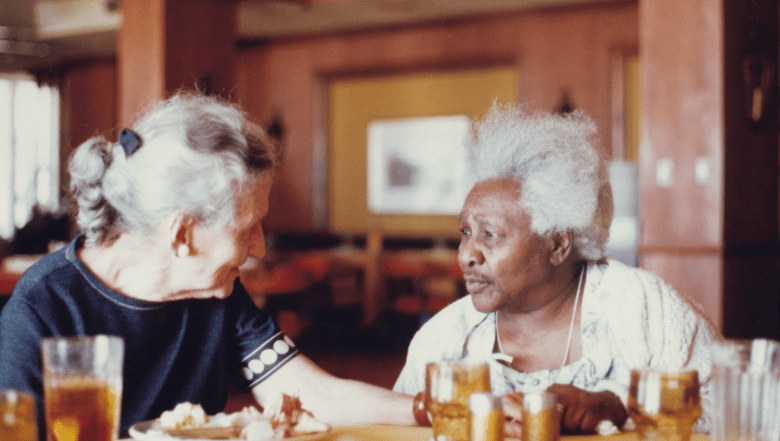
Royal’s moving documentary gives us Evans’ life in a series of prismatic facets, bookended by musical scenes at the Bottle Chapel that serves as her monument at Airlie Gardens.
Evans was born in 1892, her childhood marred by the Wilmington massacre, an infamous white supremacist coup. She grew up sounding oysters, absorbing the sunrises that would become one of her signature motifs. She married at 16 and soon had three sons.
She made her first two drawings, on the backs of shopping lists, around 1935, after her grandmother’s death. When she happened across them a few years later—she’d stuck them in a magazine—she heard a mysterious voice saying, “Why don’t you draw or die?”
From then on, she put her dreams into pictures compulsively. She would make as many as seven a day. In the documentary, one of her grandchildren remembers her drawing as a trancelike state. She didn’t always make it to church—her dialogue with the divine was more direct and more urgent.
Her dreams darkened after her mother’s death during World War II. Wilmington was a port city full of targets; German subs lurked along the North Carolina coast. She saw beautiful stars turning into falling bombs. In 1944, she visited a fortune teller who told her her drawings had predicted the war—and implied that they could end it.
In response, Evans made her landmark oil painting “Invasion Picture,” which is in the Ackland Art Museum’s collection, depicting the bombing of a river town full of massed eyes and piled skulls. Shortly afterward, the Battle of Normandy turned the tide for the Allies, deepening Evans’ connection between her art and prophecy.
Her first gallery exhibit was in Wilmington in 1961, but it was meeting photographer Nina Howell Starr the next year that introduced her to the art world. Starr was Evans’ conduit to New York galleries, academic journals, major museums, and private collections.
For Evans, she provided a measure of recognition and, late in life, financial relief. One picture from the ’80s shows her wearing a fabulous white fur coat in her wheelchair.
We want to elevate her voice
and ground her particular experience as a Southern Black woman raising grandchildren, making ends meet, in the midst
of world wars and the Civil Rights Movement, right here in
North Carolina.”Liz penton, art historian
But Starr also left something invaluable for us: a deep archive of recorded interviews, housed at the Smithsonian. It’s why we’re able to hear so much from Evans in her own words, though the only known footage of her comes from The Angel That Stands by Me: Minnie Evans’ Art, a 1983 documentary that’s incorporated into Draw or Die.
“Nina realized that Minnie was important and should be recorded,” Royal said. “She dedicated 25 years of her life to assisting Minnie with getting her art out there and getting the respect she deserved.”
The film joins a wave of renewed interest. The Lost World: The Art of Minnie Evans, the first major exhibit since the ’90s, recently closed at the High Museum of Art in Atlanta and moved to the Whitney this summer. After obscurity, then provisional success under labels like “outsider,” “self-taught,” and “vernacular,” Evans’ work is having a third life where its wondrous invention can be better seen.
“We don’t put people in those boxes anymore,” Penton said. “It lets all the air out of the fabulous inner tube coursing down these rapids of what they’re saying and who they are. We want to elevate her voice and ground her particular experience as a Southern Black woman raising grandchildren, making ends meet, in the midst of world wars and the Civil Rights Movement, right here in North Carolina.”
To comment on this story, email [email protected].