
Forever keeping a lookout for vital issues in the good old built environment to drag up into the light for you, esteemed reader, I cracked open my copy of this paper on a sunny July afternoon to find a curious item:
July 26, 2026: Cumberland County Jail inmate found dead in cell
“An inmate was found dead late Saturday night at Cumberland County Jail. Officers were doing routine rounds when they discovered the individual unresponsive in their cell just after 11 p.m., according to a press release from the Sheriff’s office ….”
So anonymous, so bland. With no name, no cause, no explanation, it barely qualified as a news item, and yet it seemed full of meaning. A few minutes in the Portland Press Herald archives unearthed several similar pieces, most equally blurry and sad, most related to premature deaths of men in the Cumberland County Jail, which serves Portland and much of southern Maine. In January 2023, the editorial board wrote: “For someone to die prematurely while incarcerated, a lot has to go wrong.”
How right. Young bodies accumulating in the same jail, despite the strict supervision and constant presence of professional medical assistance.
Though often unconfirmed, it is likely that many of these losses are suicides, acts of despair which often occur within the first week after arrest and incarceration. It is a stark national trend which bends sharply towards Caucasian men in jail, where suicide is a leading cause of death. The statistics are of course jarring:
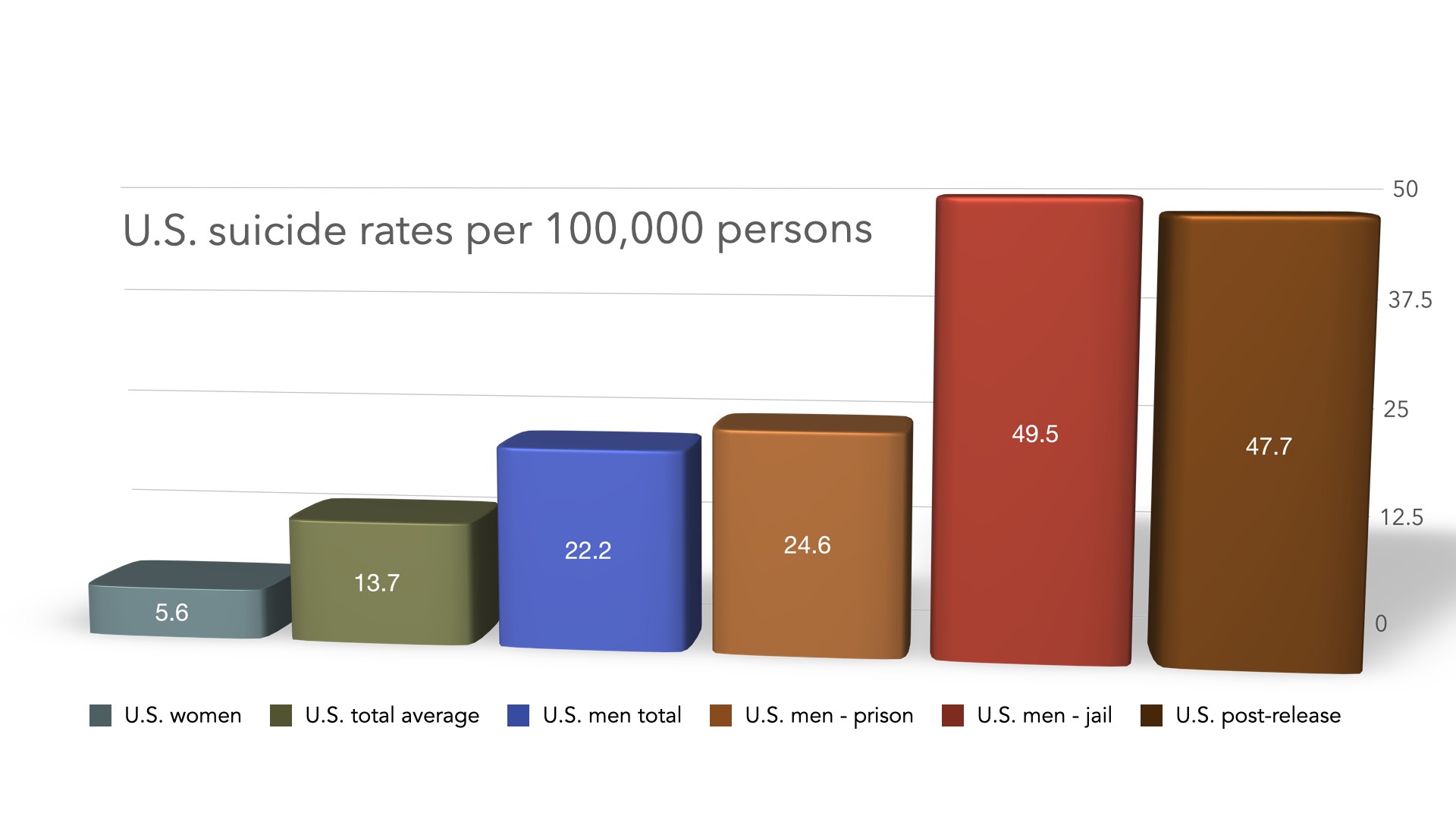
We are confronted with so many strange patterns. American men, overall, end their own lives so much more often than women do. Then, though the tendency is worsened by the prison environment (for convicted persons serving a specific sentence), it more than doubles for men in jail (for pre-trial detainees who have not yet been convicted). Common sense might have suggested it would have been the other way around.
Making a brutal situation worse, the high incidence of suicide seems to follow these men after their release from jail or prison, when suicide rates remain extremely elevated for an average of three years.
These spiked rates of excess mortality are amplified by absurdly high rates of overall incarceration in the United States – by the magnitude of the waves. Our fine, free, financially fit country keeps about 1.83 million people in jails and prisons at any given moment, the largest number in the world, and probably ever in human history. We hold 20% of all incarcerated people globally, though our population is just 5% of the world’s total.
In terms of capturing large portions of our civilian population, we are verifiable leaders; only El Salvador, Cuba, and Turkmenistan have higher incarceration rates per 100,000 – though of course their actual inmate populations are much smaller. Fourth in the world, beating tough competition from Rwanda and Turkey.
An innocent observer might assume that we have a terrific number of criminals, but in 2025, our crime rate ranked 60th internationally, just behind Costa Rica’s.
A better explanation is that we have a native enthusiasm for this particular form of punishment, a form that ruins lives permanently, wrecks families, and sends many men into needlessly desperate, one-way spirals of anxiety and shame. While 190 nations with lower incarceration rates have found other ways to cope with wrongdoers, we, true to our reputation for daring and inventiveness, charge gamely ahead in the opposite direction.
Which brings us back to those hard-to-understand deaths in the Cumberland County Jail. They are not hard to understand in relation to the trends and statistics, but they are a puzzle in terms of space, environment, and architecture.
It may be that the July 26 story in the Press Herald lacked details because jail officials deemed they would be incriminating; with all those guards, cameras, filters and security precautions in a structure designed for constant monitoring of human behavior, how is it that assault, rape, overdose and suicide can happen so frequently? Should it not be that the Cumberland County Jail, along with every other jail and prison in this country, is the last building in which such awful events could possibly occur? Yet we know these same buildings are exceedingly, reliably deadly, and that this danger is felt instantly upon contact.
Corrupted search protocols, official indifference, and weak legal mechanisms for inmate advocacy contribute to the problems. This whole awful raft of failures may be framed by an architecture of misery, a physical disaster script. One look is enough.
Space inside American jails is crowded, ugly, loud, harsh, volatile, low-budget, and chaotic. The simple shock of entry into this environment may help to explain why two-thirds of men who die by suicide in jail – persons who have yet to be tried, convicted or sentenced, who may well go free – occur within the first 30 days of incarceration, and more than 40 percent within the first week.
These spaces could be anything; they could take almost any shape, and their windows could look out onto anywhere. In many countries – ones with lower incarceration rates, higher post-incarceration rehabilitation rates, and much lower suicide rates – jails and prisons are designed to be modestly comfortable, pleasant, and calming; the punishment is understood to be the absence of liberty. Not so at the Cumberland County Jail:
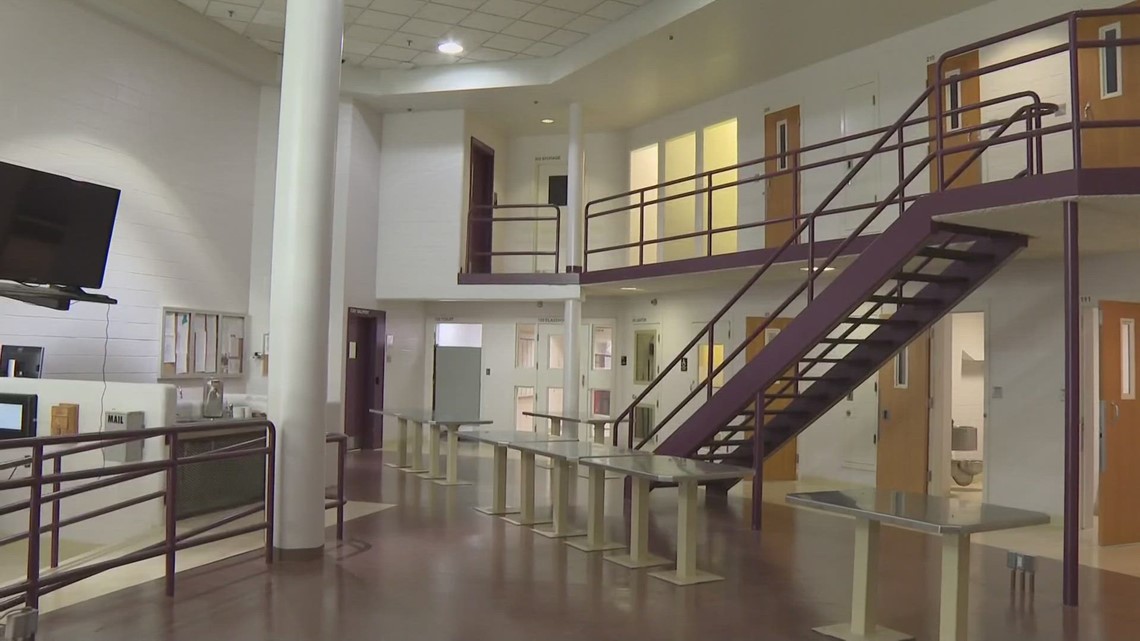
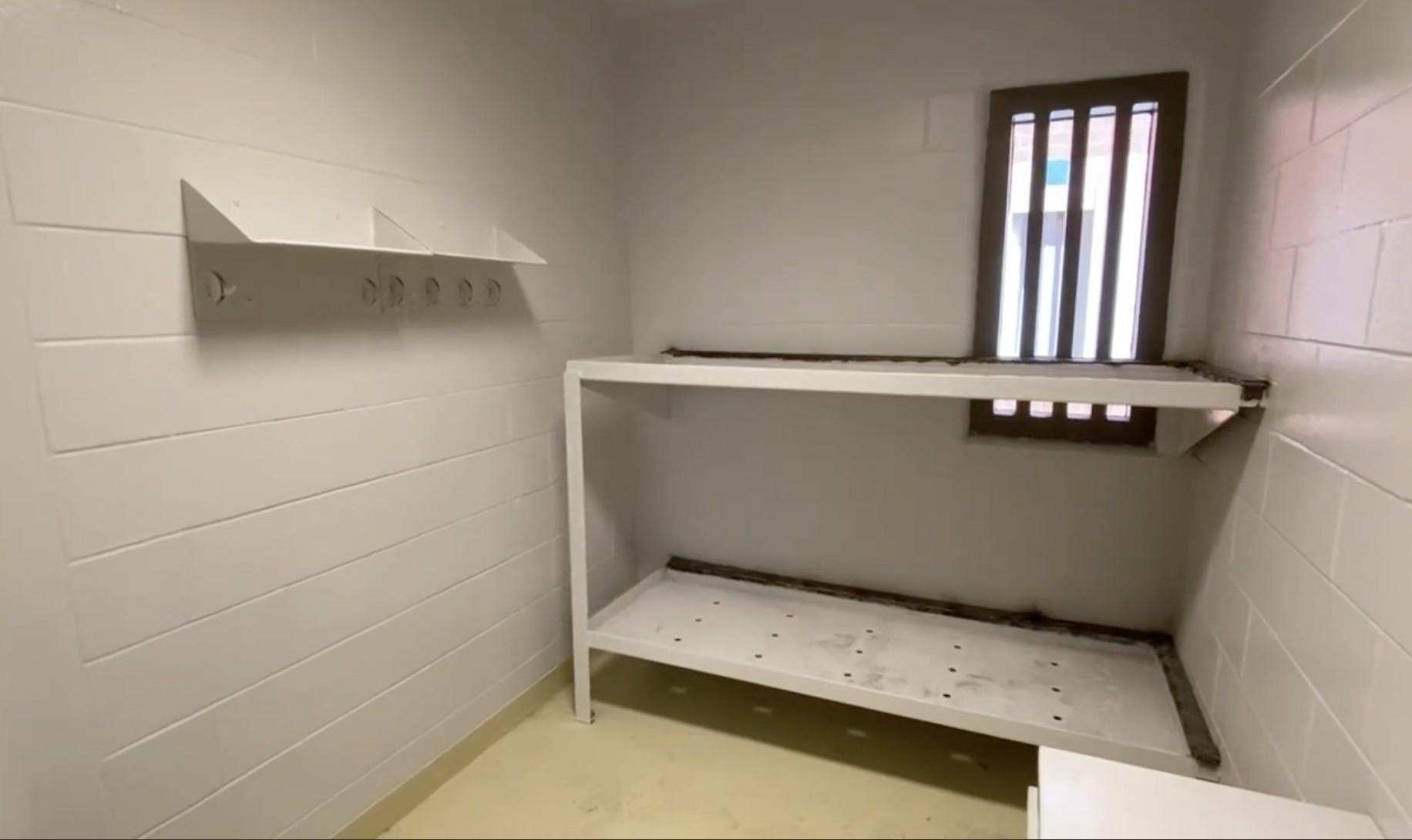
It would be difficult to find an architecture more purposefully miserable. Every square inch has been studied, scrutinized, and mercilessly fastened to some grim theory of human psychology. We must want it this way, like it this way.
There is little to admire inside these expensive, dreary structures, and much to dislike. But listing all the dehumanizing elements of a jail would require far more column inches than may be afforded here.
Instead, I hastily pull out a tape measure, which is not often known to lie under oath.
It is tragically simple to discover how much space is allotted to each inmate at the Cumberland County Jail, on average. That number is about 50 square feet…yes, five feet by ten, including bed and sink and toilet. If a single cell is doubled, the per capita space typically goes down to about 38 square feet each.
These dimensions in southern Maine are very close to the typical national figures, neither better nor worse. Though quite bad. Far below the legal minimums which apply to the rest of us. Maybe even intolerable.
In 1981, two inmates living in a cell of this size sued the government for relief based on the argument that such cramping ran foul of the 8th amendment to the Constitution, which prohibits “cruel and unusual” punishment in general, including any conditions which “involve the unnecessary and wanton infliction of pain.”
Lawyers for the plaintiffs in Rhodes v. Chapman pointed out that numerous formal studies of jail and prison conditions called for more space “to avoid serious mental, emotional, and physical deterioration.” The kind that can lead to severe distress.
They were successful with the lower courts, but their case was appealed all the way to the Supreme Court. (Bigger cell requirements would have imposed huge financial burdens on local and national prison budgets nationwide, so attention to the case was keen).
In the highest court in the land, the lower ruling in favor of better prison conditions was overturned, 8-1. The majority opinion stated that harsh physical conditions “are part of the penalty that criminals must pay” and argued feebly that structures “which house persons convicted of serious crimes cannot be free of discomfort.” With that ruling, they set back architectural reform of prisons by a generation or more.
In a future column, I’ll examine the human need for space, the downstream impacts of the regrettable Rhodes v. Chapman case, and some successful alternative incarceration designs discovered beyond our shores.
Jon Calame holds a master’s degree in historic preservation of architecture and is a Fellow of the American Academy in Rome. He currently teaches art history at the University of Southern Maine. This column is free to access through support by The Dorothea and Leo Rabkin Foundation.