
Of all the Durham galleries that have come and gone, the Carrack Modern Art holds a special place in my heart, and I’m sure many people would say the same.
Partly it’s because of the malleable moment that the Carrack was born into, in a creaky upstairs storefront on Parrish Street in 2011: a city in flux between revitalization and gentrification, a downtown riddled with empty space for artists to fill until prices climbed.
But mainly it’s because of how the Carrack met that moment. A volunteer-run community gallery that took no commission fees, it featured more than 1,000 artists and some 150 exhibits in less than a decade. For many, it was their first real show, or a steppingstone to the next level. The Carrack’s inclusive philosophy, busy social calendar, and embrace of performing arts like dance and poetry bred a rare vitality. It was the place to be on Third Friday art walks. Both anchor and lightning rod, it gave a developing art scene a place to figure itself out.
Saba Taj will tell you. Today her CV lists dozens of exhibitions, honors, and residencies. But when she first met Carrack director Laura Ritchie 15 years ago, Taj was toting around burned CDs of her paintings, feeling at the latches of the art world.
“Having a solo show at the Carrack was a big step in my career and in entering the Durham art scene, which felt both tight-knit and big to me,” Taj said by phone from her home in Chapel Hill. “The work I was creating got bigger because of the comfort I had with that space and with Laura, who I trust as a whole human. It just feels like a big part of my story.”
Not only did Taj become a Carrack regular, but when Ritchie chose to step down in 2018, Taj stepped up, running the space with the artist-activist collective Durham Artists Movement. By then the magic window had closed; the Carrack had left the heart of downtown for a building near Golden Belt in 2016, when a countywide revaluation raised property prices by almost 10%.
“Even really gracious landlords were suddenly looking at much higher bills, so a model like the Carrack didn’t work in the new Durham,” Ritchie said. The gallery closed in 2019.
But its legacy will resume this fall, when Taj becomes the first artist to have a solo exhibit at Boardinghouse Arts, opening on Trinity Avenue in September. It represents Ritchie’s return to a public role in art after eight years away, this time partnered with her wife, Shirlette Ammons, the widely celebrated poet, musician, and Peabody-winning producer.
In fact, all four of the currently scheduled exhibits come from Carrack staples, casting a warm glow of continuity over the endeavor. But like the Carrack, Boardinghouse Arts is trying to meet Durham where it is now—meaning that in some ways, it won’t be like the Carrack at all.
On a tour of the big, cheery pink box at 703 West Trinity Ave., Ritchie is bouncing on her heels. Sure, she’s excited about the impending opening, five years in the making.
But really it’s because she’s cradling May, whom Ammons keeps cooing over midsentence. Their 3-month-old daughter smiles sleepily for a little while and then promptly conks out while we explore the three levels of the building. The basement will contain a surprising thing to find in an art gallery—a recording studio.
“This is basically my domain,” Ammons said, stepping into a concrete hallway where soundproof doors divide recording spaces from an open live room, with plans for a speakeasy in one corner.
“It’s quaint, but it’ll be, for lack of a better word, boutique,” said Ammons, who is designing the studio in consultation with pros like Chris Boerner, of Hiss Golden Messenger and Sound Pure Studios. “Everything will be hand-selected, from synths to high-end mics. Our goal ultimately is to do music education and make this available to people who don’t have the bread to pay $500 a day at a big-name studio.”
Ammons also wants it to be used as a listening room, and for poetry readings, and for recording podcasts, a world she ventured into with Tending via the Southern Foodways Alliance, exploring USDA discrimination against Black farmers. She hopes to inaugurate the studio with her next album, the follow-up to 2024’s acclaimed Spectacles. (“Lord willing, the creek don’t rise, that’s the idea,” she said.)
The top floor, connected by an elevator and a metal stairway that winds upward through a spacious, newly built balcony, contains 10 studios for rent to all kinds of creative professionals, from artists to architects. These will not only provide a steady revenue stream but also infuse Boardinghouse with another layer of life.
“There’s space for performances that originate in the basement to happen up in the gallery, or artists working upstairs to access audio equipment in the basement,” Ritchie said. “We’re hoping that there’s a lot of blending happening across the three floors.”
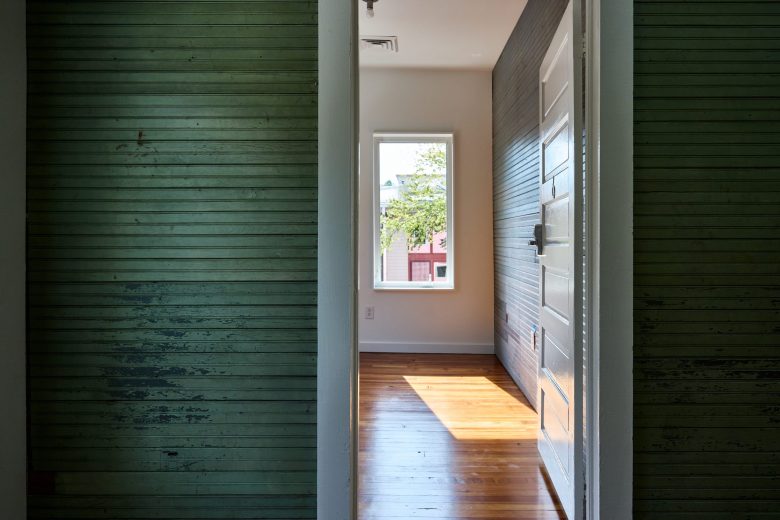
The gallery is on the main floor, where big picture windows are framed in colorful stripes of reclaimed wood and the expected pressed tin ceiling stretches above white walls. The century-old building originally had a grocery downstairs and a boardinghouse upstairs, furnishing the gallery’s name.
“We liked the idea of a place where people from different backgrounds, working in different disciplines, can find home and come together and collaborate, to historically gather around a table,” Ritchie said.
The building has been vacant for decades. Ammons and Ritchie bought it in 2021 and began renovations with architect Morgan Strider Haynes. It was a COVID project: Ritchie had finished her Duke master’s degree in liberal studies, with a focus on artist communities and gentrification, and Ammons’ gig work had dried up.
“We were like, if the world is going to end, let’s go down building,” Ritchie said. “Let’s build the thing we can uniquely build, try to make the life that we want, and provide the resource we’ve been advocating for.”
They thought they could open in a year, but “God willed and the creek rose,” as Ammons said. When they had the basement dug out, they knew the site was built on contaminated soil, but they didn’t realize the extent of the excavation they faced. Every time the pit filled up with rain, they had to pay to have the water pumped out and trucked away, in order not to pollute surrounding areas.
“We safely removed over 568 tons of soil and 42,855 gallons of contaminated water,” Ritchie said. That alone ate up a year. But this was about doing things right—about laying the foundation for something that would last.
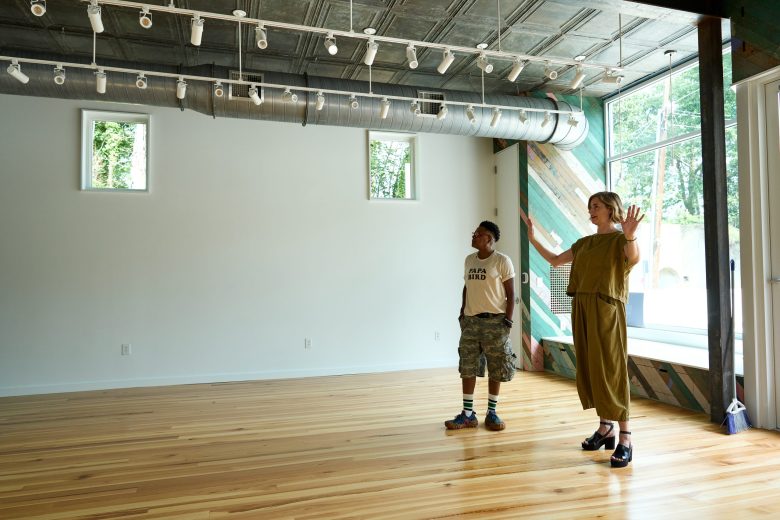
Boardinghouse Arts opens on September 19 with national hip-hop and performance artist Mykki Blanco as DJ, an example of the possibilities bred by Ammons’ music connections. The premiere exhibit will be drawn from Ritchie and Ammons’ personal collection, representing artists likely to have solo shows in the future.
“Just to seed the culture of collecting, and to introduce ourselves to the community,” Ritchie explained. “Saying, look, this is the kind of work we’ve already invested in.”
Taj’s show will follow in late October. Taj is known for large, iconic-looking paintings that blend figurative and surrealist imagery at the nexus of Islam, femininity, and queer expression. But she says her new work, which we’ll see at Boardinghouse, is probing into subtler, more open-ended terrain. She’s still developing her exhibit but expects its loose theme to be memoir and memory in the digital age.
“I started out really telling stories in a very legible language,” Taj said. “A Muslim woman with a hijab is pretty like, OK, I know what we’re talking about. Over time, it feels to me that I can tell a true story if it’s not static, if it remains in motion, if it’s not fully clear-cut.”
Next will be a duo show by interdisciplinary artists Antoine Williams and Meg Stein, both Carrack regulars; Stein is also connected to Taj and Ritchie through the social justice-focused activist group Art Ain’t Innocent. Then comes New York’s Gracelee Lawrence, a favorite of Ritchie’s from the old days.
That fills the calendar through May, because unlike the Carrack’s rapid two-week turnover, Boardinghouse shows will last six to eight weeks.
“That comes from asking artists in the community,” Ritchie says. “People I worked with at the Carrack who 10 years later are showing outside of Durham, making their way into museum collections, and people aspiring to that.”
And unlike the Carrack, Boardinghouse will take commission fees, providing services in return: writing, pricing, installation, and the like.
“The Carrack was never set up as a financially viable business, and artists were expected to do all the work,” Ritchie said. “It worked for as long as it did because there were a ton of people who believed deeply in it. Here, I do think it makes sense for us to be mutually invested in financial success, as well as emotionally and spiritually.”
Taj remembers the freedom and nurturing that came with the Carrack, but also the overwhelming labor of staging shows in addition to making art. If the Carrack helped a generation of artists find their footing, Boardinghouse aims to help those same artists take the next step.
“We need people in the artistic ecosystem not trying to extract from artists but to support them with the same vigor they’re putting into their work,” Taj said. “The longer exhibits are going to give more people time to come out, and it feels good for there to be a high but not unreachable bar for artists.”
As Ritchie and Taj both point out, Durham artists are nothing if not resourceful, and the Carrack spirit has lived on in places like perfect lovers, Shadowbox Studio, PS37 (now BOOM Club), and NorthStar Church of the Arts. And the city has fine exhibition spaces like Ella West Gallery, which happens to be currently undergoing its own exodus from Parrish Street. “We have some great spaces, and we need more,” Ritchie said. After serving as the Carrack’s self-effacing steward, she’s keen to take on a more direct curatorial role. She’s earned it.
“I feel like I have something to say,” she conceded. “There will be times when we open it up and do wild floor-to-ceiling community shows, and I also plan to invite in guest curators. But I’m excited to be the creative leader of this exhibition center. I hope it creates a place for community the way the Carrack did—and we’ll still have a lower-end commission rate, just because that’s how we roll.”
So Boardinghouse is not the Carrack in that it’s built to last. “Me and Laura have been part of the arts community in Durham for decades, and we have this little one now,” Ammons said, peeking down at May. “So this is just our way of putting down roots in a place that’s just nurtured us so much.”
“Because this is the community that raised us,” Ritchie added.
To comment on this story, email [email protected].