
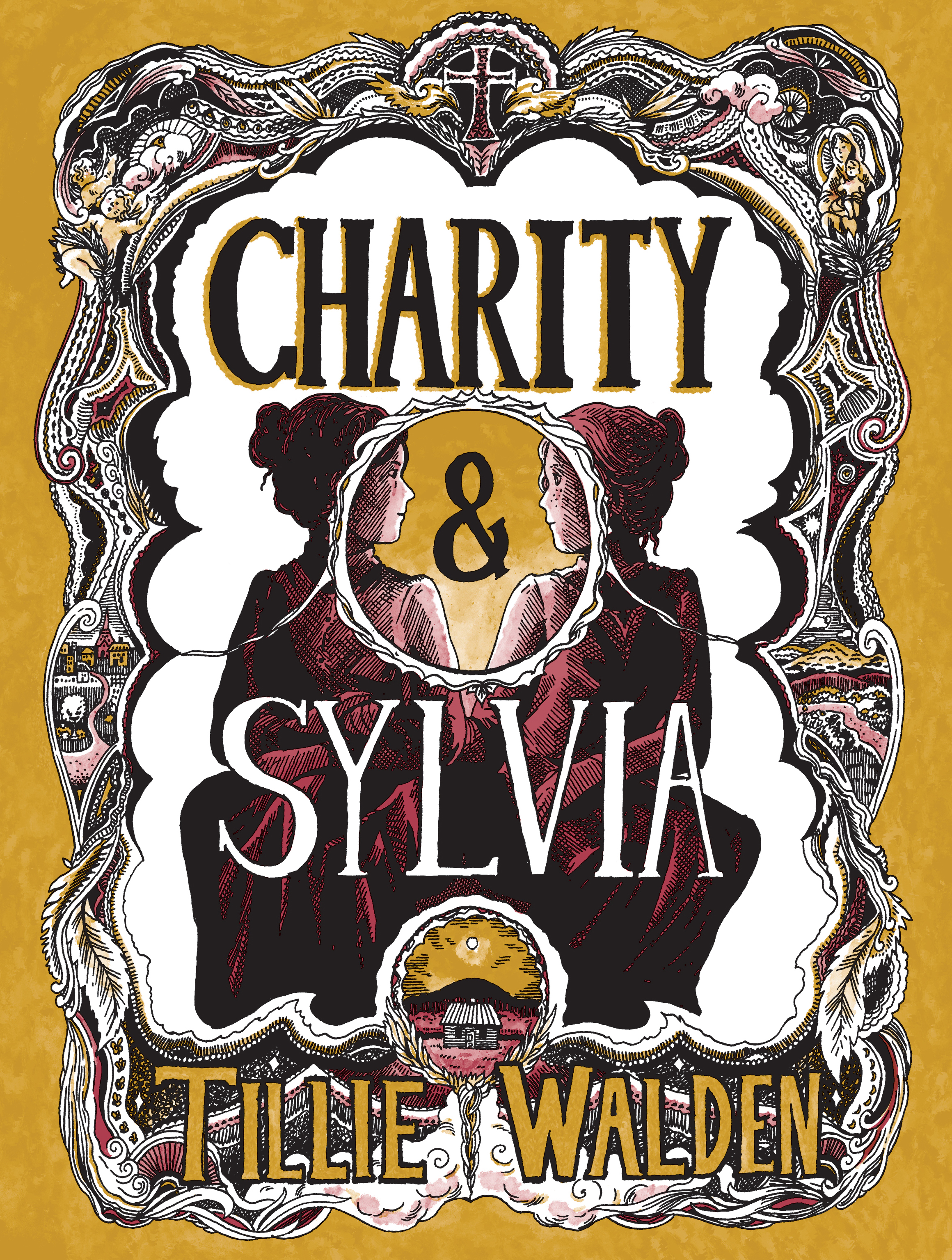
During queer graphic novelist Tillie Walden’s tenure as cartoonist laureate of Vermont, she encountered a story close to home, set centuries before. The account of openly gay Charity Bryant and Sylvia Drake, who lived in Weybridge, Vermont in the 18th and 19th centuries, is a tale of two women who did not fit neatly within the lines drawn up by society. They built a home together at a time when women could not own property, and started a successful tailoring business allowing them to live with independence and authenticity.
Through the sepia tones of Walden’s prolific pen, “Charity & Sylvia” transforms the silhouettes of two lives framed by historical archives into living, breathing neighbors, elders and lovers on the page.
‘Charity & Sylvia’ takes place during the early years of the United States, surrounded by revolution and conflict. How does their life together fit in with these other rebellions?
I think their life was a very quiet, very subtle rebellion compared to those around them. While Charity and Sylvia were different from their Vermont neighbors — they were lesbians — they never experienced discrimination to the degree of, say, the indigenous people who lived on the land before them. But this is what’s so interesting to me about American history, and why I loved writing about it. All the violence, complexities and small victories are contained together. Charity and Sylvia achieved something grand and historic, even if it was quiet.
Charity and Sylvia wrote extensively — you mention reading over 900 of their letters. What was your guide in giving voice to their history?
The archive at the Henry Sheldon Museum held my hand while I walked through the past. There was an enormous amount to read and I tried to sift through the archive with little judgment about where the story should lead. Ultimately my guide was Sylvia. Her journals gave me the most evocative and descriptive information about their lives, but it was painful to know that what I was seeing was only part of the story. The truth of their life together is something that only they knew. This book is my attempt at interpreting that truth.
There were also many other resources that helped. Rachel Hope Cleves wrote a wonderful book about them. I also read a lot of the fiction of the era to try and inhabit the language of the time, like “Pamela” by Samuel Richardson.
Sylvia grapples with her faith throughout her life, struggling to reconcile her relationship with Charity with her religion. Did her thinking evolve? How did you come to the line, ‘If you are to go to hell then I should like to come with you’?
Ah, I forgot about that line. I like that line! I don’t have an exact timeline of their faith journey. I have blips, moments. I have an excessive amount of information from the 1820s and 30s but little from later decades. Most of what I read in Sylvia’s journal is a record of shame. She clearly felt conflicted about her queerness. But the fact is, despite the shame, they lived 44 years together. They never left each other’s side. That tells me that clearly there was some other force holding them together, one fighting back against feelings of sin and shame.

How did you organize the narrative?
I was baffled at the start with how to structure the book and went through a few different versions. I’m drawn to flashes of memories but I had to ground the story to make it work for readers. I hacked it mostly by drawing in a very free-form way with a lot of loose pages scattered all around me. While drafting, I was still going to the archive every week, so the two started working together. To be honest, I had no idea if it was going to work. It was only when I started inking the final pages that I felt like I had done something interesting.
You often play with negative space on the page. Were gaps in the archives telling to you as you drafted?
Oh yes, absolutely. The gaps were riveting. I was just as moved by what I knew as what I didn’t. Sylvia was very coy with me in her journal, and would often drop a bomb, like she did when she wrote, “Charity says we should never know one another’s true thoughts.” Like, excuse me? Go on! But then she didn’t — she just stopped, moved on to talking about church and neighbors and tailoring. The gaps were visual too. I had to find ways to fill in drawings when I had no idea what was actually there. I ended up leaning a lot on logic: the materials they had, what was likely available, what was similar to what I already knew. I drew a lot of logs.

Many of Charity and Sylvia’s struggles and successes are familiar to LGBTQ+ people and other marginalized folks living today. 250 years later, how do you hope this book speaks to the contemporary queer experience?
I hope it expresses that truth about history — that every time, every era that people have experienced, was once the present. None of us start out as the past, it’s something we become even when we’re not ready. I hope the book helps people think about history, and about how varied queer lives are. Charity and Sylvia were conservative, devout women. They were lovely people and also prejudiced people. Part of what I’m proudest of in telling this story is being able to share that complexity; to get to the end of their lives and ask the question — what do they deserve? What do any of us deserve?
Rylan Hynes is a queer transgender writer living in central Maine. Their debut novel, “Grafting,” was published by Islandport Press in 2026.