
On the campaign trail, gubernatorial candidate Amanda Janoo begins every town hall the same way: “What are you most proud of in your community?” she asks the crowd.
Hands rise slowly at first. More shoot up after someone breaks the ice.
People praise their local libraries and general stores. They talk about the generosity of their neighbors and the strength of their schools. They describe community suppers that bring people together and homegrown initiatives that improve their town’s energy efficiency or provide clothing to those in need.
As they share, Janoo scrawls vigorously in a notebook, occasionally chiming in.
At a basic level, the exchange imbues the room with a warm and fuzzy feeling. It also introduces a core tenet of Janoo’s political philosophy: Policy makers should build upon the strengths, resources and ideas that already exist within communities rather than focusing on what they lack.
Or, as Janoo often says, “Together, we have everything we need.”
It’s an oversimplified statement, as any campaign tagline is. But Janoo’s message is clearly resonating with voters. Since she announced her candidacy for governor in March, the 39-year-old economist has traversed the state to share her vision for Vermont with citizens of all stripes. Thousands have shown up — at coffee shops and senior centers, barns and auditoriums — to hear her ideas about universal primary care, bottom-up decision-making, and why the state needs to fight back against corporate and private-equity ownership of Vermont’s housing stock, which disadvantages everyday people.
Janoo’s campaign has tapped into the zeitgeist by expounding a populist message that reflects many Vermonters’ disgust with the administration of President Donald Trump, frustration about the cost of living and fear of artificial intelligence. A large contingent of volunteers has coalesced around the first-time candidate, knocking on doors, phone banking and tabling at local events. In just a few months, Janoo has transformed from a political unknown into perhaps the most formidable challenger Republican Gov. Phil Scott has faced since he first ran for governor a decade ago.
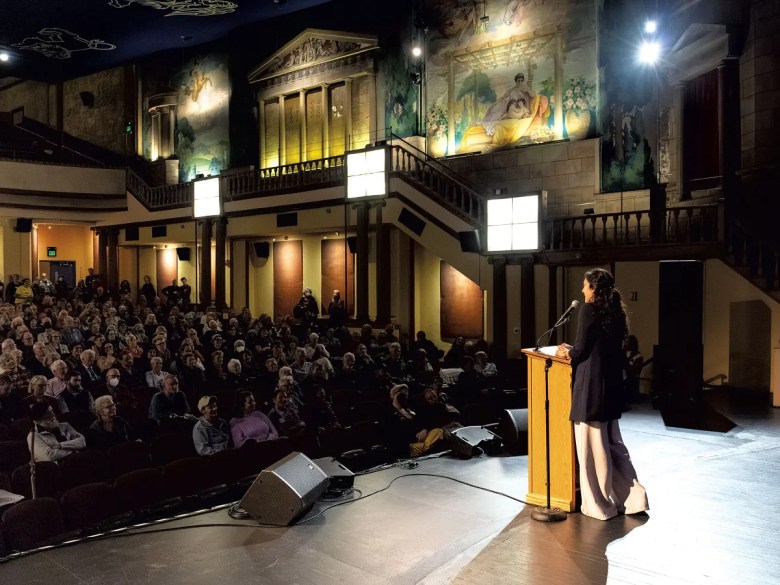
In August, Janoo won a competitive, though friendly, Democratic primary against Aly Richards, a well-connected childcare advocate with a fundraising advantage. In the months since, Janoo has drawn increasingly larger crowds at community gatherings across the state. Recent polling has found that she’s within striking distance of Scott, one of the country’s most popular governors. In September, Janoo outraised the incumbent; many of her contributions came from small-dollar donors.
Last week, just as ballots were mailed to voters, Vermont’s senior senator, independent Bernie Sanders, endorsed Janoo in a three-minute video message. She has “the energy and the leadership qualities we need right now to become a great governor,” Sanders said, praising her ideas about health care, housing and AI. U.S. Sen. Peter Welch (D-Vt.) and U.S. Rep. Becca Balint (D-Vt.) have also thrown their support behind Janoo.
Her apparent strength presents a new challenge for Scott, who trounced his Democratic opponents in four previous reelection campaigns. The former construction company owner and stock car racer from Barre has earned a reputation as a moderate Republican who steered Vermont through some of its toughest times. He earned praise for signing modest gun-control legislation in 2018, as well as for his calm, consistent leadership during the COVID-19 pandemic and catastrophic flooding in 2023 and 2024. He’s spoken out against the Trump administration and revealed that he voted for Democrats in the past two presidential elections.
But the shine may be wearing off. Fewer than half of residents approve of the job he’s doing, according to recent polls from the University of New Hampshire and Vermont Public — ratings that are well below those of previous surveys. He’s alienated many with his plan to transform education by consolidating districts and giving the state more control over school spending. And he picked a battle with Vermont’s public-sector employee union, which represents nearly 6,000 workers, by demanding that they return to the office for at least three days a week. He’s seeking a sixth term during a midterm election in which Republicans around the country are bracing for a Democratic wave that could shift the balance of power at the state and federal levels.
That bodes well for Janoo, who has no public record to pick apart, providing little fodder for her opponent. Scott, by contrast, has served in public office since 2001, when Janoo was just 14 years old. So far, the respective camps have waged a relatively polite, issues-oriented race.
Scott undoubtedly has a huge name-recognition advantage, but he’s “not riding as high as in past cycles,” said Bert Johnson, a political science professor at Middlebury College. Johnson predicted that Janoo’s campaign will benefit from “this jubilant left-wing energy out there.”
The governor’s campaigning has been subdued. He’s declined to participate in several gubernatorial forums, though he still plans to go head-to-head with Janoo in three televised debates in the weeks before Election Day. He hasn’t announced any public campaign events, save for a few honk and waves. His social media account shows him mingling with locals at fall festivals, apple orchards and a car show.
All the while, the governor’s message has stayed consistent. He’s positioned himself as a rare breed of moderate Republican, a check on the excesses of a Democrat-controlled legislature and a champion of affordability before that term was a buzzword. He avoids the culture wars and espouses civility. Janoo, he asserts, would raise taxes, drive the wealthy out of the state, and make Vermont less hospitable for working people and businesses.
Scott “has proven when he has the right partners in the legislature, he can get things done,” Vermont Republican Party chair Paul Dame said. “Amanda Janoo is a lot of theory right now and not a lot of experience.”
As Election Day draws near, Seven Days sought to find out more about Janoo, watching her on the campaign trail and speaking with family, friends and colleagues. Here’s what we learned about the political newcomer.
Who’s Janoo?
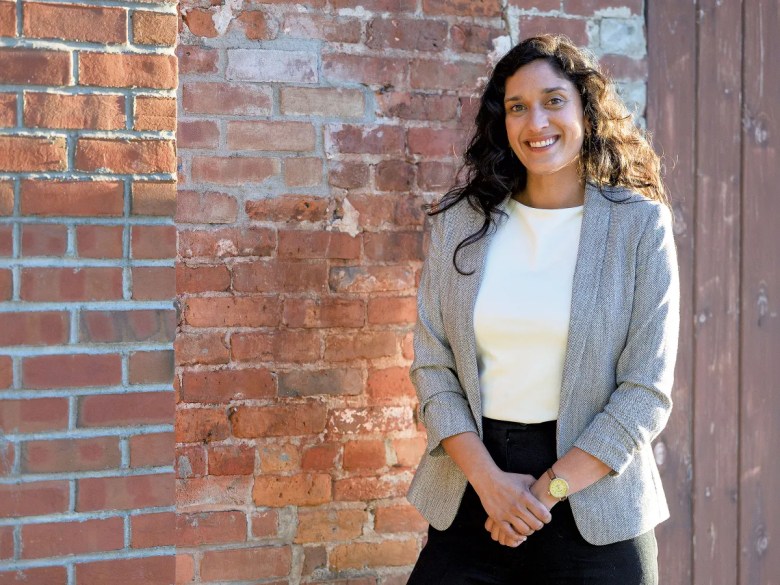
Long before Amanda Janoo was a candidate for governor, she was Mandy — the daughter of a Maine native named Judith and Vincent, an immigrant of South Indian descent born and raised in Malaysia.
In the late 1980s, Vincent took a job with the U.S. Army Corps of Engineers at its laboratory in Hanover, N.H. The couple, who were expecting their third child, moved from Alabama to the Upper Valley. A midwife delivered Amanda in a small home the family rented on a Norwich farm.
When Janoo was a toddler, her family moved to Strafford, a town that she describes on the campaign trail as “half back-to-the-land hippies and half old-school, ninth-generation Vermonters.” Her mom homeschooled her through sixth grade, an arrangement Judith said afforded the family the freedom to accompany Vincent on work trips. Janoo recalls volunteering during that time, serving community lunches to senior citizens and ushering at Northern Stage theater so her family members could attend performances for free. Her parents brought their kids to Town Meeting Day, which Janoo credits with teaching her about democracy and the importance of local decision-making.
Janoo’s sister, Angela, a middle-school special educator in Hartford, remembers her younger sibling as “an observer” who took things in and listened more than she spoke.
“She was very shy,” Angela recalled. “She used to hide behind me when people would come up and talk to her.”
Janoo attended Hanover High School in New Hampshire, a public school, where she participated in Model United Nations and “hung out in the art room a lot,” she said. During her junior year, she spent a semester in a village in the Indian Himalayas as part of a cultural exchange program offered through Sharon Academy.
That experience, Janoo said, was “one of those sliding-door moments” when she realized she was interested in learning more about economic development around the world.
Lara Avery met Janoo at the start of their first year at Macalester College, a liberal arts school in Saint Paul, Minn.
“She had the coolest leather jacket on … and these Converse sneakers and ripped jeans,” Avery said. “Since the first day I met her, she’s always been talking about the economy. She’s always been interested in why it works the way it does.”
Avery remembers Janoo as “extremely studious,” at times sequestering herself in the computer lab surrounded by piles of books. Yet Janoo also liked to spend hours talking with friends “about the economy and feminism and things that we’d read that day in class,” Avery recalled.
Janoo was a huge booster for the state of Vermont, Avery said — even telling her that she hoped to be governor one day. She talked up maple creemees and general stores, the idyllic summers and lack of billboards. Janoo was so persuasive that Avery and another friend took a cross-country road trip to visit Janoo in the Green Mountain State after their first year of college so they could see the “utopia” for themselves.
The community-centered nature of Janoo’s campaign — engaging in authentic conversations with people around the state at farm picnics and live-music events — is a true reflection of who Janoo is, Avery said.
“Gathering people together to talk about ideas and have a beer,” Avery said, “that is Mandy to a T.”
Janoo now works as a self-employed economic policy consultant and rents a modest apartment near Burlington’s waterfront.
Childhood best friend Johanna Matson described Janoo as a “Vermont girl” who knits and cross-stitches, loves puzzles and crosswords, mends her own clothes and shops at thrift stores, not on Amazon.
“She’s one of those people who walks the walk,” Matson said.
A Different Kind of Leader
Janoo has never served as a chief executive, the role she’d have if elected to the state’s highest office. The bulk of her professional work has been behind the scenes, using her economic expertise to help governments and organizations around the world develop policy in service of people and the environment.
Oleksandr Chernykh, who served as state secretary of Ukraine’s Ministry of Economy, worked with a team that included Janoo in 2017 to develop the country’s economic development strategy. Those efforts “helped make Ukraine’s economy and energy system more resilient, which became especially important after Russia’s full-scale invasion in 2022,” Chernykh wrote in an email to Seven Days.
He praised Janoo’s “systematic way of thinking” and her “strong ability to see the connection between a cause and a problem, and then between a problem and a practical solution.”
Colin Robinson collaborated with Janoo on Fair Share for Vermont, a campaign launched in 2023 that has lobbied the legislature, unsuccessfully so far, to increase taxes on top-income earners to reduce cost burdens on low- and middle-income families. The idea shows up in Janoo’s policy platform as a way to pay for universal primary care.
“She really has an ability to distill complex issues into understandable and relatable solutions … in a way that feels accessible to folks who might not be steeped in the wonky world of policy,” said Robinson, the political director for the Vermont-National Education Association.
After graduating from Macalester in 2010, Janoo received a Fulbright scholarship to research the women’s labor movement in India. While there, she reached out to a University of Cambridge professor, Ha-Joon Chang, to ask about an article he’d authored. Several years later, she was accepted into a development studies master’s program at Cambridge, where she focused on a branch of economics known as industrial policy. Chang called Janoo one of his “standout students.”
In broad strokes, Chang explained in an interview, industrial policy posits that governments must proactively support and promote specific industries in service of their goals, rather than leaving that to market forces. The policy was a strategy in the government toolbox through the 1970s but fell out of favor in the following decades as the pendulum swung toward unfettered free-market capitalism. Industrial policy has experienced a resurgence in recent years, though, “because this free-market vision has failed to deliver,” Chang said.
Janoo often hammers home its tenets during campaign events.
“For the last 40 years or so … we’ve been told that if we cut taxes at the top, if we deregulate industries, if we weaken unions and give large corporations, investors and tech entrepreneurs more and more freedom, that wealth and prosperity … would all trickle back down to us, right?” Janoo told people at Burlington’s Foam Brewers in September. “And, to be fair, the economy has grown, and the stock market is doing great, but the gains are really only benefiting the top 10 percent, while the rest of us are left continuously worse off.”
The economy has grown, and the stock market is doing great, but the gains are really only benefiting the top 10 percent, while the rest of us are left continuously worse off.
amanda Janoo
Fresh from graduate school, Janoo worked with the United Nations Industrial Development Organization to help countries assess their economic policies. Philipp Neuerburg, then a UNIDO industrial policy officer, hired Janoo to help the South African government determine whether money it was giving to private companies was benefiting the country. The two also partnered to develop tools that governments could use to design better economic policies, a framework that Neuerburg said he still uses.
Janoo believes deeply that government can make a difference in people’s lives, Neuerburg said. And she’s not one to “give in to the status quo and pressures of the establishment. She questions the deeper meaning of everything.”
Trump’s 2016 election served as a catalyst for Janoo to come back to the United States, she said, to use her professional experience to “try to help if I could in some way.” She believes that America’s economic insecurity has enabled Trump’s authoritarian tendencies.
“It makes it easier, if people don’t feel valued, seen or secure, to accept more authoritarian, fascist narratives of scapegoating or of viewing violence as a recipe for redemption,” she told a crowd in Charlotte earlier this month.
In 2020, Janoo, who’d moved back to Vermont, began working at the Wellbeing Economy Alliance, a global organization that helps governments design policy that prioritizes the well-being of people and the planet as measures of economic success as opposed to traditional markers such as growth in gross domestic product. Scotland, New Zealand, Iceland, Canada, Wales and Finland are the so-called Wellbeing Economy Governments that the organization supports.
Janoo met Sophie Howe, Wales’ first future generations commissioner, around that time. The country had undergone a process in which the government asked citizens to define the society they wanted to leave for their children and grandchildren — something Janoo said she’d like to do in Vermont.
Janoo worked with Wales and other governments following a similar approach to convene international gatherings so the countries could learn from each other. Howe also partnered with Janoo to share Wales’ process and outcomes with the United Nations, which released a report this year about using indicators other than GDP to measure progress.
“She has been at the forefront of seeding these new ideas in systems — at the UN, in different countries and right down to the very grassroots levels,” Howe said. Janoo’s collaborative, down-to-earth approach feels very of-the-moment and reminds her of New York City Mayor Zohran Mamdani.
“What is beautiful about her is her ability … to hold a room,” Howe said, whether she’s speaking with senior officials or “Mrs. Jones — as we would call her in Wales — in the city center.”
Katherine Trebeck, cofounder of the Wellbeing Economy Alliance, also highlighted what she called Janoo’s rare combination of strengths.
Not only does she have a high level of “technical, practical, policy wonk, economic geek skills,” Trebeck said, but also “she is a genuinely loving person — loving of the planet, the people on it. She’ll be able to recruit the best people to come and work with her … to help her with this journey — because of how collegial and inclusive she is.”
‘Unfinished Business’
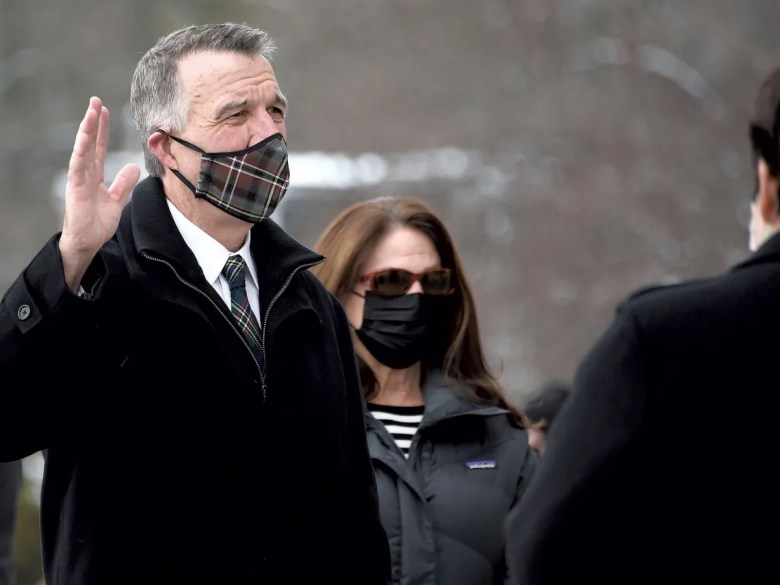
The matchup between Scott and Janoo amounts to a contrast in both style and substance.
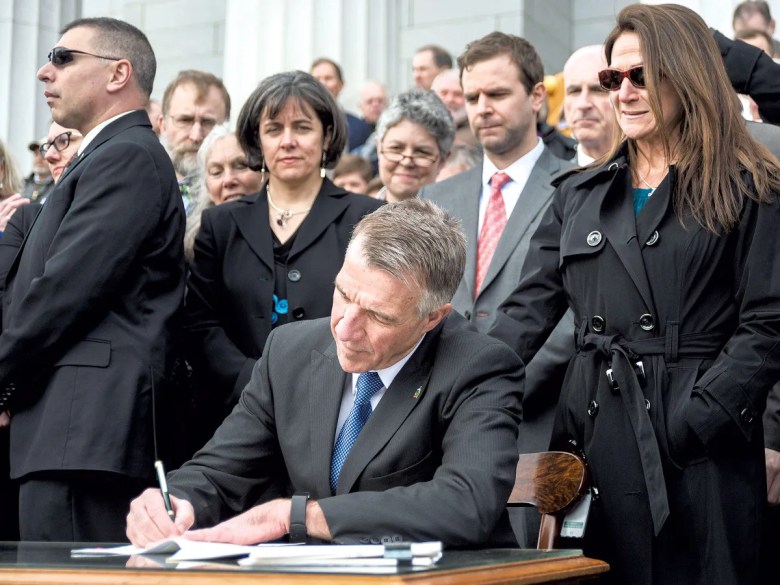
A recently released digital campaign ad for Scott shows a montage of photos that chronicle his tenure in office: the governor behind an arc of microphones during one of his daily pandemic press conferences; shoveling dirt from the back of a truck during flood recovery; speaking with a member of the Vermont Air National Guard; smiling as he signs a bill while onlookers applaud.
“We’ve been through a lot together,” the ad states. “Now, let’s finish the job.”
It portrays Scott as a steady hand on the wheel, a reliable leader who has guided Vermont through myriad challenges.
The online comments indicate that the message is resonating with supporters:
Phil, you have proven leadership.
You have my vote as always!
You continue to have my support!
During an interview earlier this month, the governor, 68, sounded slightly ambivalent about why he decided to run for a sixth term. “Sometimes I ask myself that,” he quipped. Ultimately, he said, it came down to feeling responsible to make more progress on housing, health care, education and, more broadly, affordability.
“There’s a lot of unfinished business,” Scott said.
He said he’s proud of his work on the Vermont Housing Improvement Program, which provides forgivable loans to property owners who create affordable rental housing, and the Community and Housing Infrastructure Program, which funds projects that support housing development. He also touts his administration’s work to turn contaminated brownfields into usable land and the passage last year of a tax-credit program that provides relief for senior citizens and military veterans.

Scott still hopes, he said, to enact regulatory reform that enables developers to build more housing; to lower health insurance costs, in part by allowing insurers to price premiums based on age; and to move forward with school-district consolidation and a new education funding formula. To follow through on his agenda, he said, he needs the support of lawmakers.
Scott, who has served alongside a Democratic-led General Assembly throughout his tenure, holds the record among Vermont governors for the most vetoes: 65.
“I haven’t seen much follow-through from my partners in the legislature, and I think that their natural reaction is to raise taxes,” Scott said. “My natural reaction is to live within our means, and we need to find a way to do so.” In August, the governor directed agency heads to craft lean budgets, with just a small increase to account for the contractually negotiated raise in staff salaries and benefits.
Scott knows his ideas aren’t particularly exciting, but he believes they’re what Vermont needs.
“Most of the people I speak with … are frustrated with the actual cost of living here. The property taxes are way too high, and they’re having trouble making ends meet,” Scott said. “I don’t think they’re looking for anyone to sugarcoat that. I think they’re asking for results.”
Most of the people I speak with … are frustrated with the actual cost of living here. The property taxes are way too high, and they’re having trouble making ends meet.
Gov. Phil Scott
He believes his education transformation plan, which his administration has promoted for nearly two years, will help bring down property taxes. The proposal calls for larger, consolidated school districts and a new funding system in which the state determines how much money schools receive, rather than leaving the decision up to local voters. The plan has faced widespread criticism, especially from rural residents who worry about the potential closure of their small schools.
Janoo, in contrast, has stressed her belief in the importance of retaining small, local schools — noting that research is thin on whether school-district consolidation actually saves money.
“Scott has decided to make that the place where he takes his stand, and I think he’s absolutely right,” said Bud Myers, a self-described lifelong Democrat who served as deputy education commissioner under governors Howard Dean and Jim Douglas. He said he admires Scott’s commitment to ed reform and his willingness to “touch the third rail of local control.” Myers believes that the reform Scott envisions will ultimately improve education for marginalized students.
“I hope he wins,” Myers said of the governor.
Scott said in an interview that Vermonters “have to come to grips with the fact that we have a declining school-age population … and we have to figure out how we provide better quality while providing an education that we can afford.”
“One of the detriments to being in office so long,” Scott said, “is you have to make tough decisions … for the betterment of the state and the region and for individual Vermonters.”
While Janoo is clearly intelligent, articulate and skilled at tapping into what excites people, Scott said, “we don’t really know all that much about her … Everybody knows what I believe … It’s not new. I’m in the trenches, and I’m doing the work.”
Democracy in Action
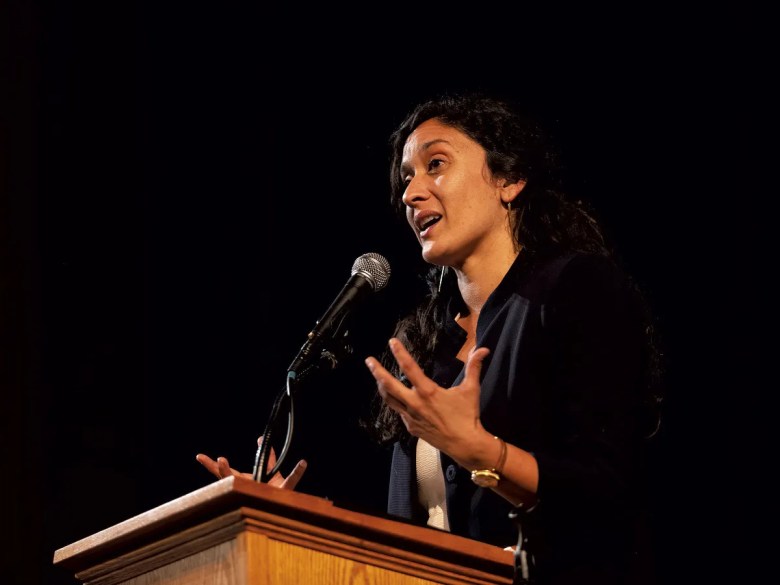
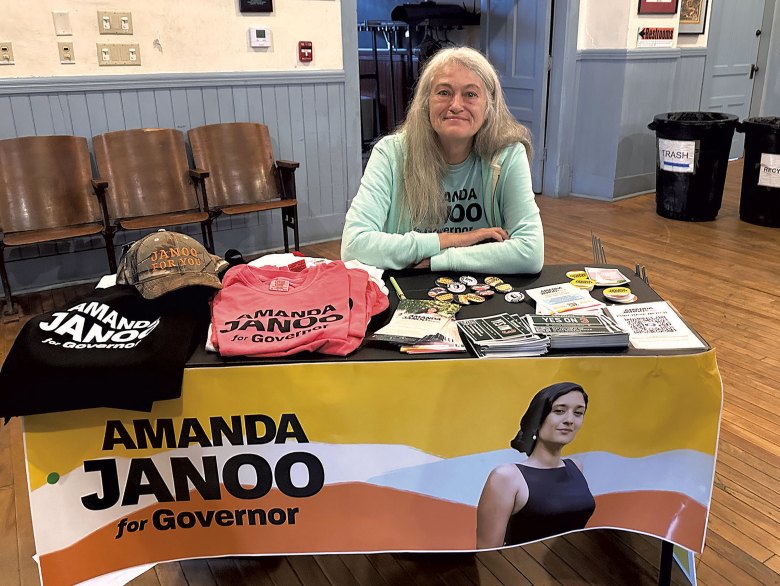
On a Sunday evening in September, around 175 Vermonters of all ages filed into the Old Labor Hall in the governor’s hometown of Barre. Cynthia Bogard, a Janoo campaign volunteer from Montpelier, presided over a merch table covered in pins, T-shirts and camouflage baseball camps emblazoned with “Janoo for You” in orange letters.
“Amanda is so Vermont values,” Bogard said. “She believes in do-it-yourself and communities deciding their futures, direct democracy, all that stuff. Her whole platform tries to figure out how to pay for it. She’s thought it through.”
Rather than giving a traditional stump speech, Janoo facilitated a conversation with the audience, asking questions while also laying out her background, economic philosophy and platform.
“I don’t think I need to explain to you all that the health care system is collapsing,” she told the audience, before introducing her plan to provide free preventative primary care by enabling communities to hire their own town doctors and nurses and pay them directly, bypassing insurance companies. The proposal could be paid for, Janoo said, by raising taxes on the top 1 percent of earners in Vermont, which would essentially claw back the amount they’re receiving under Trump’s so-called Big Beautiful Bill — around $200 million, according to an analysis by Montpelier’s Public Assets Institute.
Scott’s campaign has called into question whether a so-called “wealth tax” would raise enough revenue to fund free universal primary care and criticized the plan as vague and unrealistic.
Regarding housing policy, Janoo often cites examples from her own life to underscore her platform. She talks about being a renter in Burlington and how impossible it feels for people her age to buy a home in the state unless they have financial help from their families. She tells of how, during the pandemic, out-of-state residents bought up houses on the Northeast Kingdom dirt road where her mother now lives — noting that many of them have since moved away and kept the properties as second homes or Airbnbs.
“Let’s tax private equity, corporate ownership, second homes and vacation rentals,” Janoo said at the Barre town hall. “We can reduce the property tax burden for residential Vermonters and encourage more of the housing stock to go to folks who live here all year round.”
She also favors creating incentives for first-time homebuyers and home builders and expanding affordable-housing options by investing in community land trusts, housing cooperatives and public housing.
On education reform, Janoo believes that the state must address the true cost drivers, which she says are health insurance and additional services for students struggling with mental health or other needs. She believes a universal primary care program would help lower health insurance costs and thinks that the state should look for revenue aside from the education fund to support mental health services and other expenses that aren’t directly related to educating kids. She sees promise in what’s known as the community schools model, in which a wider array of services — such as childcare, health and dental clinics, and food shelves — are integrated into school buildings.
Janoo doesn’t mince words when it comes to the dangers of artificial intelligence.
“I am terrified of AI for a lot of different reasons … the technofascism that is being advanced right now, the mass surveillance,” she told a crowd in Charlotte earlier this month. She’s in favor of a state ban on data centers and Flock cameras, which use artificial intelligence to track car license plates and people. She’s also floated the idea of taxing digital advertising.
Scott, meanwhile, has a more temperate view on the rapidly changing technology. In June, he vetoed a bill that would have regulated AI data centers in Vermont, citing the “much broader consequences” it could have for the state’s “economic opportunity and long-term competitiveness.” In an interview, he said it’s unrealistic to think that data centers would come to Vermont given the state’s stringent environmental restrictions.
“AI is here,” Scott said. “We need to deal with AI and not worry about the data centers being built in Vermont because they’re not going to be built here.”
Scott’s mandatory financial disclosure from this year shows that his stock portfolio, managed by a brokerage firm in Barre, includes a variety of tech and artificial intelligence-related companies — including Google, Amazon, Meta and NVIDIA — each valued at $25,000 or more.
Scott said he doesn’t know what stocks he owns and dismissed the idea that his holdings could present a conflict of interest.
“I don’t look at them, and I don’t tell anybody what to do with them, one way or the other. I just ignore them,” Scott said. “I have not done anything to advance in that area at all.”
Janoo didn’t list any stocks in her financial disclosure — one reason people like Courtney Worthington, a 45-year-old Vergennes resident, see her as a candidate who understands the struggles of everyday Vermonters.
“She’s so smart,” Worthington said at an October event Janoo held in Charlotte. “I feel like she grew up in a similar era as me, where you just really had no idea life was going to be so difficult as an adult.”
Janoo’s policy ideas, especially bringing back small-town medicine and providing more services in schools, are “spot on,” said Worthington, who has a son with special needs.
“I don’t understand the way that people are projecting she’s going to tax us out of existence,” Worthington said. “That’s what’s happening now.”
The Final Lap
At a press conference the week after the August primary, a reporter asked Scott for his reaction to Janoo’s win over Richards.
“I was, I guess, a little surprised,” Scott said. “I really thought Aly would come out in the end with more support … I just assumed that there are more Democrats in Vermont than Progressives.”
In a phone interview last month, Scott again characterized Janoo as a far-left candidate who he thinks is out of step with the views of the majority of Vermonters.
“[While] the extreme right [and] extreme left are very loud and energetic … most of us are in the middle or moderate centrists — and that could be Democrats, independents and Republicans,” he said.
But polling shows that many of Janoo’s ideas have a broad base of support. A recent one from the University of Vermont’s Center for Rural Studies, for example, found that 80 percent of respondents support raising taxes on wealthy individuals and large companies, while 73 percent favor a universal, publicly funded health care system. A Vermont Public poll released last month found that the majority of respondents support a tax on second-home owners and believe school spending decisions should be made locally.
Janoo herself has said her views don’t fit neatly under a specific banner. While she’s a proponent of ideas made popular by the Democratic Socialist movement — providing universal health care, closing the wealth gap, giving less power to corporations — she also has a libertarian sensibility.
“We want to ensure everybody’s basic rights and needs are assured,” she said in an interview. “But I also … don’t think the state should be controlling everything [and should be] making sure that people have the ability to do what they want to do.”
Janoo’s rejection of identity politics and her focus on what matters to Vermonters are reasons she’s gained so much traction, according to May Hanlon, executive director of the Vermont Democratic Party.
“What Amanda is building is fundamentally centered around people and communities,” Hanlon said, “and it represents a broader trend of … candidates that are reorienting back to the fundamental through line of human connection.”
Janoo has also avoided going after the governor personally.
“There are ways to call out the failures … around health care, housing, big tech, et cetera, that focus on policy and an alternative proposal, that’s not just, like, ‘Phil Scott is the worst,’” Janoo told a crowd at the Montpelier Senior Activity Center last month. “Genuinely, for me, I’m just trying to run for Vermont, and that has got to be my orientation point.”
I’m just trying to run for Vermont, and that has got to be my orientation point.
amanda Janoo
The final weeks of the campaign will be critical.
Though some criticized Scott for declining to go head-to-head with Janoo at the Tunbridge World’s Fair and on CCTV’s Town Meeting TV, the governor says he is committed to appearing at three televised debates on October 21, 22 and 28.
“I’m competitive by nature,” Scott said, noting his experience as a stock car racer. “You don’t have to lead the first lap. You have to lead the last one. I’m feeling good about our campaign. Our polls are confirming what I’m feeling, and we’ll see what happens.”
The Scott campaign has invited supporters to several honk and waves in the coming weeks. Meanwhile, the Republican Governors Association recently gave $400,000 to an independent-expenditure political action committee, or PAC, that has started running advertisements promoting Scott and criticizing Janoo — a development that both Janoo and the Vermont Democratic Party have condemned.
Janoo is maintaining a packed schedule, with meet and greets, community conversations, and town halls across the state. Her campaign is relying on a network of more than 1,500 volunteers to help spread the word, plus a well-designed website and strong social media game.
“I do think that what will win this for us is organizing,” Janoo said last month in Montpelier. “Making a list of 10 people you know who may not vote and having a conversation with them. There’s one degree of separation between any of us in Vermont.”
Polling indicates that a good chunk of voters may still be undecided.
Berlin resident Corinne Cooper, who attended the Barre event, is one. After Janoo’s presentation, Cooper stood in a corner of the cavernous room, nibbling on a cookie from the refreshment table. The former assistant town clerk, who has five grown kids, said she’d listened carefully to Janoo’s message but still felt conflicted about who to vote for and was generally discouraged by the current state of politics. She said she wasn’t even sure why she came that night.
“I really like Phil Scott,” she said. “But on the other hand, how long has it been? I’m not really feeling like things are better, right? But would someone new get us there?”
She paused, then said, “I just don’t know.” ➆
Tune In
Three televised gubernatorial debates will be held in the lead-up to the election:
Wednesday, October 21, 7 p.m., on Vermont Public
Thursday, October 22, 8 p.m.,
on NBC5
Wednesday, October 28, 7 p.m., on WCAX-TV
The original print version of this article was headlined “Home Stretch | Gov. Phil Scott has handily defeated opponents for a decade. But political newcomer Amanda Janoo is mounting a credible challenge.”
The post Can Amanda Janoo Pull Off an Upset in the Race for Governor? appeared first on Seven Days.