Two exhibitions running through mid-May present issues of artistic truth and the legacy of slavery in thoroughly compelling ways. They also represent non-American voices — Josefina Auslender, though a Cape Elizabeth resident, is Argentine-born, and New York-based Billy Gerard Frank hails from Grenada. As such, their work takes us outside the usual insularity of Maine art galleries. That feels refreshing, and also important as Maine’s role in American art becomes more and more well known.
FOOL’S GOLD
“Josefina Auslender: La Chimera de Oro (The Golden Chimera),” at Sarah Bouchard in Woolwich through May 17, is an excellent follow-up exhibition to the Auslender retrospective currently at the Bowdoin College Museum of Art through May 31. If you have not seen the latter, don’t delay! It is one of the most intriguing and hypnotic retrospectives of this last year. Bowdoin’s overview of the nonagenarian artist’s work is comprehensive and feels epic in every sense of the word.
After taking that show in, what is instantly apparent in “La Chimera” is how deftly Auslender has for decades reinvented and renewed what has been a relatively concise aesthetic vocabulary. Over her long career, certain elements reappear again and again in persistently new guises.
In this new body of work, we see architectural structures that recall her famous series “La Ciudad” and detect little hints of the abstracted human bodies of “Los Cuerpos.” We find the striped bands of “Los Caprichos”— here appearing in yellow rather than black or red—and the spheres of the latter series as well as other series such as “Voyage” and “Wind.”
Helpfully, one section of the exhibition features works from various periods in which you can reference some elements that appear in “La Chimera.” Bouchard has hung images from the 1980s that were done using yellow ink as a way of connecting the color that she is revisiting now in “La Chimera.”
When I saw Auslender’s early works for this new group of drawings in her studio last year, their cascading clouds of gold triangles reminded me of manna from heaven. And they are, but with some reservations. As a working artist for over 65 years, Auslender has seen the art world morph dramatically into a system that emphasizes “commodity” and “investment” over an artist’s commitment to their vision. She has also witnessed artist after artist losing their way, forsaking fealty to that vision to pursue more saleable expression.
“A chimera is like walking in the desert, and suddenly you see something shining, and you approach it,” reads her statement, “and it’s so brilliantly beautiful with all these different kinds of yellows and whites…but you don’t realize that at the same time it is very beautiful, it is very dangerous…You begin working for gold.”
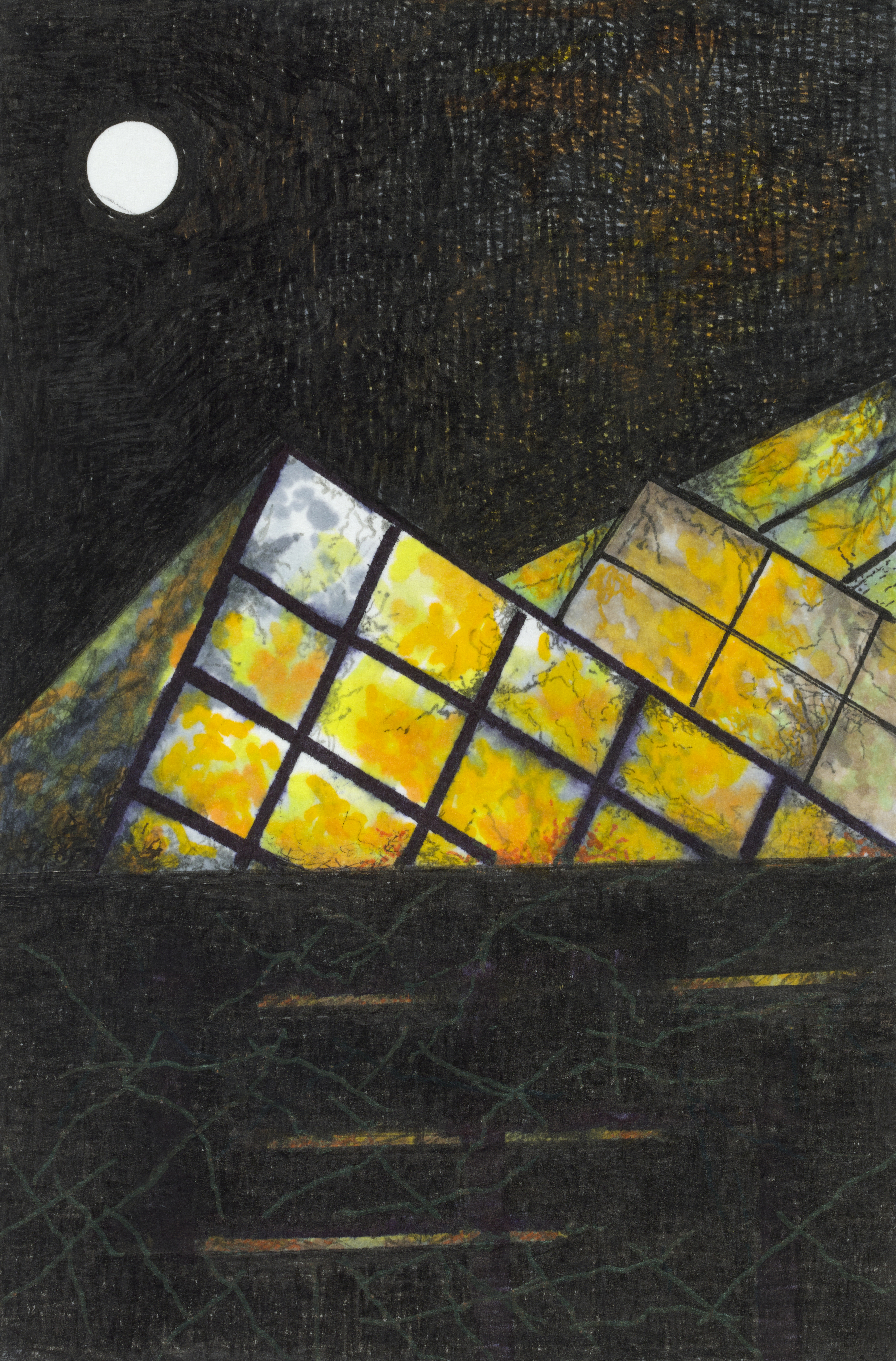
The drawings in chimera are all ink on paper, a diversion from her usual mix of graphite and colored pencil. Her control of this medium is just as astonishing as the command she brought to her latter materials. The densities and transparencies Auslender achieves with ink are mesmerizing, as is the exquisiteness of minute detail. In one untitled work, what looks like a many-paned window seems to float up out of black space from the left lower corner of the painting, while above it a cloud of her golden triangles floats, some of them no bigger than a particle. The effect is one of dissipation, as if the gold triangles are dissolving into dust as they move toward a light space in the upper right corner. At the extremities of their field, they appear as a glimmering cloud of gold dust.
In another, the gold triangles are larger and, similar to the work discussed above, emerge from a resolutely opaque black void. But the triangles at this close range and scale reveal translucent layers of color — blue, yellow, orange, gray, white — which mottles their overall gold effect and, it seems, presents them as more vacant and less substantial than we may have originally perceived.
Perceptual space also shifts in mind-warping ways. One may exist on a single plane, such as a work that looks like a mountain range of Louvre-like I.M. Pei pyramids under a full moon. But another presents at least four special planes in different gradients of black that seem to hover over each other, the gold appearing to emerge from between them and fall toward the viewer. In a piece that looks like a moon with gold triangles speeding across its face, we can intuit patches of yellow under the blackness that imply worlds behind worlds.
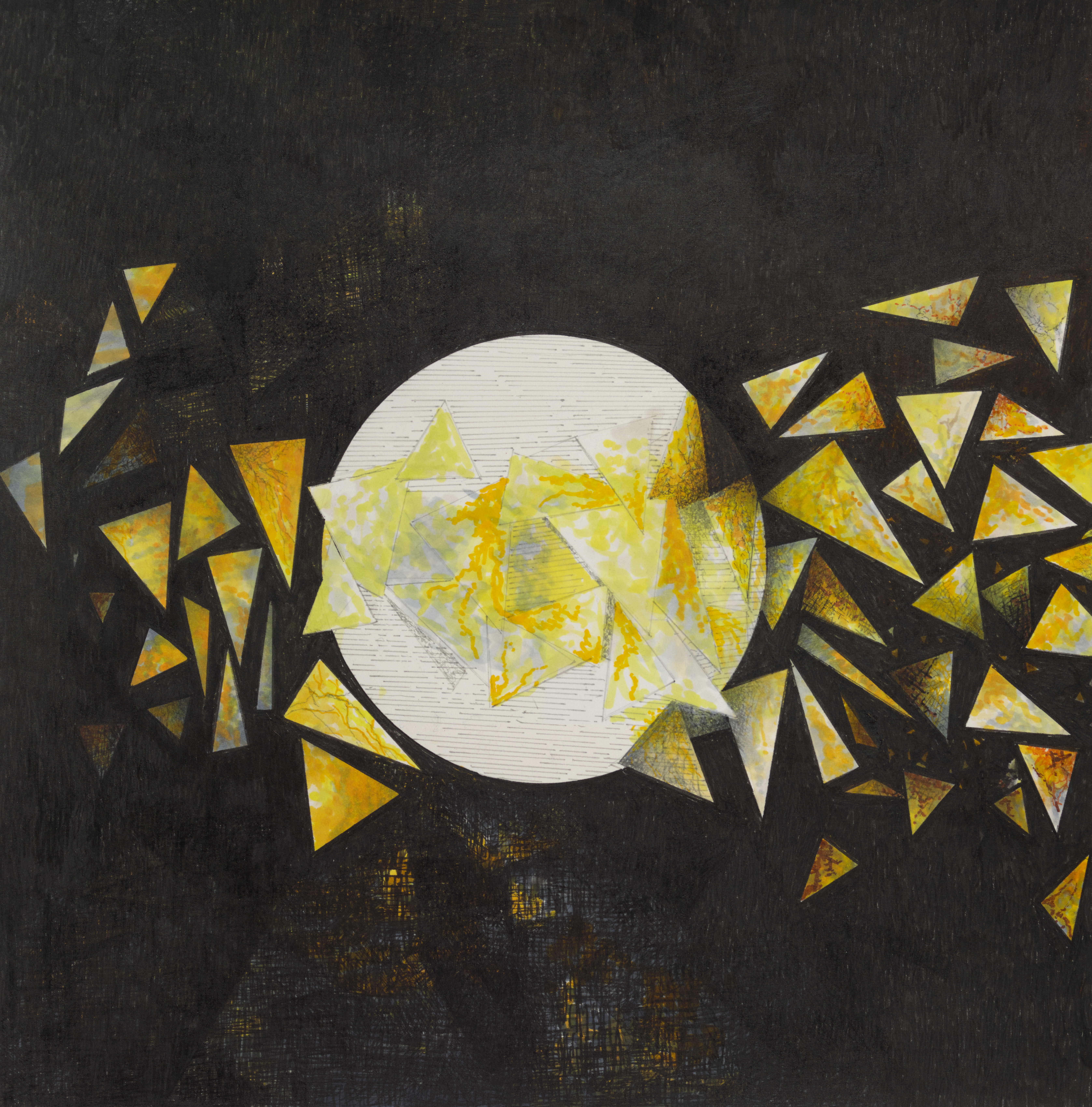
Despite the message of artistic core versus commodity, there is a lightness of touch to many of these. It shows up in the implicit movement of the gold triangles, which feel very random in their dispersal rather than focused in a particular direction. The black backgrounds emphasize the buoyant quality of suspension in space, and the way planes tilt and intersect also feels, despite their duskiness, as if they are perpetually shifting.
The constant fluctuation and variability are fine metaphors for the creative journey, which never stands still. And the gold triangles suggest the pervasive presence of shiny, glittery distractions of many kinds that always attempt to draw us away from our creative center. “These are the mirages of life,” reads the artist statement. “You must understand what they imply — they can be wonderful, but also the most terrible thing that can happen to you.”
NOT YET FREEDOM
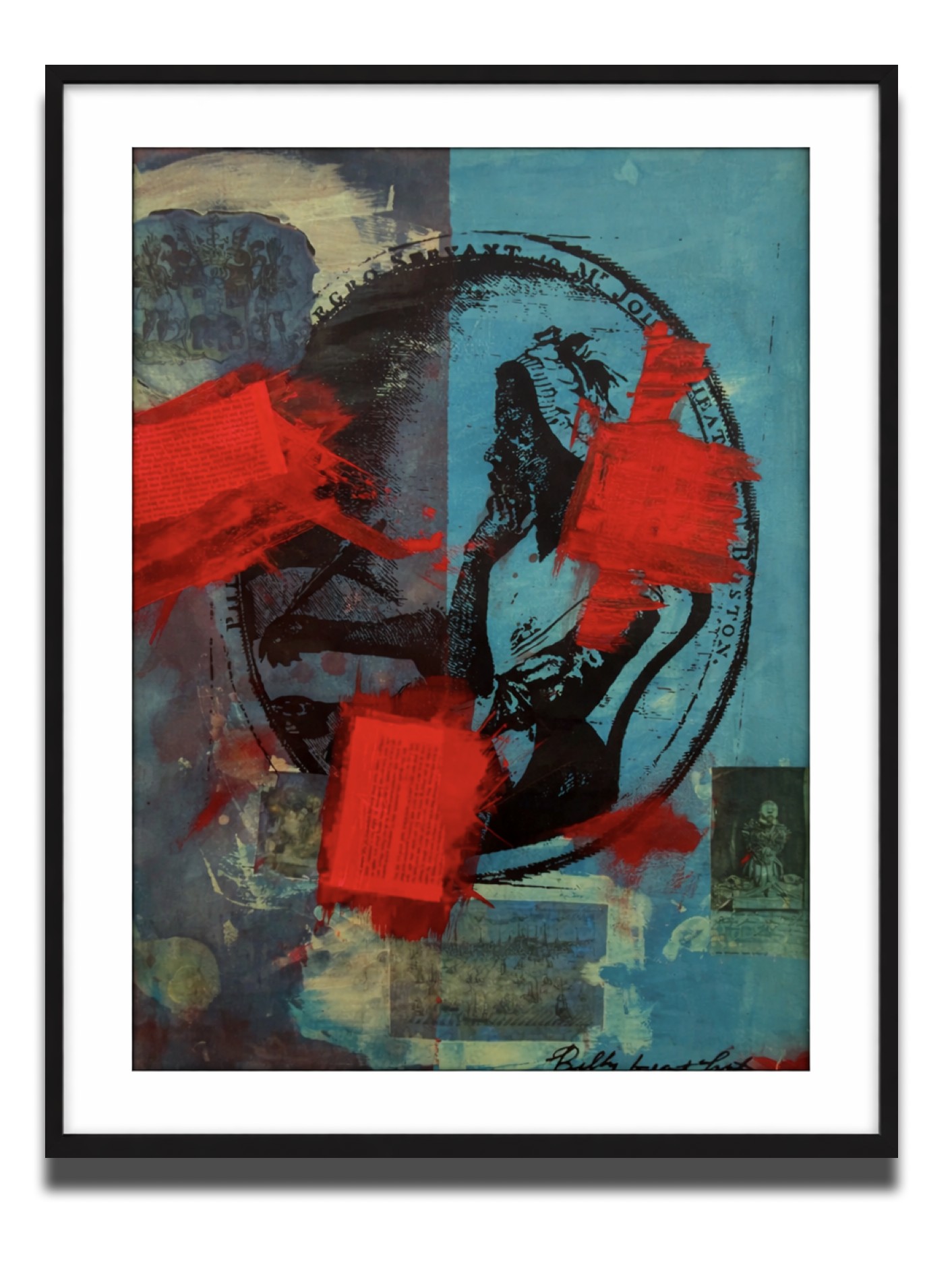
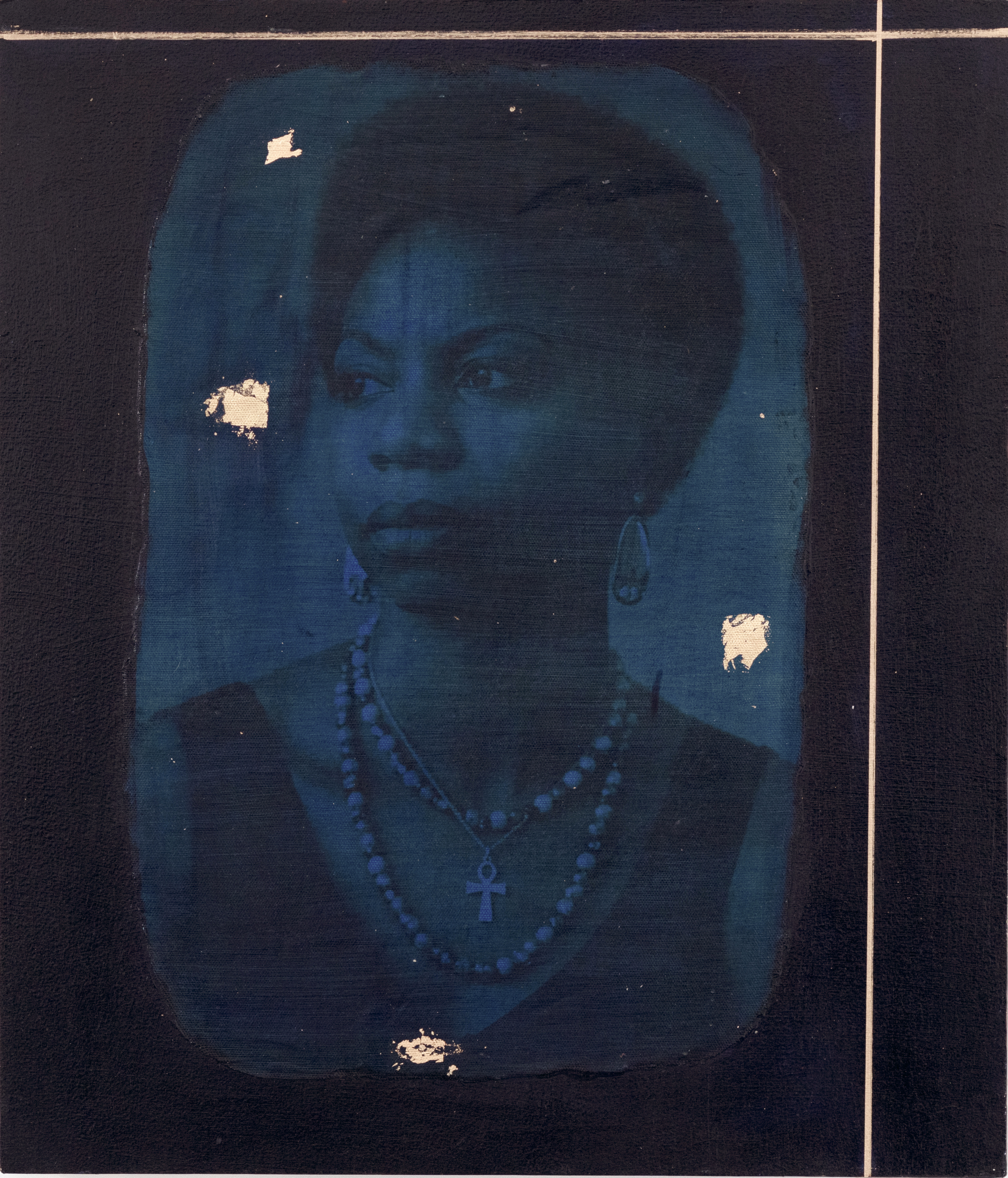
When I first saw the indigo-drenched portraits of abolitionists and civil rights figures in “Abolitionists: Cartographies of Resistance and Disobedience” (at Moss Portland through May 23), I thought of medieval and Byzantine icon paintings. Their material richness and deployment of gold and adornments give their subjects a reverential, almost saintly aura.
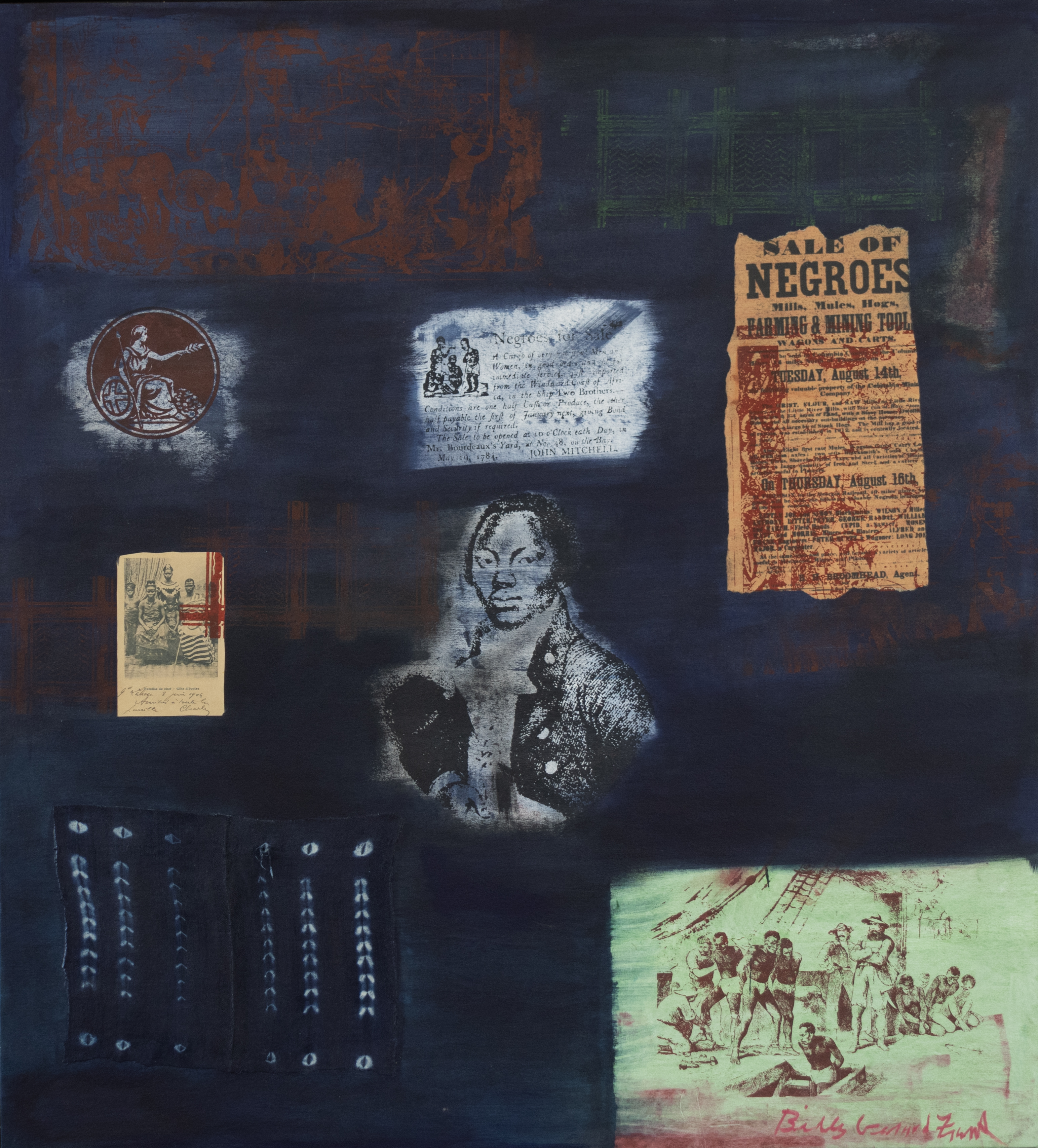
Grenada was central to the trans-Atlantic slave trade from the 17th through 19th centuries, where first the French and then the British forced Africans to cultivate and harvest cocoa, indigo, sugar and nutmeg. Not surprisingly, like many African diasporic artists, Frank employs materials deeply enmeshed with enslaved economies — most extensively indigo pigment — mixing them with others that preserve cultural ties to Africa (here, cowrie shells, which served as currency as well as objects used in spiritual rites).
However, Frank’s way of incorporating and manipulating these familiar materials feels not only new, but very nearly sacred. Hence the comparison to icons. The artist’s larger aim is to show us that abolition, rather than an end to the inhumanity of human commerce in Black and Brown lives, is an ongoing struggle. Slavery may be illegal in the modern era, yet we are still disentangling its legacy in the hope that we, according to Frank’s statement, might finally “dismantle the afterlives of bondage, racial capitalism, carceral systems, borders, and regimes of surveillance that continue to regulate Black and brown life.”
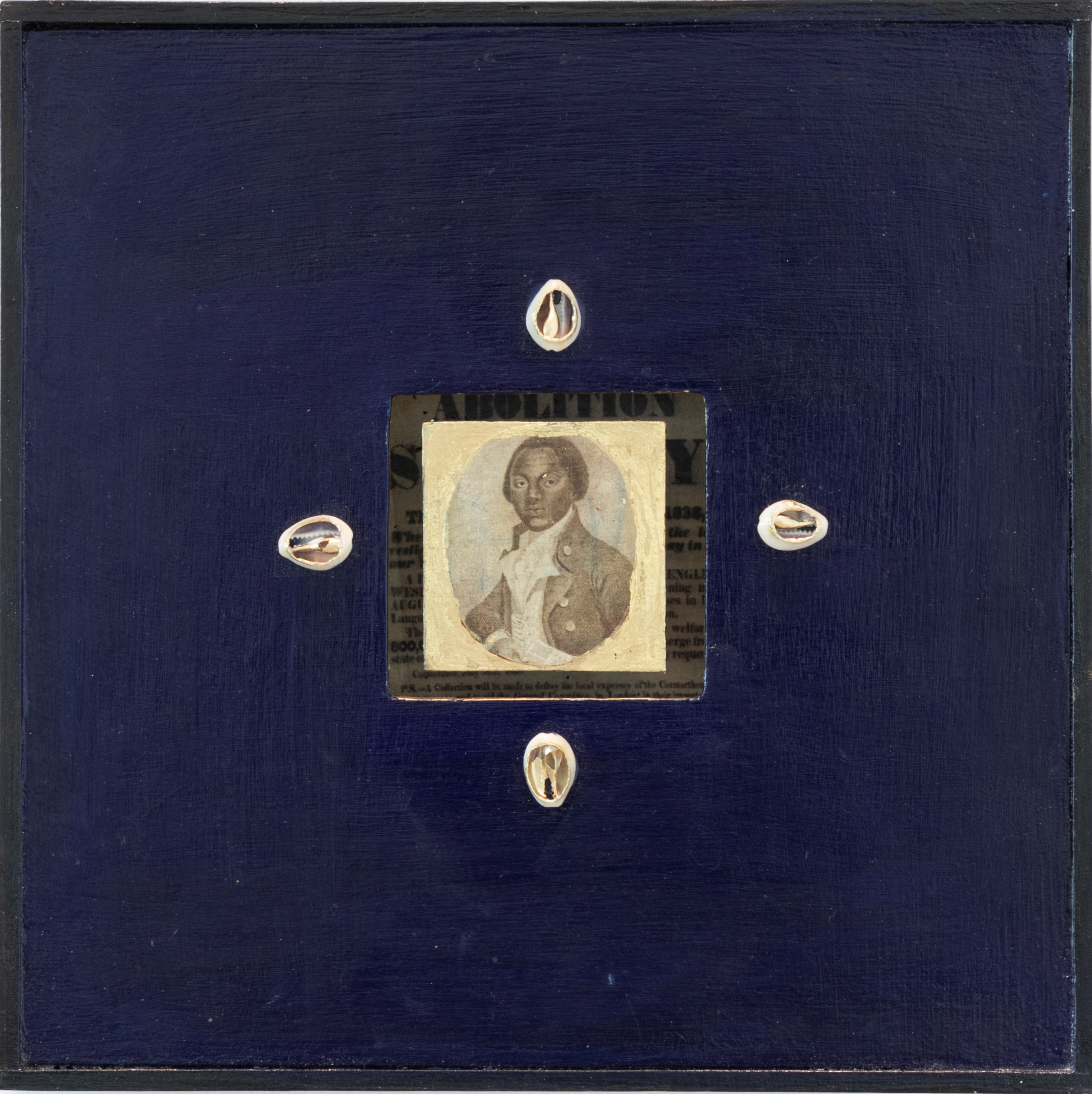
The surfaces are luxuriously layered with indigo, giving them a luminous, lacquer-like viscosity. But they also bear gouges, what the statement identifies as “the scars of labor, displacement, and survival.” The goldleaf applications are metaphors for the wealth generated and accumulated through exploitive plantation practices, “reclaimed here as a sign of Black life, dignity, and spiritual endurance.”
What Frank presents, then, is a kind of saints’ gallery of abolitionist warriors in the fight for freedom and equality. We have figures from the beginning of the struggle such as Phillis Wheatley, who was enslaved as a young girl and eventually became a published poet, and Olaudah Equiano, an 18th-century abolitionist who wrote one of the most important African autobiographical accounts of slavery’s depredations during his own journey toward freedom.
And we have portraits of “post” abolition civil rights figures such as Frederick Douglass, Malcolm X, James Baldwin, MLK and Nina Simone. These are formidable and courageous individuals also often incorporated into African diasporic art, and they have every right to be admired and revered.
But it is a pity we did not have living contemporary figures who are influencing this movement today, which would have emphasized the central thesis of abolition as an ongoing necessity. Why not lawyer and Equal Justice Initiative founder Bryan Stevenson? Or voting rights activist Stacey Abrams? Actor and playwright Anna Deavere Smith? There is a portrait of Wanda Sykes dressed as Queen Elizabeth — “Who is Queen Now?” — but this was a separate commission for an initiative on Fire Island that “honors LGBTQ lives and histories.” With its elaborate royal regalia and the American flag in the background, it feels out of sync with the other works and nowhere near as subtly powerful.
Frank includes a video that loops archival footage of water cannons and dogs being set on Black civil rights demonstrators. It is washed in blue and its presence in the gallery boosts our understanding of the depths of cruelty, humiliation and violence these hallowed icons endured. I’ve seen these scenes many times before, and each time they feel more disturbing. In this viewing, it evoked the specter of what America is now facing again through the Administration’s attempts to downplay slavery in history textbooks, obliterate DEI initiatives, deny African-Americans voting rights and so much more.
Jorge S. Arango has written about art, design and architecture for over 35 years. He lives in Portland and can be reached at [email protected]. This column is supported by The Dorothea and Leo Rabkin Foundation.
IF YOU GO
“Josefina Auslender: La Chimera de Oro (The Golden Chimera),” Sarah Bouchard Gallery, 13 Nequasset Pines Rd., Woolwich. Through May 17. By appointment seven days a week. Free. (207) 809-9670, sarahbouchardgallery.com
“Abolitionists: Cartographies of Resistance and Disobedience,” Elizabeth Moss Galleries, 100 Fore St., Portland. Through May 23. Tues.-Sat., 10 a.m. to 5 p.m. Free. (207) 804-0459, elizabethmossgalleries.com