
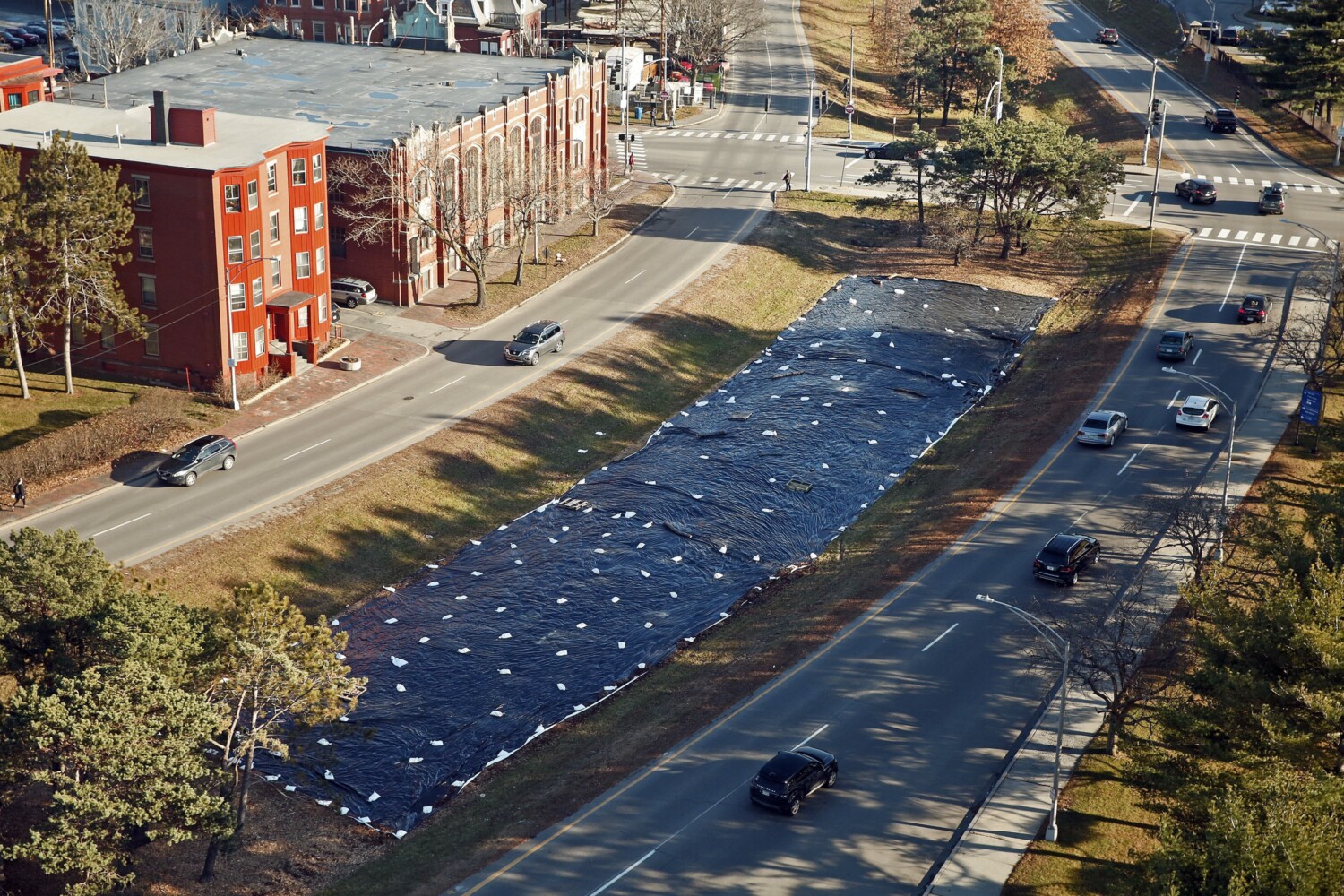
More than 50 years ago, Portland’s Bayside neighborhood was devastated by a federal program that promised to revitalize the area but instead bulldozed homes, businesses and historic buildings to make way for the Franklin Arterial.
A new federal program with similar goals again promises to spur the kind of investment that Bayside desperately needs.
But with an already uncertain future leaning on several planned large-scale projects and the echoes of so-called “urban renewal” still lingering, city councilors have made it known that they are not interested in signing on.

Purchase this image
Councilor Regina Phillips fears history could repeat itself if Bayside is chosen as one of Maine’s newest Opportunity Zones, a designation designed to help draw private investment to low-income neighborhoods. There are 32 such zones in Maine but those are set to expire next year and Gov. Janet Mills will designate 25 more this summer.
“To me this is a perfect storm of displacing people that have lived in this community for years,” Phillips said at a recent Housing and Economic Development Committee meeting.
Others fear the city is being short-sighted. The committee’s stance has been called bizarre, unfathomable, and rooted in misunderstanding
“There’s a lot of vacant land that is former scrapyard and parking lot that needs to be developed before we have to worry about displacement, so it’s an ideal candidate for this type of work,” said Chris Marshall, co-founder of GreenMars Real Estate, which has proposed a more than 300-unit housing development in the neighborhood.
OPPORTUNITY AWAITS
Bayside is one of 78 “tracts” in Maine eligible to become a federally designated Opportunity Zone. Portland’s West End, east of Clark Street, is also eligible.
The incentive program was established in 2017 by the Tax Cuts and Jobs Act to encourage long-term investments in low-income urban and rural communities nationwide and was made permanent last year.
According to the Department of Housing and Urban Development, Opportunity Zones attracted more than $100 billion in the last 10 years. Another $100 billion is expected in the next.
The program allows investors to create or invest in so-called “opportunity funds” through which they can reinvest capital gains – profits from the sale of investments – into designated areas tax-free for at least five years, then get a 10% tax break on the initial investment. Any profits they make annually through the investment after 10 years are tax-free.
For example, say a person invested $50,000 in a project that ultimately increased to $150,000, resulting in a $100,000 capital gain. If that person then invested that $100,000 into an Opportunity Zone Fund, and stuck with it for at least five years, they would pay taxes on only $90,000 of that initial profit.
If he or she made a new profit of $200,000 on this Opportunity Zone Fund investment and they waited for at least 10 years before taking the money out of the fund, they would pay $0 in taxes on this new $200,0000 profit.
If investors take their money out before 10 years, they can still receive a reduction in the taxable amount.
Governors nominate communities for the designation, which are then certified by the U.S. Department of the Treasury. Maine’s 32 zones were selected by former Gov. Paul LePage.
All are set to expire next year and Gov. Janet Mills will select new tracts (or renew existing eligible ones) under the revamped Opportunity Zone 2.0 program. The second iteration has tighter qualifying criteria and new reporting requirements. Mills can select 25 of Maine’s 78 eligible communities, which are determined based on income and poverty thresholds.
She will start making nominations July 1 but municipalities had until April 30 to make their case for why they should be selected.
However, many communities don’t have a way of measuring how or even whether an opportunity zone has benefitted them and often don’t even know which projects use it.
There’s no data, for example, on how Portland’s existing Opportunity Zone, which includes the waterfront, Old Port and downtown, has performed. The area has seen significant development over the last decade, but it’s unclear how much was due to the designation. The area is not eligible under the updated program.
In Brunswick, the Cook’s Corner/Brunswick Landing area has experienced an explosion of development in the last 10 years, but Sally Costello, economic development director, said she’s only aware of one project that used the incentive.
Still, she believes it can be a “productive” tool for municipalities to bring in important projects and attract investment from outside the state, which she said can be challenging.
Brunswick’s downtown is up for inclusion in the Opportunity Zone 2.0 and Costello is excited about the possibility.
“It could be a nice shot in the arm,” she said.
URBAN RENEWAL 2.0?
Portland City Hall staff recommended that the committee submit Bayside for consideration, but councilors instead asked to be left off the list.
“All I could think about was Franklin Arterial,” Phillips said at last month’s Housing and Economic Development Committee meeting.
The highway’s construction in 1967 demolished 130 homes and businesses, wiping out sections of Lancaster, Oxford, Federal and Newbury streets and displaced an unknown number of families.
She fears the city will welcome in a developer without any control over what is built in the neighborhood while investors line their pockets at the expense of longtime residents.
The zone is being explored as Bayside nears another turning point. The Planning Board has approved hundreds of new housing units, and several developers have hundreds more in pre-development. Meanwhile, the city is also seeking input on what to do with 3.25 acres it reacquired this summer after settling a yearslong lawsuit over a failed development.
Councilor Kate Sykes said at the recent meeting that if the city decides it wants more public housing or green space but has already encouraged heavy development, its hands would be tied.
Sarah Michniewicz, the councilor representing Bayside, noted that there’s no consensus on how these zones benefit low-income communities long term, and that like many impoverished neighborhoods, it represents something being done “to” them, whether they like it or not.
“I don’t see attracting investment as inherently bad,” she said. “I just think we need to be intentional about it.”
A LACK OF INFORMATION
Mayor Mark Dion believes the friction stems from a lack of understanding. He’s hopeful the state can provide the committee with more information about what the program actually does and how it operates.

He saw the potential designation as an advantage as Portland determines how to market the city-owned land.
The committee directed him to call the governor’s office and explain its position.
Technically, the committee’s “thanks but no thanks,” is meaningless. The city has no vote. The governor could still decide to nominate the neighborhood.
The Maine Department of Economic and Community Development is helping narrow down the selected tracts. A spokesperson for the department did not answer questions about the selection process but said Commissioner Michael Duguay is aware of the Bayside designation question and has reached out to the city to get a better understanding of their concerns.
“The proverbial ball is in their court because I’m sure they would rather see those monies expended in a community that welcomed that kind of support to potential developers,” Dion said.
MORE MARKET RATE HOUSING
Drew Sigfridson, co-founder of CEI-Boulos, a capital management firm focused on investment in under-served areas, called the committee’s decision “unfathomable.”
Maine is in the middle of a highly-publicized effort to build 84,000 homes between 2023 and 2030. By all accounts, the state is far from reaching that goal.
“Where better to build (more housing) than in an area that has the highest population, the highest density and the highest demand? The highest need?” Sigfridson said.
New York University’s Furman Center for Real Estate and Urban Policy found that in New York City, units in Opportunity Zones were more likely to be market rate than the units in eligible but not designated tracts — 57% vs 48%, respectively.
Market-rate housing isn’t inherently bad. Research shows that market-rate and even luxury apartments can help reduce rent prices in surrounding areas and free up lower-cost units.
And housing development in Portland has slowed. The city’s 2025 housing report showed that while last year was record-breaking for approvals, completions were paltry.
“Having an opportunity zone incentive might actually bring it on more of a level playing field,” Sigfridson said.
GUARDING AGAINST GENTRIFICATION
Critics also have raised questions about the link between opportunity zones and gentrification. An influx of investment and development in an area could lead to a rise in property values, rents and demand, displacing long-term residents.
But the research is inconclusive, and the data sets are limited. Opportunity zones don’t always spur new projects, they might just make existing plans more profitable.
“You’re not shaping the market, you’re kind of layering on top of existing markets,” said Brady Meixell, senior research associate in the Housing and Communities Division at the Urban Institute.
If a municipality wants to guard against displacement, said Marshall, at GreenMars, “There are lots of good ways to do that that are not declining opportunity zone benefits to a neighborhood.” The city’s inclusionary zoning policy is one example, he said. Rent control is another.
Sigfridson, at CEI-Boulos, said that if the city wants to court affordable housing developers for the lots it owns, it can. The two goals don’t have to be mutually exclusive.
Plus, he said, an opportunity zone “can be the differentiator for being able to build a workforce housing project that otherwise could not have been built.”
GreenMars Real Estate is in the early stages of a project that would bring more than 300 small apartments to Bayside.
The goal, according to co-founder Marshall, is for the project at 9 Somerset St., to offer affordably priced units without subsidy.
To make that project work, Marshall and business partner Nate Green need to attract tens of millions of dollars.
“An opportunity zone is one of the most powerful tools for making a project more attractive to investors,” Marshall said.
GreenMars’ project will still happen without it, he said. The units just might be more expensive.