
Setting release show | Sunday, May 17, 7 p.m. | The Haw River Ballroom, Saxapahaw
In the fall of 2021, three seasoned musicians gathered for a jam session under a triple-wide carport in Chapel Hill.
Jaime Fennelly, Joe Westerlund, and Nathan Bowles had been orbiting each other for years; Fennelly had previously jammed with Westerlund, and Westerlund had performed with Bowles, but the three had never played together as a group. Detecting a shared sensibility, they decided to meet up and improvise. Beneath the canopy of Westerlund’s carport, open to the autumn air, their trio unwittingly became a quartet. “I have a very specific memory of a leaf blower being the fourth member,” Bowles told me.
Noise pollution notwithstanding, that first session was “spacious” and “free,” Bowles said. Familiar as they were with the joys of musical collaboration—Westerlund (Sylvan Esso, Jake Xerxes Fussell), Fennelly (Mind Over Mirrors, Peeesseye), and Bowles (Pelt, Black Twig Pickers) can count more than 20 bands and projects between them, which run the gamut from folk rock to free jazz, experimental minimalism to electropop—they nevertheless felt that they’d landed on something special, and so they kept it going.
The pool of instruments grew each time they met. Someone would show up to the carport and say, “I brought this thing,” and pull out a zither, a metallophone, a keyboard. Each of the three had his preferred tools—drums for Westerlund, banjo and percussion for Bowles, harmonium and synths for Fennelly—but they played around.
“I had no idea what we were making,” Fennelly recalled when I spoke with all three on a recent video call, and Bowles agreed: “It was really tentative at first.”
They would record their sessions and listen back before making adjustments, like football coaches reviewing tape of the previous week’s game.
Although fresh air allowed the group a freedom that proved essential early on, they had what Westerlund called an “epiphany moment” when, after several gatherings under the carport, they went inside Westerlund’s house and played without the leaf blowers. “The interaction felt closer and more rhythmic,” he said. A sound began to cohere.
Having found their footing, the trio went outside again for a series of improvised performances called “Setting Sounds”—one of them, in the fall of 2022, took place on a tree platform next to the Eno River—during which they conjured slow-moving “environments of sound” responsive to their surroundings. Then, in 2023, Setting released their first LP, Shone a Rainbow Light On. Three live albums followed in the next couple of years.
At no point has Setting’s sound been easy to categorize—genre can only mislead when applied to this kind of improvisational music—but those first four releases traverse a sonic landscape that can loosely be called earthy kosmische, drawing on various traditions (American folk, African percussion) before spinning out into space. Harmonium, keyboard, tapes, and synths set down a layered electroacoustic drone; Westerlund’s drums plod along polyrhythmically then leap forward, jazzy one moment and neolithic the next; and the banjo charts a lonesome path overtop.
On their self-titled LP, out April 24 on Thrill Jockey, Setting digs into melody and groove with new confidence. Much of the difference results from the band building these new songs around synthesizer sequences that Fennelly had programmed ahead of time: a “totally new context” for the group’s improvisation, Westerlund said.
“Going through different sequences and playing around, we discovered that there was a handful that we wanted to take as building blocks to the studio,” Bowles explained. Fennelly would then tweak those building blocks in response to Westerlund’s and Bowles’s improvisation, dialing up one section or removing another.
“We surprised ourselves,
and I think that comes out of a general openness … This band operates like: Whoa, this happened! And that’s surprising and exciting and fun.”Joe westerlund, setting
Fennelly had plenty of time to fiddle. Setting spent two days in the studio for their first record, but for this album, they worked with Adam McDaniel at Asheville’s Drop of Sun for 15 days.
At some point, they’d considered a different tack. “I think we said something like, Let’s make a spacious flow record,” Westerlund recalled. “And then we get in the studio and get funky.”
“We surprised ourselves, and I think that comes out of a general openness,” Westerlund said. “No one’s disappointed, no one’s fighting for their idea. This band operates like: Whoa, this happened! And that’s surprising and exciting and fun.”
On the first track, “Heard a Bubble,” Setting’s signature blend of polyrhythm and banjo develops toward something new: an ecstatic synth motif that bends funkily around the edges. “Gum Bump,” retaining that energy, sounds like a radio broadcast of Miles Davis’ 1972 album On the Corner shredded by cosmic interference and reconstituted by a DJ on an exoplanet.
Related stories
Absent drums, “What Kind of Fish Is a Turtle?” stretches more slowly into an astral direction. When I asked the band about the title, which struck me as a wise and perfect question in the vein of both Seuss and Borges, no one could recall where it came from.
“It seems like it’s always existed,” said Bowles, an answer that could apply just as well to the music, gliding along the geologic timescale from the Cambrian to the Pliocene with a few detours through the future. Any metaphor fit for Setting has this time-warping quality; I couldn’t help but think of the monolith from 2001: A Space Odyssey, sleek and alien, an emissary from beyond embedded incongruously in the jagged earth.
Improvising as a trio has allowed Westerlund, Fennelly, and Bowles access to new—or, in some cases, forgotten—parts of their musician selves. As a student at Bennington College in Vermont, Westerlund had studied with the polymathic percussionist Milford Graves, from whom he learned to approach rhythm as a “malleable, viscous object,” as he put it in a 2019 essay for the INDY.
“I hadn’t had a vehicle where that felt appropriate for a long time,” Westerlund said. “This band felt like a return to something that I’d always wanted to explore more.”
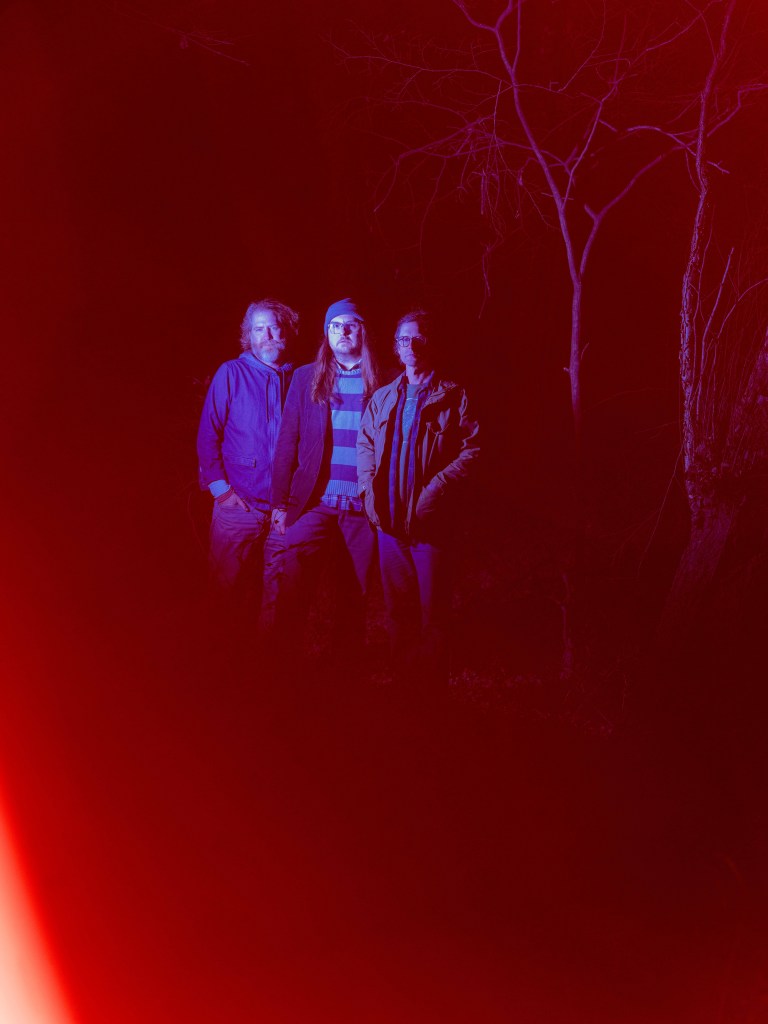
“We’re giving Joe the ability to be off the leash,” Bowles said, comparing the result to the work of free jazz legend Rashied Ali. (Fennelly referred to Westerlund’s unrestrained playing as “fire drums.”)
The open-ended spirit of the carport sessions remains on Setting.
“The music lets you know what it needs,” Bowles said when I asked about how they’d conceptualized the new album. It’s fitting to imagine these songs making their own decisions, like clumps of primordial ooze struck suddenly by the synthesizer spark of life.
In less capable hands, this approach can have the shallow, unearned profundity of someone who’s watched too much Ancient Aliens, or done too much acid, or both. But Setting doesn’t gesture at some substance that isn’t actually there. Instead, in their quicksilver jumps from atavistic percussion to extraterrestrial funk, the trio is drawing both from the venerable lineage of artists like Sun Ra and Popol Vuh who have used myth and tradition to plumb the future, and from their own deep wells of musical experience.
So when Bowles remarks psychedelically, “You can almost see the sound in three dimensions,” I agree. I saw Setting perform at Duke Coffeehouse last year, and the music could rightly have been called a physical presence, animated by the heartbeat of Westerlund’s loping kick drum.
At that lengthy performance—it ran for 75 minutes without pause—Fennelly, Westerlund, and Bowles didn’t look at each other much but nevertheless remained in absolute coordination: three veteran musicians reveling in the alchemy of a yearslong collaboration.
Coming off a recent trip to Big Ears Festival in Tennessee and a four-week residency in Durham, Setting isn’t resting on its laurels. In fact, Fennelly told me, “When we finished the record, when we were still at the studio, we were all like, ‘What if we just started making another record right now?’”
To comment on this story, email [email protected].