
Retired police detective sergeant Bruce Robert Coffin spent his career of nearly three decades in Portland leading homicide and violent crime investigations. Now as a writer of thriller novels, Coffin tails Detective Brock Justice — a state police detective brought to every corner of Maine to solve the darkest of crimes.
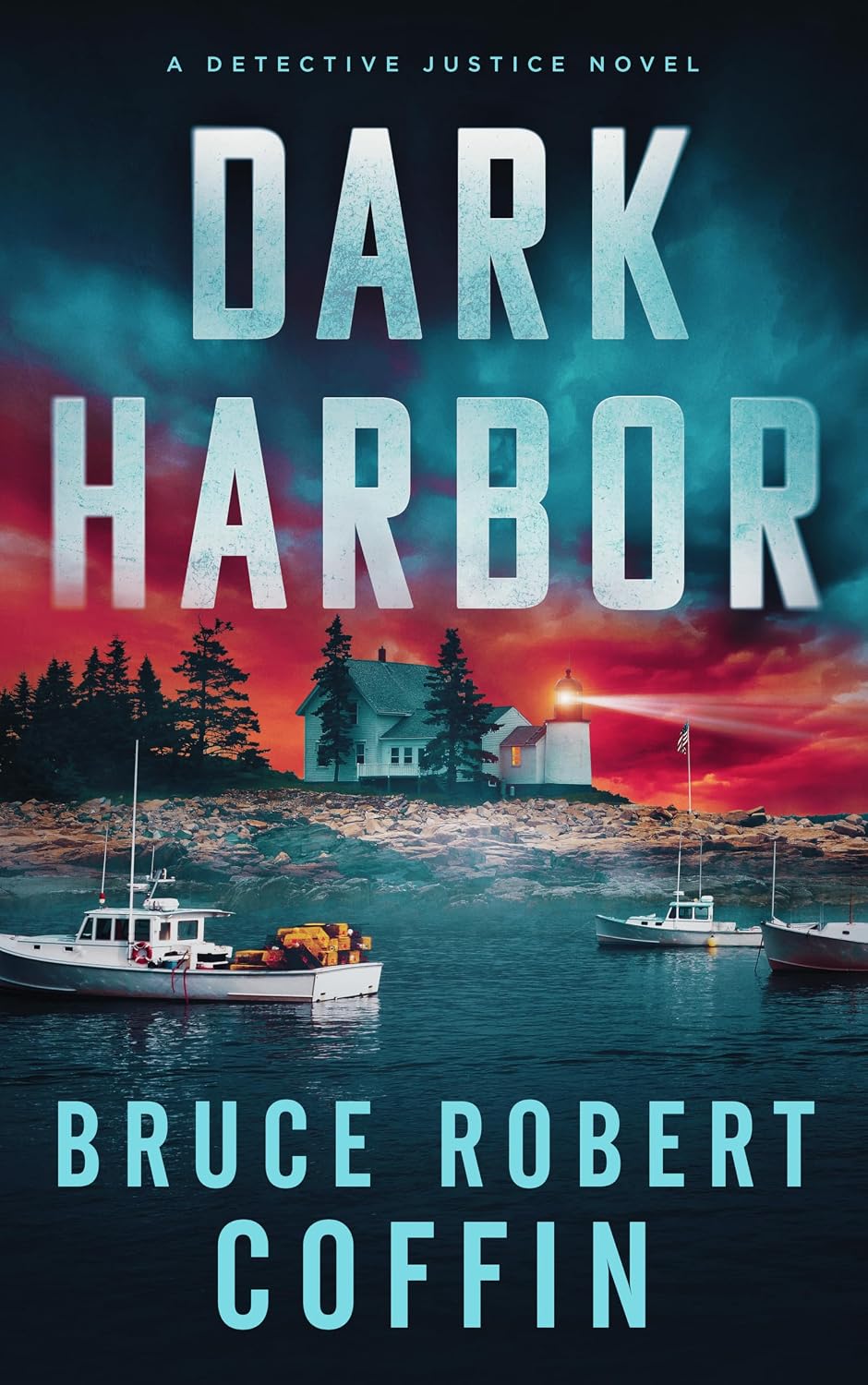
In the third installment of his “Detective Justice” series, “Dark Harbor,” Coffin brings Brock to a place he never thought had such a dark underbelly: Bar Harbor. As he investigates multimillionaire and town magnate Granville Warren’s sudden death, family ties and financial secrets, Brock is pulled beneath the shiny surface of the yacht club into a brooding, dark mess.
Coffin brings readers into the nexus of class dynamics and bureaucratic rigamarole with his signature blend of suspense and procedural drama, at every turn testing who Brock can trust.
In ‘Dark Harbor,’ we meet our lead detective, Brock Justice. This is your third book with Brock as the protagonist. How did you develop Brock? How is he influenced by your own background?
When the opportunity presented itself to revisit a procedural series, I wanted to make my protagonist a Maine State police detective. In the first book, Brock Justice is a rising star in southern Maine. He’s assigned to the Major Crimes Unit South for the Maine State Police, and everything’s going great. Then something really bad happens, he becomes persona non grata. They don’t know what to do with him, so they transfer him to the Major Crimes Unit North. He’s a fish out of water, working cases in the northern half of Maine, and not happy about it. Then he just grew.
How has exploring Maine in fiction been useful to you as a procedural and thriller writer?
I think some of that might be due to the fact that the population really is so sparse, especially when you get up to the northern reaches of the state. The population of each little town can fluctuate dramatically depending on the time of year because one of our big industries is tourism. It lends itself to an odd dynamic where I’m intentionally putting Brock and the team into different small towns. “Dark Harbor” takes place in Bar Harbor, which can change so radically in the summertime — not only do you still have the problem of the usual suspects, but now you’ve flooded in thousands of tourists.
It’s such a beautiful place to write about. I get the luxury of the changing seasons. I’m almost taking you on a tourist trip, describing the state that I love in those poetic terms. At the same time, there’s a gritty undercurrent in every one of these stories. I like that, the way it juxtaposes itself.
We find ourselves in a robbery gone awry, leaving yuppy yacht club member Granville Warren dead. Did this come from a real case for you? How did you conceive of this wild narrative?
None of those came from real cases, but I always feel like there are elements that are just floating around in my head from things that I did work on — it’s me dipping the ladle into that well of whatever I carry around in my head. I wanted to tell a story about somebody who gets victimized that outwardly looks like everything’s going great. He’s the benefactor of the town, he’s the rich guy that everybody talks about and his family lives up on the cliff overlooking Frenchman Bay. It seems to be the dream, but then, as a result of what happens in the robbery, the detectives come in and basically dissect this life — the life of Granville Warren, his daughter, his son and young bride. And so, you get to look once again. It’s peeling back the layers of the onion. You’ve got to look at what things really are and not the way they appear. Detectives don’t get to pick and choose whose deaths they investigate. Not everybody we investigate would be deemed a good person, but you still have to get to the bottom of it and realize that there might be somebody out there who’s worse.
This novel uses doubling in various ways — parallel characters, double-coded language, and perhaps even the writer and the protagonist. When Brock speaks to Christopher, the son of the victim at the center, Brock says that all along he’s wanted to be a writer. How does this drive the character and your own writing?
I stole that directly from myself. I knew early on I wanted to be a novelist. I was enamored by the success and the storytelling prowess of our own Stephen King, and I couldn’t get enough of that. In my younger years I didn’t have the ability to concentrate long enough to write a novel. I don’t think most young people have that, and they don’t have the life experience to write a novel that anybody would want to read. I spent a lot of time working on that even before even thinking about tackling something like a novel. And much like Brock, I was trying to drive my future in one direction, and the world drove me in another one.
By 11, you decided you wanted to be a novelist. What was the Stephen King book that roped you in?
“Salem’s Lot.” My folks had an argument about that. My dad thought, “Let him read it. He loves to read,” and my mother thought, “There’s no way. He’s not old enough.” Somehow my dad won. I gobbled that thing up, and it terrified the hell out of me from the opening pages to the end. It changed everything for me. That was my first foray into adult fiction. He created characters I felt like I knew. The other part was he was telling the implausible Dracula story, but he was telling the version of Dracula that was set in a time and a place that everybody could identify with. He wrote about a fictional town, but it’s surrounded by all the towns I know.
I love this state. I hope that what I’m doing is entertaining the reader with an exciting murder mystery over and over again, and getting to visit characters they enjoy. But also, for me, Maine is the character. I’ve spent a lot of time at these different places that I write about. It’s fun to get to talk to people. I’m researching right now. I’m working on a story that takes place in Presque Isle. I went up there, and everybody was so nice, and they’re all excited about the idea of some bad thing happening in their town, or maybe their business is featured, or someone looks like them. I just love that. It almost feels like a team effort.
Lisa Hiton is a writer living in Brooklyn, N.Y. She is the author of the poetry collection “Afterfeast,” and her work has been featured or is forthcoming in the Kenyon Review, The Slowdown, NPR, New South and elsewhere.