
The first six pages of Ryan Lowell’s debut novel, “Freight,” open with a crossword puzzle, a death, a murder, and the beginning of a smuggling operation, in that order. What follows is a restless story of crime and deception. Lowell, who worked as a trucking dispatcher for 13 years, never lets off the gas: a dark and tangled world unfolds in short, punchy chapters that jump between characters, keeping the reader firmly in the story with hypnotic dialogue and pill-sized detail.
As exciting as it is insightful, “Freight” is dark and often hilarious, the plot intricately woven into the conversations between characters who feel pulled straight from their tobacco-stained cabs. It’s a ride readers will be thrilled to be on, even as they’re gripping the armrest and scanning the horizon for trouble along the way.
Lowell spoke about his 13 years as a dispatcher, the gritty reality of the Con-Am trucking world and the long road to publication.
This novel centers on the gritty, raw and sometimes shocking, world of long-haul trucking. How did you become interested in this topic, and was there a specific moment or event that made you want to write this book?
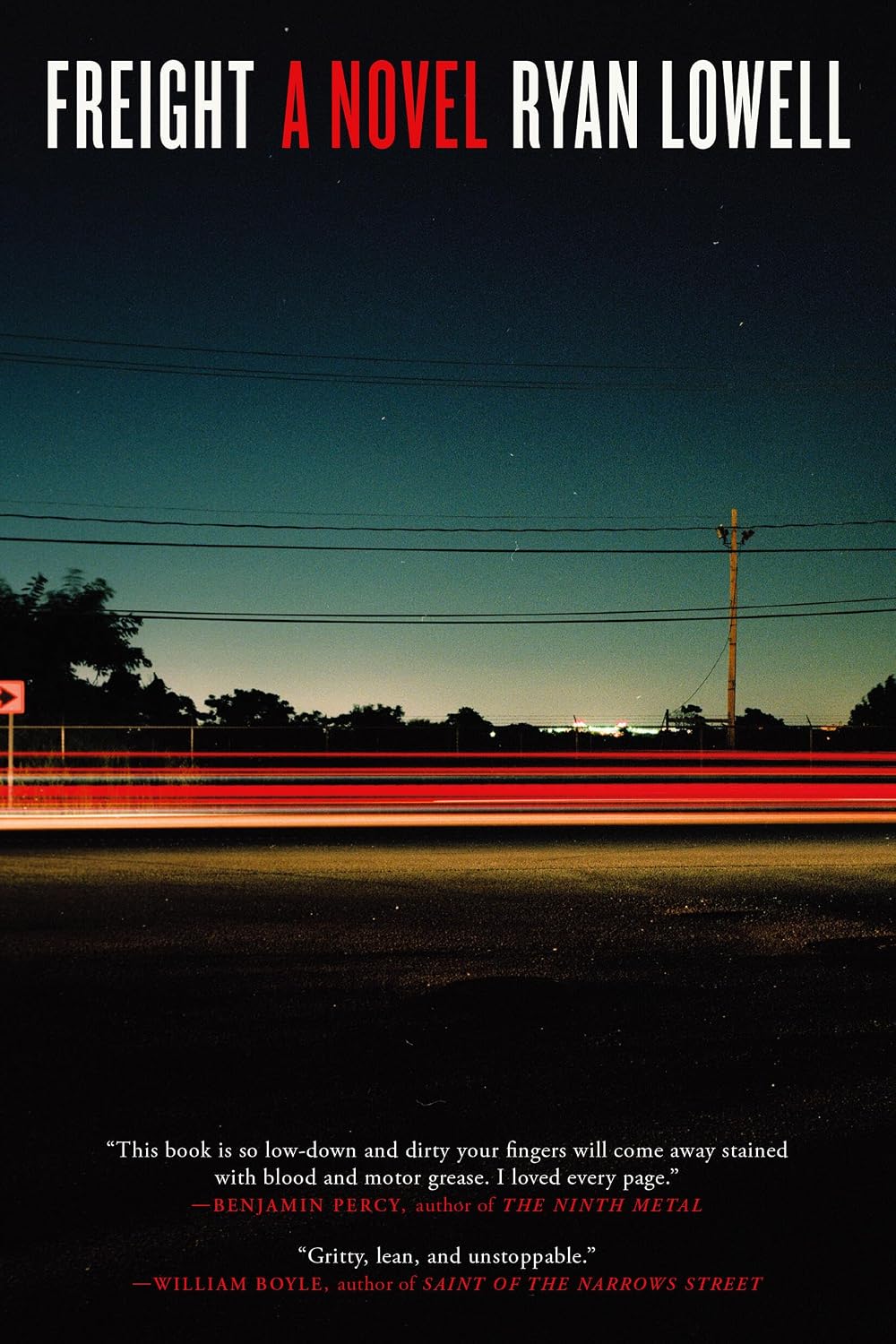
I’ve been working in trucking — not as a driver, but as dispatcher and operations manager — for over a decade, so I’m very familiar with the industry, the characters and the dynamics in play. And truck drivers are great storytellers — they love to talk about the places they’ve been and the crazy things they’ve seen. I’d been writing short fiction all along, and a few years ago I read an article about a tractor-trailer heist that happened when the driver was inside a truck stop having lunch, and I thought, there’s a great idea for a novel.
The book begins with a murder and a massive handoff of drugs that hooks the reader and creates tension throughout the book. How did you decide that was the right place to begin?
I thought it was a great way to introduce Billy Trask, the villain, and to show both the good and evil in his character. He is the caring proprietor of a backwoods strip joint, and at the same time he will discard any sense of empathy for a big score. I already had another version of the same scene from a short story in which an elderly French-Canadian man was smuggling drugs in the trunk of his Buick across the border to his nephew, so it was just a matter of making some adjustments.
Many chapters of the novel are set inside tractor-trailer cabs. It’s pretty unique; what made you decide on using this setting?
I think having much of the story set in the cab of a truck lends a sense of claustrophobia to the relationship between two of the main characters — they’re essentially stuck there together, and it heightens the tension between them.
But generally, and this relates to setting and dialogue, I always try to imagine a setting that is most conducive to people talking with minimal discomfort or unease in regular life.
The dialogue in this book is excellent. As a Mainer originally from Downeast it rings very true to me; were you already familiar with this dialect or did you research it during the writing process?
I appreciate that. I think good dialogue can really develop the characters and advance the story in a way that’s often better than descriptive narrative. As for the dialect, I’m originally from Bucksport — these are the voices and storytelling tendencies I grew up hearing. And in the trucking industry, the language is often crude and humorous and confrontational, and I think I’m a good listener.
Writing and publishing a novel is a notoriously long road. What does your writing process look like?
I write every morning, and I have a note above my desk that reads, “MOVE THE STORY,” which I got from Stephen King. When I’m at the point where I am right now — with a finished draft of a second novel — then I’m sketching out scenes for the next one or writing short stories. I oscillate between stretches of writing longhand and typing on my laptop, but I love writing longhand — it slows you down and makes you veer off in directions you might never have otherwise imagined. I also think it helps writing realistic dialogue.
Was there anything that surprised you along the way, be it during writing, querying agents or after finding a publisher?
It took me about a year and a half to find an agent, and querying is repetitive, and frustrating and you have to maintain a level of optimism that you will eventually find the right person. There were a lot of rejections — I didn’t keep an exact tally, but it was probably close to a hundred. I’m very happy with the representation that I eventually found, an agent with an exceptional editorial eye and a vision for what he wanted to present to publishers. I can’t help but think things may have turned out differently, and not as ideally, had a different agent said yes earlier.
Money and economy plays heavily in the lives of the characters — was that intentional, and is there a latent message you’re imparting there?
Absolutely. I often see characters through a lens of behavioral economics, and how the characters’ varying levels of emotional intelligence will affect their decision-making and ability to cope with what is going on in the story. Which makes sense — I studied economics in college. Also, there have been times when I could relate to the financial desperation in some of their lives.
There are so many characters in the novel, all leading independent yet somehow interconnected lives. How do you handle plotting in your writing — does it come first, or does it grow out of the story as you go?
For me, it starts with the primary characters and the very basic idea of the heist. Having the dispatcher, Curtis, as a central figure connected in some way to most of the other characters helped maintain the focus and dramatic thrust of the story, and the secondary characters and other action came about as the story got moving.
As for plotting, I don’t outline initially. I did outline while editing to make the process of moving scenes around easier. I’m not saying that’s the best approach — I write lots of material that I don’t even intend to use, because it helps me understand the characters better and sometimes find a gem I didn’t realize was hiding. It feels more natural to know in my mind where the story is going, but how we get there and what happens after is a mystery. Even to me.
Ezra Koch is a writer and realtor who lives in South Portland with his wife and children. His writing has appeared in several publications on the East and West coasts, and online. He is currently working on a novel.