
A few basic principles apply to virtually all forms of farming: Rotate your crops. Enrich and protect the soil. Manage pests, weeds and water efficiently. And don’t make your work harder than it needs to be.
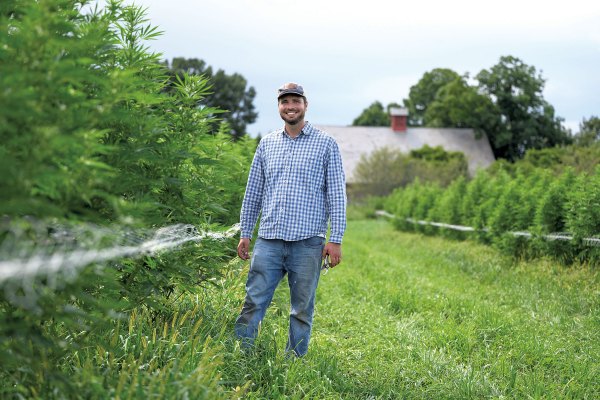
Sam Bellavance, founder and CEO of Sunset Lake Cannabis and its dispensary, Lake Effect Vermont, both in South Hero, abides by the first three rules but deliberately ignores the last: He makes his job more difficult by growing all of his weed outdoors.
That’s a major challenge in Vermont’s short growing season, with frosts that can last into mid-May and start again in late September. The state’s notoriously variable weather can swing between droughts and floods in the same season. And, unlike crops such as hay, berries and leafy greens, outdoor cannabis is harvested only once a year. If a storm snaps the plants’ stalks or heavy rains flood the field, the entire five-month growing season can be a loss — and the U.S. Department of Agriculture offers no crop insurance for cannabis.
Faced with such hurdles, why does Sunset Lake grow exclusively outdoors?
“Because that’s what Vermont farmers do,” said Bellavance, 31, who learned most of what he knows about agriculture working on his family’s dairy farm in Alburgh. He expanded into hemp in 2018 and adult-use and medical cannabis in 2022; currently, only seven of his farm’s 110 acres are in cannabis production.
“You know how much energy we used on lighting last year to grow?” he added. “Zero.”
Sunset Lake Cannabis has turned its seeming disadvantages into a brand identity, embracing sustainability and regenerative agriculture as core principles. In 2023, it became Vermont’s first Climate Neutral Certified cannabis farm. That label was discontinued in 2025, the same year Sunset Lake attained Sun+Earth Cannabis Certification, one of only four cannabis farms in the state to do so.
Because the USDA won’t certify marijuana products as organic, an independent nonprofit assesses a producer’s cultivation practices for sustainability. The certification process also evaluates the grower’s labor practices, community involvement and charitable giving, using criteria similar to those for becoming a benefit corporation.
Bellavance, who came to the cannabis industry from traditional farming rather than the legacy market, sees his operation as a way to create sustainable jobs that keep young Vermonters in the state. With a staff of 20, he’s been hiring people from other industries, including craft brewing and winemaking, to bring their expertise into Vermont’s fastest-growing agricultural sector.
In meeting the challenge of outdoor cultivation, Sunset Lake benefits from its South Hero location, Bellavance explained. Because Lake Champlain acts as a massive thermal battery, Grand Isle has a more moderate climate than the rest of Vermont, with warmer average temperatures and later harvests.
Sunset Lake typically starts germinating its seeds on April 20 (in honor of the annual stoner holiday of 4/20), gets its plants in the ground by May 20 and begins its harvest on September 20. After harvest, the crop is stored in a new energy-efficient, climate-controlled building.
During a recent tour of the farm, Bellavance was quick to dispel the common myth that outdoor-grown weed is less potent than its indoor-grown brethren. Cannabis raised outdoors faces greater environmental pressures, he explained, which stimulate the plant to develop more robust defenses, much as children raised on farms tend to have stronger immune systems and fewer allergies than city kids.
The cannabis plant’s defenses are its terpenes, the aromatic oils that give weed its aroma, its taste, and many of its mental, physical and therapeutic properties when consumed. A 2023 Columbia University study compared genetically identical strains raised indoors and outdoors and found that the outdoor, sun-grown plants produced a broader spectrum and higher concentrations of terpenes.
But Bellavance has a simpler reason for growing outdoors: It’s what he knows. His family traces its roots in Vermont to the 1750s, and he grew up farming and tending livestock, he said, not “growing [weed] in a tent in someone’s basement.”
His upbringing also makes him acutely aware of the economic pressures facing Vermont’s dairy farmers, as evidenced by the recent closures of the Hood-owned plant in Barre and Franklin Foods in Enosburg Falls. Bellavance’s family still works in dairy, and Sunset Lake raises its cannabis alongside a hayfield, rotating the crops and planting ground cover annually to rejuvenate the soil.
“We’re evolving with Vermont agriculture,” he said. “We’re not supplanting it.”
Because Bellavance comes from traditional agriculture, his cannabis operation looks and functions much like a traditional farm — aside from the state-mandated security cameras and fences. One of his neighbors, a county sheriff, parks his cruiser nearby and rides his ATV on their land to further discourage would-be trespassers.
Bellavance said he occasionally teases his father by saying, “You have it easy growing corn. You’ve got 100 years of federally backed research from land-grant universities to fall back on. We’ve got our fingers in the wind a lot of the time.”
Earlier this year, Bellavance hired a farm manager with a doctorate in plant biology, Connor Lewis, to bring more advanced plant science into the operation. Lewis recalled how, at his University of Vermont commencement ceremony in 2015, then-governor Peter Shumlin begged students to stay in Vermont. Back then, a plant biologist who wanted to work in the cannabis industry had to move to Colorado, California or Washington for a job. Lewis went on to manage a local vineyard before joining Sunset Lake.
Bellavance and his team use integrated pest-management techniques they learned from UVM Extension’s agriculture and food systems programs. They control mold by spraying their crops with natural bacteria and prevent infestations of the European corn borer, a moth that lays its eggs in cannabis stalks, by releasing parasitic wasps that destroy the eggs.
In July 2023, the same storm that flooded Montpelier brought 50- to 60-mile-per-hour winds to South Hero, flattening a third of Sunset Lake’s crop. To prevent similar damage in the future, Sunset Lake now trellises its plants with electric-fence wire that can withstand thousands of pounds of tension. The trellises also keep the cannabis plants upright to give them ample sun and better air circulation.
Such low-impact, eco-friendly techniques boost the farm’s biodiversity, as evidenced by the abundance of swallows, ladybugs and monarch butterflies buzzing amid the plants.
I’m farming more like the way my great-grandfather farmed than the way my dad farms.
Sam Bellavance
“Compared to a conventional cornfield, the amount of wildlife in our field is stunning,” Bellavance noted. “I’m farming more like the way my great-grandfather farmed than the way my dad farms. That’s really cool.”
And productive. Sunset Lake is now among the biggest outdoor growers in Vermont, producing 1,000 to 1,500 pounds of trimmed flower per year and another 2,500 pounds of cannabis “biomass” used to make distillate products such as tinctures, vape cartridges, gummies, topical salves and THC-infused beverages. The farm grows about a dozen different strains for market, including the sativa-dominant Jelly Donutz, which won the “Best in Show” ribbon in the sun-grown flower category at this year’s Vermont Cannabis Convention.
Since its founding, Sunset Lake has also seen its sales bloom, from less than $100,000 per year in 2022 to several million this year. Because the Bellavance 600-cow milking operation receives USDA grants, and cannabis is still illegal under federal law, Sunset Lake is a separate business entity that leases its land from the dairy.
Lake Effect, Bellavance’s dispensary, also supports other growers in the Champlain Islands, carrying products from Emerald Visions in Alburgh, Island Sun in Grand Isle, and Island Craft and Little Dipper, both in North Hero. Providing those growers with a nearby market reduces their own transport costs and carbon footprint.
High Branch, Sunset Lake’s THC-infused sparkling cider, is made from apples grown at Hackett’s Orchard. The South Hero apple farm is just down the road from Lake Effect, which moved from its tiny original location on South Street into a long-vacant pharmacy on Route 2 in June. Sunset Lake kept the old building, the site of a former artisanal candy store with a commercial kitchen, for making its vape cartridges and packaging gummies and salves.
“Lake Effect’s relocation shows how emerging industries like cannabis are filling empty storefronts, creating jobs and sustaining year-round economic growth in our rural communities,” Vermont State Treasurer Mike Pieciak wrote in a recent email.
Bellavance, who also serves on the board of the Cannabis Retailers Association of Vermont and occasionally testifies at the Statehouse, said he gets frustrated when lawmakers try to link his products to underage consumption. A recent survey of Lake Effect’s customers revealed that their average age was 58.
“Come here on a Saturday. We could be an AARP ad,” Bellavance joked. The people consuming his products “aren’t your kids. It’s your parents.”
In fact, he now supplies his mother and her book club with Sunset Lake’s THC-infused cider so they won’t get hung over after an evening of drinking wine. ➆
The original print version of this article was headlined “Greener Pastures | Sunset Lake founder Sam Bellavance applies his knowledge of dairy farming to growing cannabis strictly outdoors”
The post Sunset Lake Cannabis Goes Green by Farming Only Outdoors appeared first on Seven Days.