
Do You Dream of Me Too?, the new album by Anne-Claire Cleaver, isn’t about her. It’s not about you either, even when it uses the second person.
“I think not being confessional is refreshing,” the Durham musician said recently. “My first record was kind of confessional, but now I want something bigger, grander, where maybe I’m just a persona. So much of songwriting can be visual.”
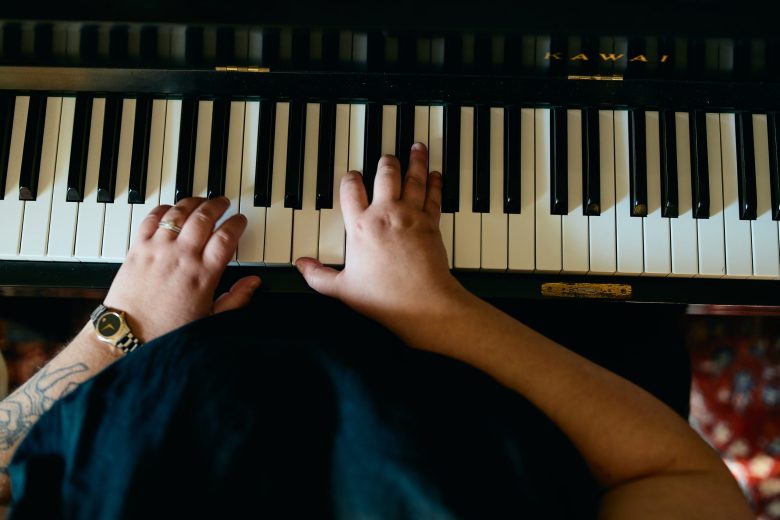
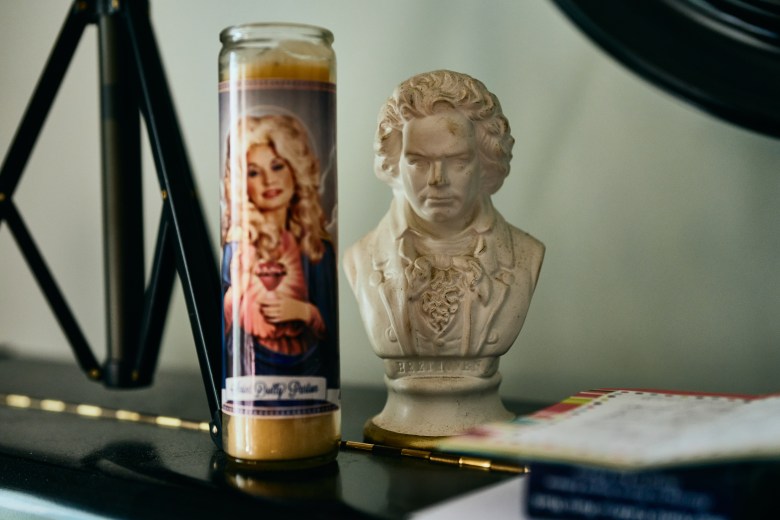
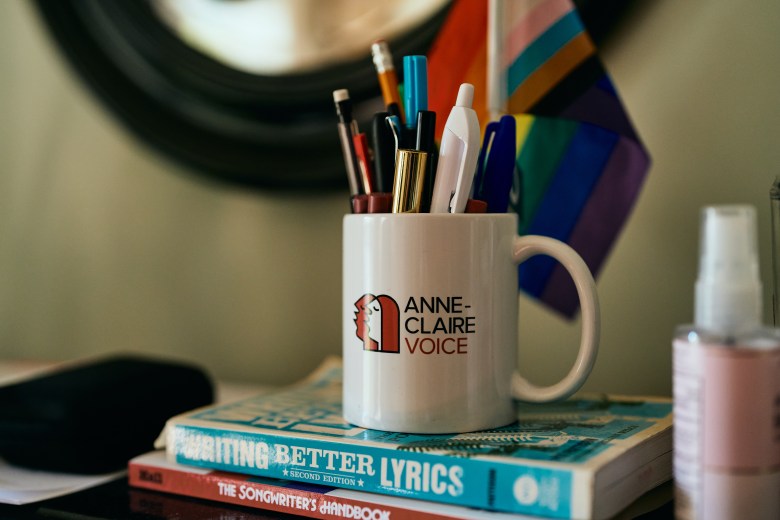
In the home studio where she gives singing lessons, she ran her hand over the piano keyboard, where her vocal range spans six E’s. Atop the upright piano sat a votive candle, a box of tissues, two songwriting books, a Pride flag in a mug of pens, and a little bust of Beethoven.
Presiding over all is a mall portrait of her grandmother, costumed for a Hello, Dolly! production in eastern North Carolina.
“She participated in the local theater her entire life,” Cleaver said. “This was her legacy. It’s the perfect encapsulation of what we’re doing in this studio.”
From this homey space came the highly staged songs on Cleaver’s second album, eight years after her first. The you in “Good Trouble” is civil rights hero John Lewis, with a country-kissed string arrangement by album coproducer Jeff Crawford. “Night of the Hunter,” with neoclassical noir orchestration by Chris Stamey, is about Robert Mitchum in the Southern Gothic film classic.
Instead of the personally revealing lyrical content we might have expected after her introspective debut, these vivid tableaux strike the listener with their newfound confidence. This growth was earned through eight years of personal challenges and starting a small business—eight years during which the arts of learning, teaching, and singing became inseparably entwined.
This is the story pulsing beneath the cinematic vignettes, the way the songs are about her.
But why shouldn’t the mononymic Anne-Claire embrace the theatrical?
Drama was her first love, which she studied with a formative teacher named Sue Scarborough at Raleigh’s Enloe High School. But when she went to UNC-Greensboro, the cutthroat audition process soured her on acting.She wound up as a voice major instead.
Graduating in 2013, she moved to Thailand to teach English, where she felt very alone and started writing songs as a way of self-soothing. Coming home, she made GarageBand demos and worked on her piano playing. Friends from music school encouraged her to take the songs to the stage, eventually resulting in I Still Look For You, with experienced local musicians Alex Bingham and Jeff Crawford. It was a hard-won debut that she wasn’t able to fully capitalize on.
“I was going through a really difficult time,” she said. “My grandmother had passed away very suddenly and was the inspiration for a lot of that record. I had been in eating disorder recovery since I came home from Thailand, and when she died, I had a huge relapse. I had to get real about some things. I was preoccupied with getting my health together when it came out.”
Cleaver got a job at Russell Lacey Music in Durham, where she taught kids for several years until the pandemic moved everything online.
“In my mind, that was something you had to have a graduate degree to do,” she said. “You had to be taught to teach. I learned this could be more than teaching someone how to sing. You’re here to connect with yourself, to self-regulate, to have confidence in a thing that you know you can do.”
In 2021, she started Anne-Claire Voice, where she works with adults, mostly beginners, though more seasoned musicians come to her too. It has allowed her to become a full-time musician.
“When I’m working with the artist crowd, it’s a different experience,” she said. “There might be a vocal issue. But sometimes the problem is that they don’t accept themselves and what their voice sounds like, or they feel lost and need an accountability person to bounce ideas off of.”
When Hope Thomson came to Cleaver for lessons three years ago, she certainly wasn’t a beginner, but she didn’t think of herself as an artist either. She had grown up singing but injured her voice in jazz combos at UNC. It had mostly recovered, but her confidence, her sense of direction, had not. What began as warm-up exercises evolved into a deeper, more holistic dynamic.
Singing is one of the most vulnerable things you can do in front of somebody, and it puts you in a position where if someone wants to hurt you, they can. I have people come in and cry through the whole first lesson.”
anne-claire cleaver
“I didn’t expect what happened at all,” Thomson said. “We hit it off because she’s a really wonderful person, approachable, easy to talk to and sing for. When she was like, ‘I think you should write original music,’ that was not in my universe of possibility.” Thomson didn’t wind up writing one song—she wrote an album’s worth. She recently recorded them at Nightsound Studios with Charles Cleaver, Anne-Claire’s husband, and plans to release them as the album Reverie.
“I had a lot of kinship with Hope right away,” Anne-Claire said. “We had a similar training background. Singing is one of the most vulnerable things you can do in front of somebody, and it puts you in a position where if someone wants to hurt you, they can. I have people come in and cry through the whole first lesson.” (This explains those tissues on the piano.)
Thomson thinks of Cleaver as her musical fairy godmother. Her process is “very different from good versus bad technique—it’s almost somatic,” Thomson said. “Thinking about radical acceptance of my voice has been very healing. What’s cool is that she’s been in her own recording and release process this year, so it makes me feel like she’s welcoming me in: ‘I’m doing this too, let’s talk about how you want to do it.’”
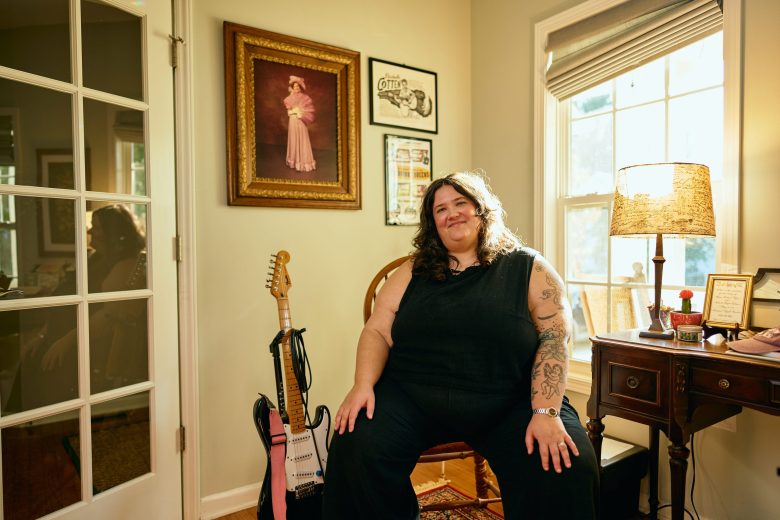
Teaching doesn’t just support Cleaver’s music, it infuses it. Do You Dream of Me Too? wouldn’t be what it is without Craig Carothers, the coach who gave her prompts—say, “a song about boats”—that spurred the songs. Nor without Jess Baldwin, who guided her through creative blocks.
“She helped me remember that as artists, we have a cycle,” Cleaver said. “We have clarity. We know where we’re going. We’re following through. And then there’s usually a period of, like, ‘What the fuck?’ We’re in the fog. And then we emerge again.”
With a decade of teaching behind her, she’s had to learn her own lessons too. “Saying this five times a day five days a week has to have rubbed off on me,” she said. It’s rubbed off on Do You Dream of Me Too?, which features piano by Charles Cleaver, guitar and pedal steel by Nathan Golub, bass by Casey Toll, and drums by TJ Maiani.
“I was dreaming really big,” Cleaver said. “I was not content with how I’d done it before. I wanted more grandeur.”
She divided up the songs among arrangers, hired a string section, and booked time in Manifold Recording, the fancy Frank Lloyd Wright-inspired studio in Pittsboro. Sinclair Palmer provided a lush, languorous arrangement for “Three Things,” the EP’s touching centerpiece. “River” has a video by Florida photographer Shoog McDaniel where Cleaver swims in a sunny river while wearing a clown suit—persona in motion.
In his arrangements, Crawford found inspiration in old records by Roy Orbison and Frank Sinatra, where someone would “sit in the big studio, Capitol Records, with the orchestra and sing,” Crawford said. “I was looking for this classic, beautiful support of a vocal that’s going to take center stage. Her voice is truly an instrument; the amount of colors—sometimes it feels like a theremin, sometimes it’s really powerful, operatic, very vulnerable, alternating within one song.”
As a veteran of the first album—and a close friend who informally officiated the Cleavers’ wedding—Crawford saw the marked change on the second.
“She’s very active in the production, very confident,” he said. “I feel like the project is generated from her wanting to do this instead of just feeling like it’s the right next step.”
“I trust myself so much more than I did on my first record,” Cleaver said, starting to tidy up for her next client. “I even listen back to this new record and hear some things I’d want to change. But I always have to return to what I told Hope, which is that a record is a snapshot of a moment in time, and you’re not there to be anyone other than who you are right now.”
To comment on this story, email [email protected].