
Orange County Sheriff John Mina downplayed the role of the sheriff’s office in federal immigration enforcement Wednesday after facing scrutiny from local immigrant rights advocates over its proposed budget this next fiscal year of $470 million (an 11 percent increase).
The Orange County Sheriff’s Office, like every other sheriff’s office in Florida, has what’s known as a 287(g) agreement with U.S. Immigration and Customs Enforcement that allows local deputies to be trained to carry out federal immigration duties.
Such agreements are mandated for counties under Florida law, but have faced greater pushback over the last year and a half under the Trump administration’s mass immigrant detention and deportation agenda.
“As a sheriff in Florida, I will follow the law,” Mina told the board of Orange County commissioners Wednesday. “I’m not going to break the law … that says I will use my best efforts to assist in immigration enforcement.”
Still, Mina argued that federal immigration enforcement — including the detention of immigrants allegedly in the U.S. without documentation or legal authorization — isn’t the Orange County Sheriff’s Office’s top priority.
“We will follow the law,” he repeated (multiple times, as if he were concerned that state officials were watching the public discussion). “But it’s just not a top priority for us.”
Out of more than 15,000 arrests his deputies made in 2025 — roughly 14,400 of which involved adults — Mina said that just about 101 of those arrests “related to immigration.” All of the immigration-related arrests, he added, involved cases of local criminal charges.
“It’s just not a top priority for us.”
Orange County Sheriff John Mina, referring to federal immigration enforcement
“We don’t go on any raids. We don’t initiate any type of self-initiated immigration enforcement,” Mina said. “The people who are here illegally who happen to come into our contact, they committed a crime.”
Mina was on the hot seat on the issue of immigration enforcement Wednesday in part due to the scrutiny of immigrant rights activists organized with a local, grassroots Immigrants Are Welcome Here Coalition.
The coalition — made up of social justice, labor and immigrant advocacy groups — this week sent a letter to the sheriff’s office asking for greater transparency in how much of the office’s proposed budget increase for this next fiscal year would go toward carrying out immigration duties.
“I am the son of a first-generation immigrant family, and a lot of the times when I see everything that’s happening, I imagine, how would I feel if this were happening to my parents?” said Alejandro Cardozo, speaking during the public comment period of the county board meeting Wednesday.
Cordoza, along with others, directly referenced recent killings of immigrants by ICE agents in Maine and Texas in his comments.
Lorenzo Salgado Araujo, a 52-year-old Mexican national who was close to obtaining legal status according to his family, was fatally shot by an ICE agent on his way to work at a construction site in Houston last week.
Just days later, 25-year-old food delivery driver and Colombian immigrant Johan Sebastian Guerrero, was similarly shot dead by an ICE agent in Maine, reportedly in front of his partner and 3-year-old daughter.
And in Florida, a 28-year-old man from Mexico was struck and killed by a tractor trailer while fleeing ICE agents at a gas station in St. Augustine in the early hours of this past Tuesday. The Florida Highway Patrol, which confirmed the deadly encounter, has not revealed the man’s immigration status.
“We as taxpayers should know exactly where our money is going,” Cardozo argued, speaking on the Orange County Sheriff’s Office budget. “I think that’s totally fair, and especially if it’s going to causes that are not being used to respond to emergencies or to solve violent crimes, but to harass and deport hard-working immigrants trying to make their lives better in a peaceful way.”
The Orange County Jail, and the county corrections department that operates it, has faced its own scrutiny as a temporary detention facility for immigrants detained by ICE on federal immigration holds.
The county recently renegotiated an agreement with ICE to restrict the amount of time that ICE can hold federal inmates in the jail following a more-than-yearlong public pressure campaign by the Immigrants Are Welcome Here coalition.
“Can you guarantee that no portion of this budget increase, whether for personal equipment, training, technology, detention, transportation or administrative costs, will be used directly or indirectly to support federal-funded immigration enforcement activities?” pressed Linda Coffin, a member of the coalition and the local League of Women Voters, ahead of Mina’s budget presentation for the OCSO.
“We do not want any of our taxpayer money to be used for federally funded immigration operations,” she said, point-blank. “Thank you.”
The Orange County Sheriff’s Office receives more funding than any other county agency, with a current budget of $423 million. For the next fiscal year, beginning Oct. 1, Mina initially pitched a $508 million budget, but lowered that to $470 million “after a conversation” with Orange County Mayor Jerry Demings — the former Orange County sheriff himself.
The sheriff’s office staffs 1,939 sworn deputies, according to Mina, in addition to 814 civilian positions. Just 160 deputies — roughly 8 percent of his sworn personnel — are deputized to carry out ICE duties, he said. Deputies have also been called by ICE to “assist” with protests organized outside its federal office in Orlando.
“They asked for us to assist them with crowd-control training — which they desperately need, as you can see throughout the country — and we are experts at it,” Mina boasted, before again appearing to downplay the frequency of their collaboration. “They just don’t call us that much for that assistance.”
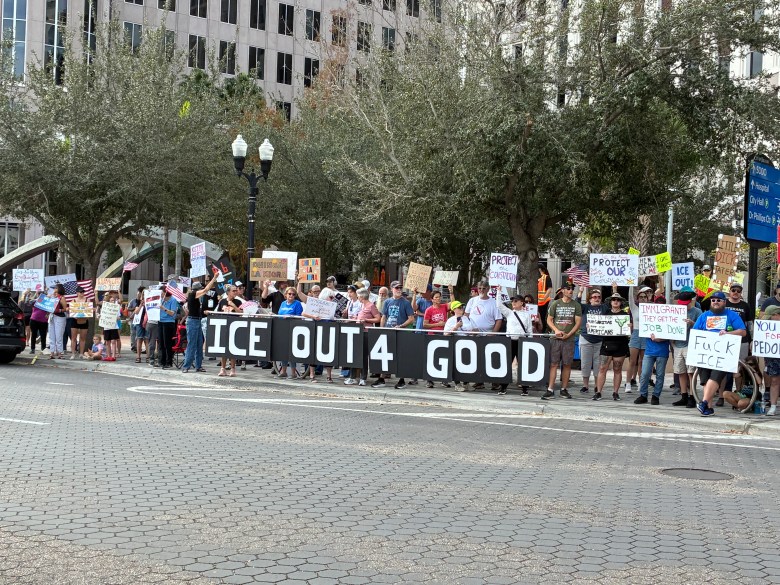
Immigration enforcement has become an increasingly sensitive issue with the recent Supreme Court decision allowing the Trump administration to end Temporary Protected Status for hundreds of thousands of Haitians and Syrians living in the U.S. due to political turmoil in their home countries. Florida is home to the largest population of Haitian TPS holders in the United States.
Mina admitted he watches board of county commissioner meetings to hear what people are saying about the Sheriff’s Office, but believes the concerns voiced by “very nice, passionate people” are misdirected.
“It seems more of that passion is directed towards Maine and other parts of our country. We’re just not seeing those interactions here,” he said, referring to deadly incidents involving ICE and Customs and Border Patrol agents. “And I can tell you that the Orange County Sheriff’s Office is not going to be involved in any of that.”
“I certainly can’t control what ICE or DHS does,” he added, “but our deputies know what their priorities are.” According to Mina, priorities broadly include violent crime, property crime, “people who are selling drugs and killing our residents” and engaging with the community.
Mina’s 11 percent proposed budget increase for OCSO, he said, is predominantly to cover salary increases, state-mandated increases for the Florida Retirement System, and anticipated health insurance costs.
The budget proposal also requests funding for 140 new positions in the sheriff’s office, including two additional deputies for its Behavioral Response Unit — to respond to mental health crises in the community — and 25 patrol deputies.
“It reflects our operational needs, based on service demands, contractual obligations and the growth in the calls for service,” he explained.
A proposed amendment to Florida’s Constitution, subject to approval by Florida voters this fall, could also affect public safety funding, Mina admitted. The proposed amendment, Amendment 3, would expand the state’s homestead tax exemption, effectively reducing the amount of property tax revenue available to local governments for funding essential public services.
“I know that myself, I know probably the Florida Sheriffs Association will be doing some education [about Amendment 3],” he said. An analysis by state economists found that the proposal could cost local governments nearly $5 billion in the first year of its implementation alone.

They’ll lose nearly $12 billion in the fifth year, according to projections developed by state economists
“Honestly, I think that the reason — one of the reasons — the governor is not campaigning for it is because he knows, based on polling, that it might not be popular with everyone,” Mina added.
Florida Gov. Ron DeSantis, an outgoing governor who initially pitched a more far-reaching property tax plan that would have also affected public education funding, distanced himself from the Legislature-approved Amendment 3 (which specifically applies to non-school taxes) last week.
“What the Legislature did wasn’t my proposal,” he told reporters at a press conference.
“I think it’ll likely pass,” DeSantis predicted, adding that he plans to vote in favor of it himself.
Orange County commissioner Kelly Martinez Semrad, an ally of the local Immigrants Are Welcome Here coalition, pointed out the irony of the sheriff’s office asking for so much extra money shortly after DeSantis and other state officials accused the county of unnecessary bloat.
“Generally, I am supportive,” she said of the $470 million OCSO budget proposal. “But I am concerned that the narratives don’t align at this time, where we talk about increased local taxes while the state is slamming us for for having too much money in taxes. So I’m concerned about the timing.”
The county’s total budget proposal for the 2026-2027 fiscal year is roughly $8.9 billion. More than $1.1 billion of that is allocated for public safety, a category of spending that includes the Sheriff’s Office, Fire Rescue and the Corrections Department.

Related Stories
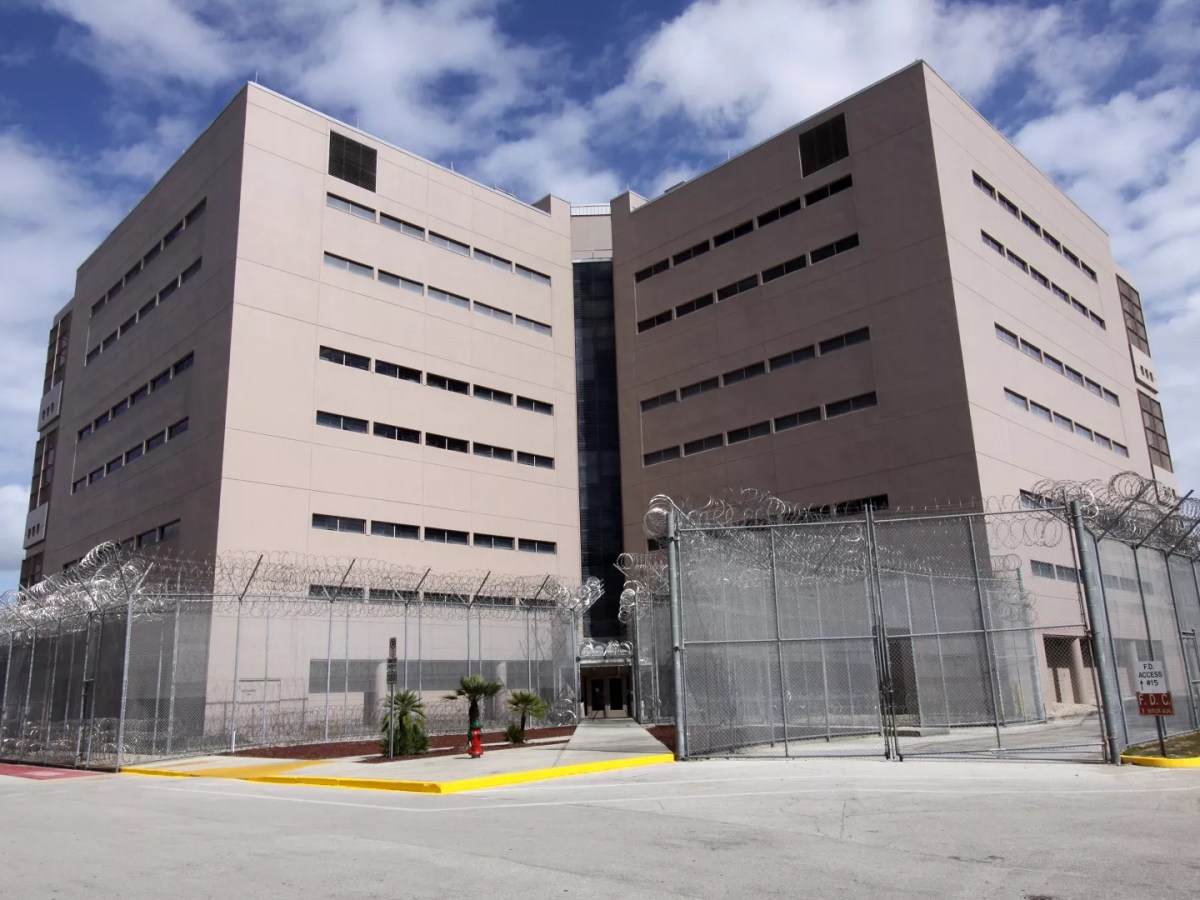
The Orange County Corrections Department could be forced to cut staff, implement a hiring freeze, and reduce training designed to help staff appropriately respond to mental health crises in the jail.

Cyclospora has sickened people in nearly 40 states


Will it be the shot in the arm downtown needs?
Related
Source link