
Olive Estrin has attended Twinfield Union School since kindergarten. The modest, low-slung building serves just over 300 students, from prekindergarten through 12th grade, who live in the towns of Plainfield or Marshfield.
By almost any measure, Twinfield Union is tiny. Estrin, 17, has just 25 students in her graduating class. The physics teacher also teaches film — and woodshop, too.
“When someone walks down the hallway, I know who they are,” Estrin said in an interview this spring. “I know who they’re dating. I know who their best friend is.”
Several years ago, Estrin thought about transferring to a larger high school, where she knew there would be more course offerings, extracurricular activities, social opportunities. She was offered a spot at Spaulding High School in Barre, a school with almost six times the number of high school students as Twinfield.
Ultimately, though, she decided to stay put. That meant having to work a little harder to get what she wanted out of the experience. In order to take Advanced Placement biology, she drove 45 minutes to Cabot School every morning of her senior year because that was the closest place it was offered. She practiced and competed with Montpelier High School’s gymnastics squad, since her school lacked a team.
Still, Estrin said it was all worth it to preserve the strong connections she’d made with classmates and teachers.
“Even though we’re not all best friends here,” Estrin said, “it is like a big family.”
Estrin’s experience attending a small, rural high school isn’t unique in Vermont, which since the mid-1990s has seen birth rates drop steeply to the lowest in the country. Federal standards classify more than 76 percent of the state’s schools as rural, according to a report from the National Rural Education Association — a percentage that hasn’t fluctuated much in recent decades. Vermont high schools have an average size of 361 students, according to state data, well below the national average of around 850. A handful of public high schools have fewer than 100 students, and only two boast more than 1,000: Essex and Champlain Valley Union, both in Chittenden County. Many of the smallest are on larger campuses that also serve elementary and middle school students.
State lawmakers seemed to embrace the idea of preserving small, local elementary schools when they considered education reform this year. But the education bill passed last month calls for “comprehensive, regional high schools.” Larger high schools, the bill asserts, “provide expanded and more equitable access to academic programming, career and technical education, co-curricular opportunities, and specialized staff, which are often not sustainable at smaller scales.”
The reality, though, is more nuanced, according to Mara Tieken, an education professor at Bates College in Maine who studies rural schools. Research, she said, shows there’s no optimal school size, with benefits at both small and large ones.
A school may offer a wide array of classes, sports or clubs, but that doesn’t mean every student has easy access to them, Tieken said. Transportation or parents’ inflexible work schedules might get in the way. At the same time, certain classes, such as driver’s education, may be easier to participate in at smaller schools.
“Having a principal who knows your name and is willing to go out of their way to ensure that you have access to the robotics class — or the teacher that really deeply knows your family” — are important, too, she said.
The real experts on small high schools, of course, are those who attend them. Seven Days traveled to two, in Rutland and Orange counties, and interviewed more than a dozen students about their experiences. The teens at these schools spoke of feeling a strong sense of place, close-knit relationships and a lack of anonymity. They described, as well, the ways they’ve had to get creative in order to achieve their goals.
‘Can’t Slip Under the Radar’
Proctor was once home to the world’s largest marble company, but business went bust in the 1970s. The town’s middle and high school — a white marble rectangle with a shiny burgundy entryway — pays homage to its storied past.
The building, which serves around 115 students in grades 7 through 12, is more than 70 years old but has been well maintained thanks in part to an endowment from former governor Mortimer Proctor, who was once president of the Vermont Marble Company. The money helps the school fix up the building as well as pay for student enrichment and training for teachers.
Reagan Phelps, a senior, has been attending Proctor schools since first grade. Even with fewer course offerings, Phelps was able to take three Advanced Placement classes during high school. Each had around 10 kids.
“Teachers encourage us to speak our minds” and challenge each other, Phelps said. “One downfall of having a discussion with a smaller class is less perspective.”
Phelps is grateful for the “intensive support” she’s gotten from teachers. Because students “can’t slip under the radar” at Proctor, they grow comfortable reaching out for help, she said.
Being in a small school also means it’s sometimes easier to make an impact, Proctor senior Maura Thompson said. She recruited a group of peers and started a mentoring program that involves weekly visits to nearby Proctor Elementary for activities with children in grades 4 through 6. The idea is to create a smoother transition between schools for the younger students.
In elementary and part of middle school, Thompson attended bigger schools in Rutland City before moving in with an adult brother in Proctor for a year. She later moved back to Rutland — less than a 15-minute drive from Proctor — but chose to stay at Proctor High School through the state’s public-school choice lottery.
“The biggest misconception about small schools is, there aren’t as many opportunities,” Thompson said. But she disagrees: “You just need to be willing to take that step and bring the opportunities to you.”
While Proctor doesn’t have the wide range of sports teams that larger schools do, athletics still feature prominently for many students. Senior Aaron Brock captained teams in all three of his sports: baseball, basketball and soccer. To boost the teams’ numbers, Proctor invites students from neighboring private and public schools, including Rutland Area Christian School and Killington Mountain School, to play on its teams. Many of Brock’s friendships have been forged on the playing field, he said. School sports also bring the broader community together.
“When there’s a game, the parking lot is always full,” Brock said.
Because the small-school teams need players, students are never cut — and sometimes get the chance to play varsity at a younger age. That happened to junior Lindsey Gearwar, who moved up to varsity softball when she was in eighth grade. She said the experience instilled in her maturity and commitment.
Everyone comes together when tragedy strikes, Gearwar said. A beloved teacher died unexpectedly two years ago, and school staff set up a memorial inside his classroom that students could visit.
“Because we were so small, I feel like we were able to … really bond and grieve together,” Gearwar said.
That familiarity appeals to junior Olivia Outslay, a self-described “fifth-generation Proctorian” whose grandparents taught at the town’s elementary school.
“You get to see how people change over time … You really get to know them inside and out,” Outslay said. “I joke around with my principal. The janitor knows my name. That’s cool.”
‘What You Get Is Pretty Good’
Ninety-two miles northeast of Proctor on the border with New Hampshire is Blue Mountain Union School, a pre-K-12 school in the town of Wells River, which has fewer than 500 residents. When the students, who come primarily from Ryegate, Groton and Wells River, want a little more hustle and bustle, they drive 35 minutes to Littleton, N.H., or Montpelier, an hour in the other direction.
At a school that serves 120 high school students, class options are limited, sophomore Jasmine Ormiston said. But students can take classes online through the Vermont Virtual Learning Collaborative, an organization that partners with most school districts in the state to offer several hundred classes taught by licensed teachers.
Ormiston has used the service to take both precalculus and a health class. Vermont high school students can also take college classes for credit through a separate state-funded program called Dual Enrollment. Senior Evan Farquharson said he’ll enter the University of Vermont this fall with 28 college credits under his belt.
Farquharson, who plans to become a high school history teacher, has been attending Blue Mountain since preschool. His parents also attended the school. He said he likes having deep roots where he lives, the comfort of knowing everyone he passes in the hall and the relationships he’s forged with teachers — not just within the confines of the school building but also in the community.
Ezra Woodward began attending the school last year after being homeschooled. Woodward, a self-described introvert, thinks the smallness of Blue Mountain made the transition easier. She’s found a close group of friends through the school’s Gender Sexuality Alliance, and the school helped her enroll in a college-preparatory program called Upward Bound.
Lance Zornes, a senior from a military family, had attended bigger schools in Texas and Kentucky before coming to Blue Mountain in 2022. He said there’s a notable difference between educators elsewhere and the ones he’s had in Vermont.
“I feel like the teachers care more, and they just really get up in your grill and make sure you’re doing all right,” Zornes said. “They suggest different ways to get your work done and be more efficient. I think since I’ve attended here, I’ve become a much better student.”
Educators also enjoy the tight bonds they form with the students, according to Neil Emerson, who teaches a potpourri of classes, including social studies, driver’s education and electronic journalism. Taking on multiple roles is part of the deal at a school such as Blue Mountain, he said.
I think since I’ve attended here, I’ve become a much better student.
lance zornes
Emerson said he and his wife, a special educator at the school, decided to move from Chittenden County to Ryegate before they had their first child because the community-focused feel of a small school appealed to them. Emerson’s daughter graduated this year from Fairfield University in Connecticut, and his son is a fourth-year apprentice with a local electrical company. Emerson, meanwhile, just finished his 22nd year at Blue Mountain and remains just as passionate about small schools.
When it comes to legislators calling for regional high schools, “I think they’re wrong,” Emerson said. “I don’t think they get it.”
Juniors Jacob Roberts and Grady Souliere said Emerson’s electronic journalism class is their all-time favorite. They’ve gotten to interview local shopkeepers, film high school athletic competitions and report for WYKR, the local radio station.
Roberts, who is also studying plumbing part time at St. Johnsbury Academy, said volunteering to coach elementary students in basketball and soccer at the school has been another highlight.
“It’s a lot of fun to work with the kids because they’re the future of your school,” he said.
Souliere, who’s been at Blue Mountain since kindergarten, said the school’s familiar rhythms suit him well.
“I’ve never, ever wanted to leave,” he said. “You know what you’re going to get, and what you get is pretty good.”
The Next Chapter
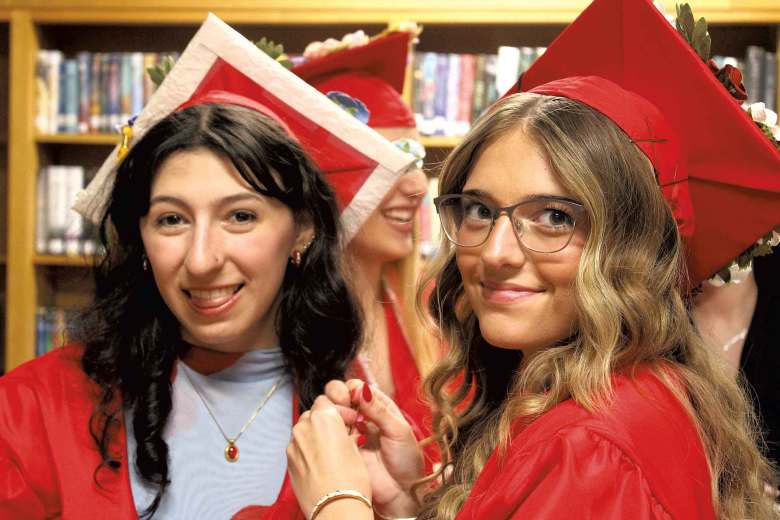
Estrin, the Twinfield student, is getting ready to leave. She graduated from Twinfield on Saturday and will spend the summer working with kids at Sunrise Gymnastics in Berlin. This fall, she’s headed to Skidmore College in Saratoga Springs, N.Y.
Estrin is excited about what comes next but plans to cherish this time before what she and her friends call “the great separation.”
“It’s a scary thing for all of us,” she said. “I don’t think any of us are really ready for it.”
Estrin said she worried when applying to colleges that her experience at Twinfield would put her at a competitive disadvantage. Nationally, rural students enroll in college at significantly lower rates than their suburban and urban peers. But she was accepted to every one of the schools to which she applied.
She wrote her college essay about a topic she knows well: what it’s like to attend a small school. ➆

About the Series
Seven Days is delving into the far-reaching ramifications of the declining number of young Vermonters.
Got a tip or feedback? Write to us at [email protected].
The original print version of this article was headlined “‘It Is Like a Big Family’ | Vermont students reflect on their experiences attending tiny high schools”
This article appears in June 17 • 2026.